
Resurrected English Skiffle band return to their roots with their first record in eight years.
 Skiffle, I hear you say, isn’t that Lonnie Whatsisname knocking out a homemade English rock and roll and singing about Gor’ Blimey Trousers? Why should I read this?
So let’s start with a potted history. Skiffle, as a term, was first heard in the southern states of America in the early 20th Century and reflected a mix of blues and jazz played by jug bands on washboards, jugs, washtub bass, cigar box fiddle, and other homemade instruments. It was picked up as a term and used in Chicago as part of the African-American migration to Northern Cities; early references on record being to “Hometown skiffle” (1929) and “Skiffle blues” (1946). By the time the term vanished from common use in the 1940’s, it was generally referring to country-blues-style songs.
In the mid 50’s, it was revived in England, predominantly by Lonnie Donegan. He started his career playing banjo in Chris Barber’s Jazzmen. He was allowed to play skiffle songs in the intervals between sets. Banjo, washboard and tea chest bass were used to play American folk and blues songs. Donegan recorded and had a hit single with Leadbelly’s Rock Island Line in 1956. The song spent 8 months in the chart and went Gold, selling 1,000,000 copies. The fast-tempo music and the sense that you could make it with improvised instruments and more enthusiasm than ability led to a skiffle boom, with an estimated 30,000-50,000 groups in England by the late 50’s. The Quarrymen (who went to Hamburg, learnt their chops, and changed their name to a beat combo with the unlikely name The Beatles) were one such skiffle act. Skiffle died as quickly as it came and had all but vanished by 1959. Donegan went on to have an illustrious career playing country and acoustic blues until his death in 2001.
So far, so americana, with country blues and folk being the progenitors of much of our music; fast forward to 2008 and the Severed Limb began life as a skiffle trio led by Bobby Paul on guitar and vocals. Busking and gigging around the South London pub scene brought them to the attention of Imelda May, who had them open for her at various venues – ultimately including the Albert Hall in 2012. They developed a sound that took in the acoustic country blues of skiffle, Cumbia, Garage and R’n’B. This increasingly became more punk in style and energy. They were championed by Steve Lamacq and Mark Radcliffe, and by 2018, expanded to a five-piece, they were putting out their third LP, Good and Gone. This took their style to its apogee and perhaps further from skiffle than ever, definitely Clash referencing in sound with stabbing electric guitars, swirling keyboards and prominent bass.
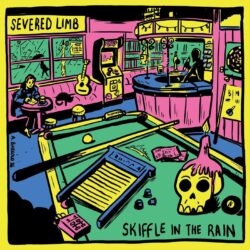
They chose to disband after this, feeling that they had taken that direction as far as they could. Now in 2026, they have reformed as a full six-piece and issued Skiffle in the Rain, its title an indication of a return to their roots. A tight selection of tunes, only one of which strays past the 3-minute mark, this is a ten-track album that doesn’t outstay its welcome. The songs come thick and fast in a variety of styles, opening with the title track, a song about the joys of busking in the rain in various parts of London played on harmonica, squeezebox, washboard and acoustic guitar – exactly what you might expect skiffle to sound like. This, though, is followed by one of only two songs not written by Bobby Paul: See My Mother, is written and beautifully sung by Samantha Jean Scuffham, the band’s washboard and acoustic guitar player and vocalist, against a solo acoustic folk guitar backing.
Returning to Southend is a skiffle to a shuffle beat and acoustic instruments, Hong Kong Dollars has an electric guitar accompaniment, which brings western movie soundtracks to mind. The fifth track, Twelfth Night, is a post-Christmas blues which sounds adjacent in all the right ways to The Beautiful South in style, with excellent backing vocals and a melodic electric guitar solo. Freight Train is where they really go back to the roots of skiffle; this is a cover version of the classic song by Elizabeth Cotten, one of the leaders in guitar picking and country blues in the early Twentieth Century. The cover is effective, bringing the country blues vibe to the album, with excellent vocals by Scuffham again.
The remaining songs cycle through a Caribbean jazz feel, a blues-based guitar and harmonica-led track and a Bo Diddley beat before closing with Good Evening to the Blues, at just over 1 minute, the shortest song on the album, which has Paul closing the album with a guitar-led lament and plaintive vocals.
This is an intriguing album that demonstrates a rich variety of styles and tone in a modern take on skiffle, played with feeling by excellent musicians, all in under 25 minutes.


