
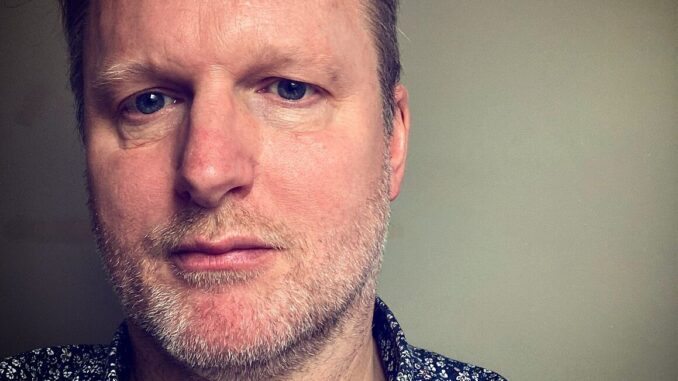
Stephen Eyre is singer and guitarist with South Oxfordshire band Only The Brave. Our Graeme Tait reviewed their debut EP and described them as a band with a bright future in his February EP roundup. Stephen also proves to be an accomplished writer of short stories, as you will see below. You can try one of his songs at the end of the story.
On the road
by Stephen Eyre
I looked at the case for a long time before I opened it. Checked it visually against my memory, daring it to be different or changed. I knew the dust was new. And old. How many years since I’d pulled it out from its resting place? Certainly more than the 3 years just spent with her. A deft search under the foot of the bed had located the tip of the case. Sliding it out and using the handle to lift it onto the bed that had sheltered it for so long had led to this moment where I had suddenly stopped. A moment that had opened up like a chasm that I fell helplessly into, forced finally to confront the bad before the… whatever was waiting for me.
She wasn’t coming back. Of course I had already known this; my melancholy over the last months wasn’t the only symptom. There had been one abject weekend of drinking from the old days; unrestrained and joyless, leading to an emotional paralysis I accepted like people who put up with guests who don’t leave; accommodating, present but unavailable. Waking up in the next week and having the sense to stop, but knowing the punishment would last and could not be rescinded. Damage done.
I looked at my phone again, as I had done a thousand times already. Every day. No text, no WhatsApp, no call. And finally, in the chasm, I realised, felt, she wasn’t coming back. The case was on the bed, and the dust on it was a nag to hurry and open, a ladder out of the reckoning back into the present, the bedroom and my future.
I reached down and felt an old apprehension. What if my desire wasn’t there anymore? What if I had managed to break that too, or even worse, imagined it in the first place? Assumed a lie and now about to pay a heavy price. No, that would be too cruel. I lifted the latches one by one and slowly opened the case, allowing the light to hit the old guitar for the first time in this house. I caught the scent of the instrument and looked down on it, remembering and verifying a rush of experiences, a collage of bars, stages, the people who frequented and remained in these fragments of recall. People who made the nights come alive and the others, the grifters and sharks, waiting for their moment.
Four years ago I was standing outside the florist where I met Elise: another funeral, this time for my mother. An eerie and dark October with persistent gales and rain that lowered everyone’s tolerance, hitting like a dull thud after the summer. I was not a regular customer of florists; she must have sensed that I was adrift, lost in the relative triviality of choice at this time. She spoke, gently taking control and leading me to the safe harbour of a few choices that captured something of my loss. We moved beyond the flowers and began somehow to unpack our lives a little, sharing some of the tapestry with a little wry humour. I liked the way she spoke without any varnish but never with the bitterness of regret. She was attractive and had a face that could morph from serious to impish with a beguiling speed. I liked her immediately and certainly returned to the shop more to continue conversation than to check in on the order. I asked her out for a drink and had to change my bluff offhandness to the expected no when she agreed. My eyes gave it away, and she laughed but left it there.
We dated over several months, finding more about each other. We talked all the time. Politics, art, philosophy, travel; all of it. We made love, playfully, passionately. Always with joy. We talked about moving in together. We moved in together.
There was one problem that we couldn’t resolve. Elise was from a family of music lovers as I was. But Elise’s music was classical, opera and sometimes liturgical. She would take the bus into Oxford to hear college madrigals and sung matins. She would play Puccini at home and take me into London occasionally if there was a concert she had earmarked and talk with passion about the story and the magic of this production. I loved her madly for this and happily undertook a new musical education under her guidance.
But for all this love of music, there were hard bounds to her appreciation; and the music I played and felt in my heart was on the wrong side of it. She detested roots-based music and found the mythology of the culture, the Americana landscape, to be alien and unattractive. There was something about the primitive essence and rawness of sounds that jarred to the point that Elise couldn’t tolerate the sounds that I loved to be around her. The very qualities that thrilled me and made me want to play and sing were the sounds that assaulted her sensibilities.
I had little time to react, and after the briefest consideration, I instinctively chose Elise over the music that had underwritten my happiness for so long. I was falling in love with her and wanted to give us the best chance of making our new and almost perfect love work out. Both of us had experienced how love can pay out badly; the pain of relationships terminally breaking under strains that can come from anywhere. We knew that love is an investment, and I believed, truly believed, that something as special as this would inevitably require a sacrifice. I quit the band I led and put the guitars into cases. Everything beyond the core instruments that had defined my passion was sold. No way back, just commitment.
I settled into our shared life with the energy and happiness that love provides; a renewal of everything. I breezed through work, got on top of the eternal list of house jobs, reawakened my interest in the kitchen and shared this energy and joy with Elise at every opportunity. Long walks, concerts and lazy mornings making love and choosing what to watch, who to visit and where to go next to explore and celebrate the joy of our mutual being. We never seemed to be apart, but never felt we overcrowded each other, and looked forward to every moment together. We must have been sickeningly happy as a couple to our friends. But we were popular, and my social life had never been better. I was swept up into Elise’s world of high culture, politics, travel, and art, and introduced to an amazing array of friends that bewildered and bewitched in equal measure. I was exposed to so much that was new and vibrant that I was in a constant state of transformation.
Elise’s parents, Edward and Cadence, were the lodestone of this world. Edward was a celebrated professor of music up in the fens. His speciality of 20th-century Western art music had given him a gilded career that allowed for numerous published articles and books and even a small but celebrated TV series that had cemented his position as a leading intellectual voice on culture in the early 2000s. His address book was enviable on a global scale, and he used it skilfully to ensure that life around him was a kaleidoscope of the zeitgeist, critical commentary and creative force. I was both smitten by Elise and this new world of abundance to the point of infatuation. It settled as some kind of fever in my soul. Edward was a kind, warm and charismatic man in his mid-seventies. He imbued authority without trying, casually controlling the social sphere he was at the epicentre of with a grace that tempered any contention. He was handsome and had a quick and mischievous wit that he deployed generously; laughter was never far away. Elise got what I would call her outer personality and looks from him. His handsomeness transformed into an elfin version in Elise, and his humour took a new lease of playfulness in her hands.
Cadence was the power behind the throne. Quiet, American and from a powerful New York publishing family, she had a calm authority that even Edward would cede to. When she spoke, she did so with such charm and clarity that others demurred and let her have the floor instantaneously. She had an encyclopaedic knowledge of 20th-century art and politics and was an equal to Edward in every subject bar perhaps his music specialisms. He led the attentive listening when she talked, but Cadence was economical with this side of her character, happy to let Edward have the light. Her real power was in her listening and surgical cross-examinations that could either make your day or reveal shortcomings in the calm but brutal way truly gifted people can’t help when they tire of ignorance. She was a magical presence, still captivatingly beautiful in her early seventies, glamorous and beyond competition. The wealth her family had provided gave both of them an aura that was so compelling that otherwise powerful and strong personalities would fawn in their presence. I had no chance.
They lived in a manor house on a small rise that loomed out of the surrounding countryside like an old warship in the mist. Old, long and leaded windows allowed light to pierce the old rooms in shafts that captured the time and essence of each day, writing a visual journal across the walls in the reception rooms. 2 elderly dogs, hounds of course, completed the family. There was a housekeeping couple, the Robertsons, who hovered and smoothly underwrote the delivery of each gathering with an expert and attentive nonchalance that belied their dedication. When Elise and I stayed, which seemed to be most weekends, we took one of the old front-facing rooms of the house, far from Edward and Cadence and lived a make-believe world where all of it seemed normal, expected.
My own contributions, dusty stories from old tours as a musician, or convictions learnt from teaching the teenagers I had the pleasure of supporting at our college, were met with interest and curiosity and a kind indulgence that effortlessly folded me into their world. My quiet form of socialism was welcome, and my general engagement with our global concerns meant I could keep up and would occasionally offer a critique that drew interest. Elise and I travelled extensively; we even learned to sail together, and, of course, tried to make a baby. We failed.
II’mnot sure there are words for the disappointment Elise felt. I know I was miserable for her and for my part in this reality. But try as we might, a baby would not come and not even the considerable financial power and influence of Edward and Cadence could change this. It was the one brooding and incurable wound that scarred our life together. When we decided, when Elise finally gave in and accepted that she would not bear a child with me, a tiredness, a phantom of mortality I had not experienced, crept into her eyes and our lives. It was a creeping and profound sadness; neither of us able to escape its heavy presence. Then Dave died.
Every young musician needs a mentor. Many who don’t have luck in finding one will drown in their mistakes, musical and otherwise. A good mentor is the catalyst for change and a voice in your head when stupidity walks into the bar and buys you a drink. Dave was mine, and for me, having lost my father early, he became the most important person in my life as I tried to build something on my small but evolving talent and a boilerplate self-belief. Dave made sure that belief was not allowed to rot into arrogance and insisted I tended to the handful of talent so that it eventually grew large enough and strong enough to survive the unforgiving arena of paid performance. We stayed in touch, talked constantly about music in general and life as a performer in particular. He was an oracle of knowledge, lore, and judgement; an equal to Edward’s feted intellect in every sense. Dave had spent decades playing as a gifted and in-demand guitarist and knew everyone and every aspect of the business. From the minimum required kit to how to structure a solo, how to play with an egotist or someone barely able to overcome stage fright, he’d seen it all and moved things along to the general benefit of all, not least the audience.
As I slowly grew into my role as a reliable musician, writer, performer and finally band leader, I had to acknowledge every step was underpinned by Dave’s knowledge and generosity; his ability to teach without being heavy-handed and grace every lesson with experience from the road gave his words a vibrancy that doubled their potency. I was a willing student and loved the evenings where, with a pint in front of us, we would unpick a challenge for the band, or I would just listen to tales from the road and let Dave unpack them, sometimes just as stories, sometimes as gentle lessons. Missing cables, dead batteries, drunk drummers, forgetful promoters and psychotic audience members; surly bar staff, hungover landlords, rude and lecherous security, spaced-out roadies and light-fingered leeches waiting for their moments to ruin your day. The loneliness and boredom of hanging around literally half your life, the monotony of motorways and cheap hotels. Shit food at the wrong time. The tiredness that never leaves. Wanting to be home but not knowing what to do with yourself when you get there. The children who couldn’t help but treat you as a semi-stranger. Dave lived it all and shared it with humour and a sharp perception for what was important and what was just plain bullshit.
And he would also talk about the point, the gig. How the day inevitably led to the 2 hours on stage and how to protect that space and make sure it was worth it. How to turn a young bband’s35 minutes into the 2 hours a headliner would deliver without revealing the stretch marks and gaps in stagecraft that could lurk in the transition. How to avoid drinking ruinously before and after the gig, creating headspace for the ounce of sanity that needs to underpin the show and the human that must emerge afterwards. How to warm up but not overplay, to be prepared but not be robotic and to remember the reason you put yourself through it; to be able to reveal the art, the thin slice of perception you have as a creator. The choice of notes or words and clarity to deliver them with your own authenticity; to demand your band give the space or provide the support for these moments where there should be no barrier between what was in your head or soul, and what the audience hears. The point. The place where no one else will do, and it has to be what came from you. You are the difference, said Dave. You have to be brave enough to deliver those moments and strong enough to demand the space to do so. He talked about health, mental health, presence, energy, being selfish for the sake of the art, and stepping away, coming down, opening the door to that kernel of sanity that needs to re-establish command and save you from being the most ferocious arsehole in the room.
When I was told Dave had died, a miserable fucking heart attack in his garden, my world stopped. A terrible greyness settled in my heart, and my constructed life with Elise collapsed inwards in an awful, unpreventable and slow fall that left us both disoriented and helpless.
When worlds collide, there is always collateral damage. In my case, no one got away lightly, least of myself. After a lost weekend of booze fuelled medication, I returned to our home older, sadder and more tired than II’dever felt, humiliated that my first instinct had been so self-destructive and so wrong. I couldn’t look at Elise without guilt and unease, and some old dark voices returned, unwelcome but persistent, filling the void with their malice. Shitting everywhere.
I functioned monosyllabically, and Elise was little better, unable to provide the strength to help us either. We failed together, understood our pain but couldn’t find a way to heal together.
A nadir came at a weekend with Edward and Cadence. Everyone short of patience, tired, and perhaps even defeated; I finally found the words to speak about Dave with a little of the eloquence he deserved. It was the wrong pain at the wrong time. No one had the energy to even pretend they were interested, and at some point in the evening, strung out and bitterly angry, I lashed out. A monologue of frustration ended with my incredulity that they couldn’t understand the importance of my loss. The most important person in my life. As the words left my lips, I knew they were an aural disaster, a self-imposed death sentence. Cadence barely looked up as she delivered a coup de grace that I should perhaps look close to home for such people. Ice cold and final. Elise and I limped on for another couple of months. Eventually, after 3 days of non-verbal pain, she rose, packed and left. She looked back at the door, said sorry and shut it behind her. I stared at the closed door for an eternity, finally found my way to the bed and lay down, expecting to stare at the ceiling for the rest of the night and promptly fell asleep for 2 days.
My old friends hadn’t entirely left me alone whilst I was with Elise. That older world of music, egos, dusty halls and dubious rehearsal space, bars with tiny stages that we magically moulded to every night. The players and the con artists, the wannabe managers and fan friends who would always come out to be near the happening; they tried to stay in touch, awkwardly, often rebuffed as I concentrated on building with Elise. But some of them persistently.
Dallas was perhaps my oldest friend. We grew up together, opposite sides of the same street. He had crash-landed into my life when we were both kids, imported from San Diego, military parents whom he was already constructing a difficult and rebellious relationship with. He was loud and laid-back at the same time and couldn’t keep still. When he began to put that to good use as a teenager by picking up drums, we coalesced as my guitar obsession was already in full flow. As I was awkward, full of unvarnished desire and not much knowledge, Dallas appeared assured, effortless even, to my untrained eyes. He had a natural, wasted cool that polarised people’s opinions quickly. I was an acolyte. He also seemed to grow an encyclopaedic knowledge of late 20th-century West Coast rock overnight that left me in awe. Over teenage years of fumbling our way through life, me always a lesson behind, we experimented with music and slowly got good at it. I dedicated myself to playing the guitar without a pick and, after spending an age being tangled in my own fingers and awkwardness, began to carve out an idiosyncratic and sparse but clever style that leant heavily into my strengths and, by and large, successfully hid the weaknesses. Dallas spent ages perfecting a groove that married elements of The Meters and 770’sfunk with the best of English rock ‘n’ roll. We were obsessive, and whilst there was a healthy interest in girls and getting wasted too, it was really about the music. After some initial band life together, Dallas shot through the local scene while I painfully constructed my style, and he was soon gigging most nights, sometimes travelling out to city venues that were achingly cool and, at this point, unobtainable to me.
We stayed in touch as the closest of friends but musically separated for an age before reuniting when I switched from endless cover band gigs and began to write and carve out a reputation as a gifted singer-songwriter on the local circuit. Dallas was as curious as everyone else when I met Elise and stopped playing. Unlike others, he didn’t ask questions or pester me to play; he just watched and listened, forming a relaxed friendship with Elise and, without a hint of artifice, kept all channels open between my new and old life. When Dave died, he was the first to call and the first to see me. He saw my anguish, and his energy and gift in bringing me out of the misery were a large part of my sanity. Dallas was instinctive in his knowledge that answers are revealed in behaviour, not words. He was a perfect friend.
Back in the room. The guitar in my hands. I slung the old leather strap over my head and let it settle in my arms as I stood. I tuned the strings and placed my hands at the bottom of the neck and played the opening passage to an old song. The notes rang out clearly, a sheen of magic in their beauty. I paused and quickly found the old amp at the back of the wardrobe and plugged it in. That warm hum that it always had gently filled the bedroom, and I turned the volume up to the quietest point that it would sing. I played the riff again, and this time I sat down on the edge of the bed with joy. The notes cascaded as I remembered, overlapping and shimmering, generating a faded glory that prologued the words to follow.
I whispered the lyrics, dredged with some amazement from somewhere in my mind, occasionally stumbling but by the chorus reaching a recognisable if weak facsimile of my singing. I could feel the old resonance in the lower mids and felt a surge of vindication and relief. Damn! This had been way too long. I looked around and in the corner of the room saw Elise, standing quietly, staring at me.
I physically locked up, froze. Caught in a car crash of emotion. My hand gripped the guitar so that my fingers turned white. We just stared at each other; hopeless and profoundly broken. She faded. I bowed my head… and started to play again. Flurries and shards of melodies figured in terse arpeggios and then notes together, strings bent to evoke the ambiguity of life. The sounds Elise found alien and unwanted.
Eventually I looked up again, and Dave smiled back at me, sat in the corner with his own guitar gently resting in his lap. He leant forward to speak and of course vanished before the words came. The smile was the message. I had two days to make this work.
___________
Dallas pulled up outside, one last time, to see if I was ready to play again, to go out on tour. Valencia and down the coast, finally to Granada. Small bars all the way. Low pay, no sleep, grifters and conmen as promoters and an audience that would have forgotten you by morning. Drunks, sharks, weed and bullshit. But also band as family, precious conversations that spoke themselves into your soul, and the playing on the nights where it all came together. Notes and words elevated by the skill and passion of the band. Dallas driving us forward with his laconic pulse; the genius slacker conductor of it all. And those moments, once or twice in the night, when the whole thing transcended the bar and lifted the audience and us away from corporeal chains into the dream.
This time I said yes.


