
A poignant final act from Dallas Good in collaboration with Richard Reed Parry, leaving us with a melancholic album, beautiful, sad and thought-provoking.
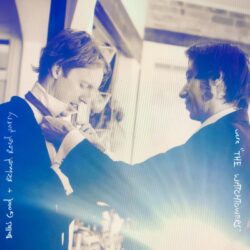 There’s something quietly arresting about this new record by Dallas Good and Richard Reed Parry. It explores the transience of life and the confusion and despair produced by parting and loss, and Good’s sudden passing in 2022, at the age of 48, makes the record all the more poignant. Much in the record seems strangely prescient concerning Good’s fate, and yet it is still joyful, spiritual and bursting with musical treasure.
The record is the result of a collaboration between 2 highly accomplished artists, Good, the leading light in the cosmic americana Canadian institution that is The Sadies, and Reed Parry, of the well-renowned Arcade Fire. It also features a host of guest appearances from, amongst others, Neko Case, Kurt Vile, Scott McCaughey, Gary Louris and Margaret Atwood. The pair worked over a period of 10 years to create this record, as Reed Parry explains. “It has been the slowest-moving musical endeavour of my entire life. We didn’t plan to do it this way; it’s just how it happened. Inching along in tiny, joyous flourishes of activity a couple times a year for over a decade, until sudden death brought it to an unexpected end.” This timescale gives the record a strange timeless dimension. It evolved through an open-ended musical process, a sideline, casual in its manifestation, yet clearly not in its execution.
Alone Alone opens proceedings, a thrumming acoustic guitar drawing you back to the dawn of time, an ethereal rabbit hole of uncertainty and questions. It ponders on the nature of solitude and the separateness of things, seeking meaning in connections. Yet maybe there are no connections, maybe everything is separate, disparate, alone, alone…alone. The drama and sense of elemental foreboding is heightened by the falling chord progression, moving downwards, descending into the depths. The refrain “it is alone” haunts; the rain continues and the feeling of the drowned world envelopes. Transience and superficiality are manifested in Echo The Part, “And though it seemed civilized/Too soon they realized/It falls apart”, and throughout big existential questions bubble to the surface. In The Brightest Light, “Now you’re gone, I can’t go on with only me” sounds like a line written by someone close to Good and his music. Your Hand and Mine is a simple song about oneness: “Say your hand and mine/ We’ll leave this all behind”, again bringing the essentialness of human connection to the fore. There’s Time bounces into life with an optimistic energy; love is unrequited, yet, as the song reiterates, there is always time. Yet, of course, there isn’t always time, and sadly, that is one thing that ultimately Good ran out of.
Hope I Dream Again feels like a focal point, bringing together many of the themes addressed elsewhere. Drama abounds, a slightly discordant introduction heralding an almost canticle-like vocal which questions whether your dreams will go on forever. The key change towards the end adds further drama as if we are passing into this unknown phase of a dreamlike state. Are You Gone (When You’re Gone) addresses the unknowable that all of us face at some point in our lives. You were here, but now you’re gone, but how, where. The Hole In The Wall further explores this with a haunting vocal from Neko Case and traditional music from Purcell.
Finally, Not In This World, the last song Good ever worked on. Reed Parry invited devotees to contribute their voices to this track; the result is that over 500 of Good’s friends and fans around the world sing together. “That title, which is also the main refrain in the song, is extra poignant now that he’s gone, almost eerily so. Finishing the lyrics and the record without him has been a strange and very emotional journey,” says Reed Parry.
So what can we make of this. There is an otherworldliness to the record; it has a choral, almost psalmic quality in places. It feels like it should be performed in a tranquil, quiescent atmosphere, with choristers, incense, soutanes at the ready. In reviewing this record, it felt at times almost impossible to focus on the artistic merits and not constantly reflect back on Good’s untimely death. Maybe a lead can be taken from Good himself, who rather humourously described the last Sadies’ album that he played on as “by far, the best record that has ever been made by anyone. Ever”. Not particularly helpful for the task at hand, yet maybe, if we could ask him, he would say the same about this record. It is pretty good after all.
Reed Parry has done sterling work to bring this project to fruition. Artistically, there are some fine moments to be enjoyed here, and when you consider the circumstances surrounding the record’s creation it becomes all the more intriguing. The feeling that Good is, in some way, speaking to us from beyond the grave is hard to shake, yet this aside, the record stands up as a testament to 2 fine artists and their close musical bond. Referring to their meeting in 2008, Reed Parry said: “We fell deeply musically in love with each other at that moment and have been dear friends ever since”. This is an important record of the work that they created together.



AUK has an interview coming soon with Richard Reed Parry about the album, and his memories of Dallas Good as a musician and friend.
Great thanks Martin – looking forward to it