
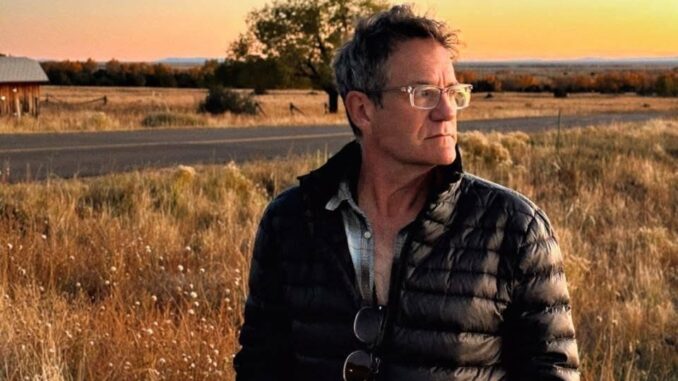
In 2023, an AUK writer displayed exquisite taste by naming Jeff Finlin as one of the top ten greatest americana artists of all time. Congrats to Jeff, as well as, after all, he did record the music that so moved all of us. Finlin has been sober for 11 years but remains a music junkie. Once an addict, always an addict? I like Häagen-Dazs vanilla ice cream and buying way too many CDs (including all of Finlin’s).
The day Jeff Finlin stops making music is the day hell freezes over. He is a super prolific singer-songwriter and drummer who has released 17 critically acclaimed excellent records, authored three books of prose, written two books on yoga and recovery, and has a cool blog called Hummingbirds Holler (either a ravine or loud birds). He has been at his craft for over four decades now, and his pace hasn’t slowed; if anything, it’s picked up. More impressive than even that, though, is just how consistent this musician has been throughout the years. He does have a formula and, praise be, has perfected it. But that doesn’t mean he is not willing to explore. His latest, Myth of the Giver (2025), recalls the kinetic energy of his earlier records but possesses the sophistication of his more recent output. New path to travel, but staying true to his roots.
He has more than a hundred songs stored in the basement of his Colorado home, some of them eager to be dusted off and inserted in new records. The idea behind this constant composing is to write without inhibition to unburden the subconscious and unlock creativity. Some songwriters say you shouldn’t even re-read what you’ve written, never mind edit it, though it seems likely that Finlin doesn’t subscribe to that particular idea. Lyrics in the ten songs on Myth of the Giver are polished enough to suggest that the singer has spent some time shaping them, or maybe his thirty years of experience writing for the rock band the Thieves alongside Gwil Owen and, since the early 1990s, a respected solo artist, means his stream of consciousness is supremely well-honed.
Finlin is reportedly in his late 60s, which is an age that lends itself to reflection, though his exact number of years on the planet is unknown. We do know that he was born in Cleveland, Ohio, the grandson of Irish railroad workers (who seemed to be in the habit of leaping from trains). As he sorts through the comings and goings of life, his songs are tack-sharp, wonderfully unnerving, but never overworked. At times, the songs are tougher than a $2 steak. Still, these albums exhale in elegance, illustrating a humorous yet fragile sensibility, as in Unknowing, “my destination’s lost in the sound of the chord ringing in the grace between the lamb and the lord, unknowing.”
Finlin has been on a road to discovery with an unquenchable wanderlust since the time he first hitchhiked his way out of Ohio and started travelling across America. Apparently, he has found a town in Colorado that suits him, though it is from Brazil where the following conversation took place.
Americana UK: Hey, Jeff. I understand you are outside the US now.
Jeff Finlin: I’m in Brazil. I flew down here to spend a few weeks working on my book and hanging with a couple writer friends. I’ve been sick for three days with this fricking chest thing, so if I go into a coughing fit, I apologize beforehand.
AUK: No worries. You don’t even need to cover your mouth if you cough, since we are on Zoom.
JF: That’s right. You don’t want to catch what I’ve got.
AUK: What little I know about Brazil is rainforests, a long river and Brazilian jiu jitsu.
JF: I’m in Curitiba, and they’re kind of famous for boxing. My friend, who I used to tour with in Ireland, knew Curitiba, and it was from boxing.
AUK: You wrote about being into yoga.
JF: I’ve been into yoga for a long time. I’m a sober dude now, and yoga was a big part of my recovery.
AUK: Are you playing any shows in Brazil?
JF: I did hook up with a producer here, and we did a video. I’m not playing live, though.
AUK: Back in the US, you are living in Colorado?
JF: I’ve been in Fort Collins 22 years. I moved to Nashville when I was young and stayed for 20 years, and that was enough of that, but I was lucky enough to cut my teeth there, so it’s an amazing place that way.
AUK: While you were there, what’s your take on Nashville?
JF: Well, people always ask me, ” What’s so great about Nashville? And my answer is, everybody’s better than you, and the bar is set really high. So, you’re always trying not to embarrass yourself as a performer and a writer. You go out, and you see a drummer. I started out as a drummer, and I go, I’m never going to play drums that good. And then you see other people and think, I’m never going to play guitar that good. I’m never going to write a song that good. How am I going to stick out? What do I have to offer that’s unique? And of course, I didn’t fit in anywhere there. Finally, one guy actually told me the truth one day and said, “Dude, nobody’s going to get what you do here, ever.” So, I moved to New York for a while, but that didn’t go too well.
AUK: Like you had to put yourself in a box that maybe was not you?
JF: In Nashville, nobody operates outside that box. Back in the eighties and early nineties, that box was pretty heavy. You couldn’t operate outside that box and get anything going in the business in Nashville.
AUK: You’re very prolific. Do you use most of the songs you write, or are there some on the back burner?
JF: I have a hundred songs in my basement pretty much at all times. The storyline is important. My records are all basically novellas. There’s a beginning, a middle, and the end, and they’re based on the hero’s journey. So, the thread of the story and the flow of the record from the beginning to the end is always really important. What am I trying to say? Where did our hero leave off? The last one, Myth of the Giver, is no different. The interesting thing about this was when it came to picking the songs for the record, I went to the songs in the basement. A lot of these are older songs from the nineties, and I’ve been listening to four-track demos of these things for 30 years. Within 15 minutes, I had the whole 12 songs based on the story that I wanted to tell. And it’s funny that when I plugged them in, people say, ” Who is this chick all dressed up like Michigan? Well, she’s the female archetype of a greaser chick in Detroit in the seventies. The story is a contemporary hero’s journey, how he goes from this place of disillusion and meets this woman who lets him go. He tries to go backwards, hits the highway, and things that he discovers on the highway about himself, about love. He returns, and what does he find in the end?
AUK: The record ends on Volunteer. I get the sense there is yoga in the song.
JF: Well, that song’s just about being a volunteer for life and getting the hell out of our own way. I mean, I hit bottom after bottom until I met my spiritual guy. He has 17 million volunteers around the world. His whole foundation is based on volunteers. It’s showing up and doing something and asking nothing in return. That’s where my whole journey has left me in many ways. And I still have to be reminded of that every day to just be a volunteer. You volunteer for this thing we call life and just live it to the best of your ability. I was a big agenda guy. I grew up in a rough family, and my willpower was on 10, and then I just got crushed over many years.
AUK: You talk about the archetypical ride through life, love and longing as the ultimate gift.
JF: All my ideals kind of got crushed. So as I go along that journey, my ideals don’t add up to much, just living the best that we can live.
AUK: You’ve authored books of prose, and here you are in Brazil writing again.
JF: Basically, I’m always writing every day; I’m just a conduit for whatever. I open myself up, and it comes in, and then I throw it in a folder. Over the years, I’ve accumulated a lot of that stuff, and that’s how I met my friend in Brazil. She edited all my poetry books. I don’t know if it’s any good, even what this is, but she said send it. She is really good and put this here, put that there, in these three sections. Then, all of a sudden, we had a poetry book or a book of prose. I’m grateful because she’s a really good writer herself.
AUK: Have any of your characters ever jumped off the written page and wound up in a song?
JF: A new song Mexicali was based on this long poem I wrote last year called The Story of Man. It’s this long, rambling archetypical story about this journey between a man and a woman. At one point, I just thought, what’s this thing saying, so I’m going to write a song and, not necessarily dumb it down, but condense the story to where it works within a song.
AUK: You released a live record digitally (in 2025) with the 89’s. Where was that recorded?
JF: We have this great venue in Fort Collins. I don’t really play much. I never really had the career that was sustainable enough where I can go out and make money and not do that gorilla touring, which just destroys me. There was an opportunity to do this show in a state-of-the-art venue, and so I put together a band with some old friends of mine. We just went out and did it, and it came out really great.
AUK: More than a few very good musicians have gone that route and limited their road gigs.
JF: As you get older and you’ve done all that shit, people will say, oh, you’re retired now, you can just make music and play live and do all this stuff. I’m like, dude, I’ve been doing that for 40 years. I didn’t work some shitty job for 40 years, so I could do that. When I retired, that was always number one on my list. I worked shitty jobs so I could do that and be available enough where if my records came out in England, I could go to England and do a tour, or go to Holland, or Italy, or wherever. That was always my priority, but now there’s just no money in it. My career never hit that point where I can go play, and 400 people are going to show up. So, I have to make hard decisions about what’s good for me currently.
AUK: Like some jazz musicians, are you more popular in Europe than America?
JF: Oh, yeah. I never could get arrested in America, and I tried really hard. Nobody really got me here. But there was a guy in England, Nick Stewart, who’s a famous old school A&R guy. He used to work for Island. He signed U2 and Killing Joke to their first deals. He worked with Nick Drake and was always trying to get money for his own label to release music he loved, and he just loved me. Said, “If ever I get a label, Finn, you’re on it.” I’m really grateful for that man because he released all my records in Europe and in England, Ireland, Scotland, and that’s where all my business came from. My records really never came out in America.

AUK: You have a friend who edits your prose and poetry. So, do you have anyone to run your songs by?
JF: I have my guys. In Tennessee, my old friend Jeff Coppage is an old-school engineer dude, and I got my friend Joe McMahan. As you go along, you find these special people that you can really trust. They’re going to shoot you straight and not blow smoke up your ass, and they’ll make you better. They will make you fight for your idea or get rid of it, and nine times out of 10, they were right.
AUK: Down at the bottom with the credits on the digital live album, there is a quote: “As the wild poet dogs holler their sorrow and joy … so is the world a better place.” Sounds like something Kipling would have written, maybe “Power of the Dog.” Is it yours?
JF: Yeah, it’s mine. I think it is a special calling to be an artist, and it really doesn’t make sense in many ways in the contemporary world, especially the way I grew up. I mean, it was dangerous back then, and my parents didn’t want anything to do with it. They didn’t understand it and were concerned for me. But I knew when I was 11 that my path was going to be music. And then for the next 30 years, it was just overcoming the voices telling me that I shouldn’t do that, and overcoming this wild, crazy thing that you really can’t put your finger on that you have to do that really makes no sense logically in the contemporary world.
AUK: Maybe playing the drums in the house was of concern to your parents?
JF: They were pretty good about that. I had a room over the garage, and they just let me go at it every day. I would come home from school and play the drums for three hours, but when it came to making a career of it, they just thought I was irresponsible. I think my daddy still thinks I’m irresponsible.

AUK: The Cowgirl in Forever is an interesting song. Is that relatively new or one that had been stored in your basement?
JF: I wrote that in maybe ’94. Nashville was never really a happy home for me. There wasn’t a lot of nature there, and it’s kind of a shitty place to live. I went out to Colorado to visit my sister and spent a couple of weeks driving around in her car in the wilderness. Going back home, every time we’d go out of town and pull over that hill on 65 South on Trinity, my heart would just sink. It’s about that feeling of knowing that you have to go and do this work in this place that isn’t necessarily home, and asking for the divine to get me through that.
AUK: I’ve always wanted to have the chance to ask you about that song I Killed Myself Last Night from the My Moby Dick album (2013). You are still here, so it couldn’t have been you suiciding.
JF: It’s not really literal. I had a radio guy in Colorado, and he’s like, dude, you can’t say that. Well, it’s not really about killing yourself; it’s about transcending the self. He still says I just can’t say that. Well, I did. All my records really document my spiritual path, and in the early days, it was fine. I felt I was building this ladder, and then I had this experience in that ashram in Tennessee that I couldn’t explain. It kind of threw a monkey wrench into everything I’d been doing as a writer because I experienced this one thing that you just couldn’t explain in words. It was beyond words. After that, I started making shit up.
AUK: Does music really soothe the savage beast?
JF: In some ways, I have to be careful. I’m always walking the line. It’s just as important to know when to put it down as when to pick it up.
AUK: If you could change one thing about yourself, what would that be?
JF: Probably my crazy work ethic. I tend to be a willpower-driven kind of dude, and it’s good to have, but at this point in my life, it’s not so much. I just have to start letting go and living the day a little more than living my agenda.
AUK: The downside of being prolific, a workaholic or simply driven is that other parts of your life suffer. And it tends to be exhausting.
JF: I’ve done a lot of work in the past couple of years, and it takes its toll. I quit living and just keep working, so I think I’m always trying to walk that tightrope. But it’s really hard to just sit in that space. We tend to fill up our worlds. I’m a good human doing. I’m not such a good human being.
Since the date of this interview, Jeff Finlin has released a 30-track digital album called Reject: Demos, Outtakes and Mystic Musings. You can check it out on Bandcamp.

