
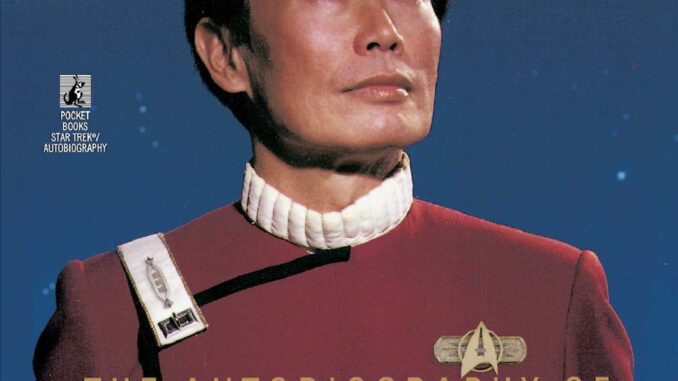
 George Takei’s 1994 autobiography, To the Stars, is rather more than a standard Hollywood memoir. Whilst it does cover his years on the USS Enterprise in detail, the more interesting aspects lie in the exploration of his early trauma and later civic engagement. Takei frames his journey not just as an individual success story, but as a personal testament to the fragility and potential of the American way of life.
The core themes of his life, his childhood internment, his political service under Los Angeles Mayor Tom Bradley, and his path to becoming an LGBTQ+ icon, reveal a consistent undercurrent: turning personal exclusion into public activism.
The memoir opens in the spring of 1942. Following the signing of Executive Order 9066, five-year-old Takei and his family were forced from their Los Angeles home at bayonet point. He recounts his childhood years spent behind the barbed wire of the Rohwer War Relocation Center in Arkansas and, later, the maximum-security Tule Lake Segregation Center in California.
Takei captures the innocence of a child who thought the searchlights were there to illuminate his evening playtime and that “the barbwire fence was just part of the landscape.” Yet, this innocence is starkly contrasted with the adult awareness of his parents’ humiliation and loss. The book highlights the influence of his father, Takekuma Norman Takei, to whom it is dedicated. Rather than allowing his children to succumb to bitterness, his father used the experience to teach them about the fallibility of democracy. These late-night kitchen table conversations became the foundation of Takei’s civic consciousness. He understood that the American system is only as strong as the people actively participating in it.
Takei provides an enlightening (at least for the British) look at his run for the Los Angeles City Council in 1973, where he narrowly lost to David Cunningham. Rather than marking the end of his political ambitions, this loss caught the attention of newly elected Los Angeles Mayor Tom Bradley, the city’s first African American mayor. Bradley recognised Takei’s dedication to public transit and urban equity, appointing him to the Board of Directors of the Southern California Rapid Transit District (RTD), where Takei served from 1973 to 1984.
Takei clearly looks on this part of his life with immense pride. He discusses the gruelling hours of transit policy and his historic, tie-breaking vote in 1978 that paved the way for the creation of the Los Angeles subway system. Through these sections of the book, Takei illustrates that real change in public works is often achieved through unglamorous committee meetings and long-term infrastructure planning.
When To the Stars was published in 1994, Takei was not yet publicly “out”. He lived in a Hollywood era where coming out meant immediate career suicide, forcing him to keep his decades-long relationship with his partner, Brad Altman, strictly private. The memoir reads as a bit of a historical stepping stone. The silence on his personal life in the 1994 text highlights the exact “legalistic barbed-wire fence” of discrimination he would spend his later years tearing down. Altman’s only credit in the acknowledgements is as a supporting Journalist, although with hindsight it is easy to read between the lines.
The trials of Takei’s childhood internment, his passion for civic justice, and his openness about his identity found their ultimate, unified expression decades after his autobiography was published. In 2015, Takei made his Broadway debut in Allegiance, a musical directly inspired by his own wartime memories and his family’s struggles inside the camps.
The project was born almost by chance in 2008 when Takei and Altman met composers Jay Kuo and Lorenzo Thione. During a conversation about family duty, Takei recounted his father’s feelings of helplessness behind barbed wire. Recognising the dramatic and educational power of his story, they set out to create the first Broadway musical to directly address the Japanese American incarceration. In the production, Takei took on a deeply symbolic double role. He played the elderly Sam Kimura in the present day, a veteran looking back on his choices, as well as the whimsical grandfather, “Ojii-chan,” in the 1940s scenes. This framing allowed the production to explore how families were fractured by the US government’s infamous “loyalty questionnaire”.
Of course he talks about Star Trek, speaking of his castmates with obvious love. William Shatner doesn’t emerge from the account with much credit, which seems to be a theme for anyone who has much involvement with him, but even there Takei brings a warmth to his relationship with Captain Kirk. Other parts of his film career, including a feature in John Wayne’s Vietnam movie The Green Berets, suggest that Hollywood at the time had little use for a Japanese American other than to play the “enemy.”
As now, the longest-serving Star Trek character, appearing in 2025’s Star Trek: Khan audio drama at the age of 88, he is still vocal in his support for what was after all one of the most inclusive TV shows of the 1960s, and his character Sulu in particular. Having influenced the use of Sulu to show a gay couple with children in 2016’s Star Trek Beyond, he has grown beyond just being an ensemble cast member to shaping how the franchise continues to advocate for a fairer world.
To The Stars is a story of American potential with a clear message: our individual heritages, no matter how painful, bind us to a shared future. His journey asks us to engage with our communities, protect the vulnerable, and help build a more perfect union. He maintains his activism with the 2024 release of My Lost Freedom: A Japanese American World War II Story, a children’s graphic novel version of his early life. Don’t be put off by the Star Trek-oriented cover and title pages; this is an essential book for anyone interested in the American 20th century.


