
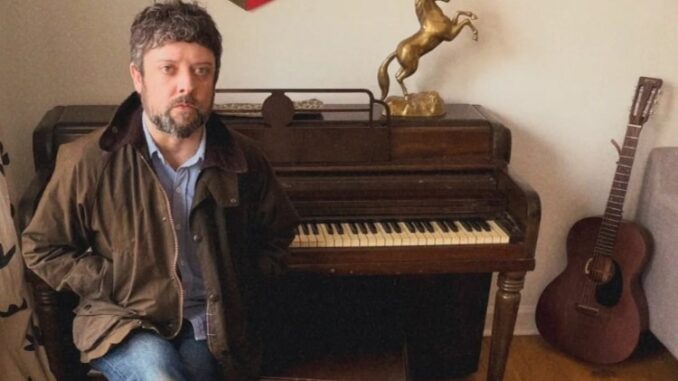
It’s no secret that americana music in all its colorful variations has been prevalent and in vogue for years now as countless bands and singer/songwriters from the last two decades have found success filtering their music through distinctly alt-country lenses. Still to this day, you can hardly swing a dead cat without hitting a band with one or more of these elements: raw storytelling, organic instruments, gritty rhythms and sincere emotion over pop or rock bombast. To join these ranks is both a blessing and a curse. On one hand, there’s a huge demand for this music, but on the other hand, it’s hard to stand out in such a saturated market – and even harder to make lasting, impactful songs that transcend its revivalist roots. Kansas band The Roseline approach this weighty task with more bite and far better songwriting chops than the vast majority of bands who attempt to navigate this territory. For starters, lead singer and songwriter Colin Halliburton has a an aching voice that just screams classic heartland rock, but more crucially, he has an ear for awe-inspiring melodies and lyrical lines that go above and beyond mere mimicry. Nearly every one of his songs prompts a mental video of either one’s own life or someone you either know or know of. It’s the profound kind of songcraft that allows you to imagine yourself at your lowest and highest moments.
The Roseline is not solely Halliburton behind some random moniker, however; this is an actual band with an established supporting cast of Bradley McKellip on guitars and dobro, Heidi Gluck on keys and vocals, Lynn Piller on pedal steel, and backed with a rhythm section of Jim Piller (drums) and Colin Jones (bass). This makes a big difference in that the Roseline sounds, well …. together and tight as opposed to a hired backing band, no matter how good its individual players may be. Baked in is a constancy, speaking of which, is the title of their 2021 album. Starting out as an acoustic trio, the band Halliburton fronts has strung together nine studio albums, its latest having the quizzical title of 86 Gumption, recorded over the course of a year in myriad studios and band members’ homes. The album is stocked with an endless supply of terrific songs (think of organizers stocking a lake before a bass fishing tournament). The fish, er, songs are biting and tasty and the band cooks. Pay attention to the lyrics and play it loud.
It’s refreshing to hear a band whose music is this emotionally literate tackle head-on such experiences as the nuances of marriage, middle-age, grief, geopolitics, acts of creation, hedonism, sobriety, and everything in between. Halliburton’s stories often revolve around hard-living folks, people just scraping by and those on the wrong end of the zeitgeist. Transfixes and transports would be verbs that enter the mind. I haven’t heard many bands that better encapsulate the loss of American optimism, although as former Israeli Prime Minister Ehud Barak once said, “a pessimist is simply an optimist with experience.”
“I think just observing humans and how they interact with each other, whether it’s kind and gentle or brutal and hateful,” Halliburton said with furrowed brow during a Zoom interview, grappling with the question of where he gets inspiration from. As he offered about the song Wet Black Fin: “This is a song about navigating a partner’s emotions while they’re processing grief. There’s no real handbook for this and I found myself second guessing every approach I took. Ultimately, they just want you to be there for them and to listen.” The last sentence serves to approximate this suggestion – read the interview, be there (on CD, vinyl or digital) and listen to the Roseline.
Americana UK: Good morning, Colin. I understand your day job is at the university in Kansas. Did you move there from someplace else?
Colin Halliburton: I grew up down the road from Kansas City, went to college in Lawrence and wound up staying.
AUK: 89 Gumption is The Roseline’s nineth album in 19 years, a strong body of work. Did the band start as a band and is it still a band or rather you and a fluid cast of musicians?
CH: It was originally a three-piece and very quiet, acoustic guitar, upright bass and all brush drums. Then it evolved into more of a rock band. I consider it a band probably now more than ever. This current lineup has been together about six or seven years, and it feels a lot more collaborative than the early days.
AUK: Did you name the band?
CH: I didn’t. It was one of those classic stories where we had our first gig booked and we didn’t have a name. Our bass player came to practice one day and said his wife was reading a book with some reference to the Roseline. We just went with it.
AUK: Is there a favorite among the band’s albums?
CH: I feel like everyone says this, but the most recent one is the one I’m most pleased with. It’s not yet stale to me and still seems exciting.
AUK: You’ve toured all over Europe and you will be touring there again. Jazz artists have gone to Europe often to seek an audience. Why do you think a Midwestern band is so popular there?
CH: We’ve been fortunate enough to be able to go to Scandinavia a few times, mainly Sweden, just through this little agency called Rootsy over there that championed us regardless of being kind of a no name act. The people over there just respond to, for lack of a better word, americana music really well and are great, kind, generous audiences. So, it’s always fun.
AUK: What would you say are the most challenging aspects of being a working musician, not counting having a day job?
CH: That’s where I am right now. But just money really; it’s hard to eke out a living at this, but if I can subsidize some cool travel, playing shows, hop the pond occasionally, I’m pretty happy. It’s already gone above and beyond anything I dreamed about when I started.
AUK: The new album is filled with tunes that really show your talent as a songwriter. How did you begin mastering that craft? And when did you begin writing songs?
CH: Kind of late compared to other people, 24-ish I think. I didn’t even pick up a guitar until I was 21. I have written hundreds of songs at this point. I think you have to start out writing a lot of really bad songs and then hone the craft. I feel like I’ve improved a lot since I first started, at least I would hope so.
AUK: The title of this collection is 86 Gumption. Does that translate as getting rid of ambition? Former FBI director James Comey found himself in a lot of trouble by expressing “86-47.”
CH: He sure did. But it’s kind of a goofy inside band joke thing. We were all out to dinner one night, catching up after not seeing each other in a while. Heidi and I were not too enthused about booking shows or writing, and I was asking her, because she’s a solo musician in her own right, if she had been writing or had any shows booked. And she said, “No, that would require gumption.” And then Bradley, our guitarist, who was a former line cook, said “86 gumption.” I just liked that phrase, and it felt appropriate for the times.
AUK: Is there a particular song on the record that stands out?
CH: That’s tough. The one I’ve been knocking around for a while is Wet Black Fin.
AUK: A rather ominous sounding title. Cue the shark.
CH: We could never figure out a rhythm section that felt appropriate for that one, but it finally coalesced and feels sort of atypical for us. So that felt exciting to finally crack that one.
AUK: The song screams grief. Is this for a parent, a relationship or just being in debt?
CH: That one was actually about my wife losing her mom to suicide. From my perspective, learning how to navigate her grieving process because there’s no real handbook for that per se. I was just trying to learn what the right approach is to support her best. It’s not easy.
AUK: You and your wife have children. Going by your age in the bio, you must have had them later in life than most.
CH: I have two girls – six and three-and-a-half. I’m 44 so, yeah, later than traditional fatherhood. But people are having kids later these days.
AUK: In Metal Mouth, the song talks about staying together for the kids. Do you think that’s the best way for a couple to handle a relationship falling apart?
CH: I think it depends on the dynamic in the home. If it’s clearly unhealthy and you’re constantly at odds with each other, it’s probably not great for the kids. But if you can be civil and be good co-parents, then it probably is. I mean, it’s a nuanced thing.
AUK: There is the lyric about a defibrillator and a stent, should they try to make it beat again?
CH: That was just in relation to resuscitating a marriage. I think anyone that’s been in a partnership, let’s say over a decade, is going to run into some bumpy stuff, and you’re going to have some deeper questions about its longevity.
AUK: You talk about war criminals, corrupt leaders, spending life in prison in The Hague in the song North Sea Views. What do you think happened to these people as young children? Was it a lack of parenting or just the way they were wired?
CH: It has to be more on the nurture side of things than nature. But that’s what I was exploring in that song, how you’re born an innocent and then how bizarre it is to turn so evil.
AUK: Well, to sort of lighten the mood with a little country sound in Tooth and Claw, you have got sunsets not pleasing to the eye, boiling oceans, roaches, and losing your sense of taste. I ain’t sure that I can charm the cobra tonight.
CH: That’s another one I wrote a ton of lines and verses for and picked the stuff I thought was most interesting. The phrasing worked best. It’s another one seeking some sort of forgiveness or redemption. I think it’s about the brutal reality of the nature of man, if I can be that pretentious about it.
AUK: The record seems to follow along lines of Keystone of the Heart (2024 album). The lyrics come off as pessimistic. Are you more pessimistic these days, either with personal affairs or world affairs?
CH: I think that’s my baseline mode of operations. These are very strange grim times we’re living in. That being said, you’ve got to capture joy wherever you can, and I’m certainly not incapable of that. But yeah, that’s just the stuff I gravitate towards, not just in writing.
AUK: In Heart of Oak, it appears you have a sniper taking somebody out.
CH: That’s just heavy stuff, but it’s what I’m drawn to. For that song, I wrote a ton of lines, edited then threw lines together sequentially that didn’t quite line up thematically. So, it’s a little jarring and cryptic. It was an interesting way to approach a song. But it’s about seeking forgiveness and innocence without getting too into the weeds or too literal about everything.
AUK: You talk about flooding the basement of your heart, being stoic in Wild as Weather. Isn’t there something about the professional managerial class too?
CH: Yeah, you caught that. The managerial class is exploitive and they do the bidding of the capitalists. I mean, I’m obviously a diehard lefty.
AUK: You mentioned moderate in the song Apex, which you also did in Tooth and Claw, where you’re talking about a once-great protest singer being exposed as a moderate.
CH: In Apex, that’s more of ingesting substances. The other song is a political reference. I think my problem with moderates is I feel like they don’t really stand for anything. They’re too out to please everybody but are ineffectual. I think you’ve got to be pretty much a malignant narcissist to want to be a politician. I mean, that’s probably true for entertainers too to a certain point. I feel like anyone that gets up on stage is kind of a deeply broken person in a way. There’s a certain hubris required, I think, or delusion to even get that far
AUK: On the last track, Palm to the Sky, you wrap the whole intent up in a way – religious indoctrination, paycheck loans, prison for minor offenses. But at the end, “he was bidin’ his time, writin’ and revisin’ til it wasn’t a mess.
CH: I don’t know where that came from. I just wanted to write about, for lack of a better word, a loser that wasn’t a lovable loser, but someone that was just due to circumstance or bad luck or whatever, ended up on the losing side of things. But like I say in the song, it’s not for lack of trying. Those are the kind of the characters that I’m attracted to and that I relate to. And there’s some of me in that song for sure, but I think I was reading a lot of Willie Vlautin.
AUK: Good choice. Loved his novella, The Horse. If you could open a show for any artist, who would you choose?
CH: I would have to say Bright Eyes. Been a longtime fan.
AUK: You say Bright Eyes and what immediately pops into my head is that song with the long spoken word intro about a plane going down, At the Bottom of Everything.
CH: Yeah. Fellow Midwestern champions of doom and gloom.
AUK: Pessimism aside, what gives you hope for the world today?
CH: Young people give me hope. I think people that are fighting for a better society give me hope, and my kids give me hope. They’re beautiful. People still making cool art gives me hope.


A great band that deserves more attention. Thanks for this…