
One of our finest songwriters delivers an album for our times with consummate clarity and lyrical daring.
 .Mary Gauthier was something of a late starter, delivering her first album when she was in her late thirties but she has become one of americana’s most distinctive songwriters over the years since she started recording her songs in 1997.
But let us go back for a short resume of her life, because it informs her songwriting and her later music. Mary Gauthier was born in New Orleans in March 1962 and adopted as an infant by a couple in Thibodaux, Louisiana – the father was an alcoholic and there was little emotional attachment to her as a child. She ran away from home at fifteen and stole her parents’ car, spending the following years passing through drug centres, so-called halfway houses, and friends’ couches, often under the strong influence of drink and drugs. She spent her eighteenth birthday in jail in Kansas on theft charges that were later dropped as long as she left the State and never returned. She enrolled at LSU as a philosophy major but dropped out after five years due to addiction issues, eventually relocating to Boston. There she enrolled at a Culinary Arts college and at the age of 28, opened a Cajun restaurant in Boston known as Dixie Kitchen.
A few years later she started to write songs, and released her debut independently, the appropriately named Dixie Kitchen, in 1997 at the age of 35. It received largely favourable critical reviews despite being a relatively unpolished album. There followed a considerably more eloquent and sophisticated album Drag Queens in Limousines, the title track of which explored her life as a lost soul amongst those who were on the outside of society and her experience as a gay, effectively homeless teenager. Awards starting coming in for her incisive songwriting and she drew the attention of people who liked John Prine or Steve Earle. The album kickstarted her career and she sold the restaurant.
Now sober, a series of albums followed, spread out over years as Gauthier found the songwriting process difficult and wrote most of her songs when she was on the road. Her most famous album included the song that is probably her signature tune, Mercy Now (released in 2005), but her other albums found just as much praise. The Foundling in 2010 was an ambitious autobiographical examination of her adoption and the search for her real mother, Trouble and Love in 2014 followed a very difficult breakup and Rifles and Rosary Beads (2018) was written in conjunction with Army veterans and their families, and was Grammy-nominated., as well as scoring an almost unprecedented 92 on Metacritic.
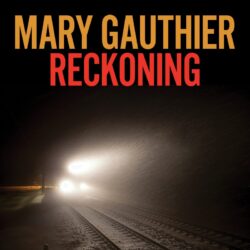
After the grief-ridden yet strangely and magically upbeat Dark Enough to See the Stars in 2022, Gauthier now releases her 10th original album, the prophetically titled Reckoning, produced for the third time in a row by the brilliant and empathetic Neilsen Hubbard.
It is, generally speaking, a subtle, low-key affair musically but far from it lyrically. Moving away somewhat from personal observations, this album tackles major issues of the day at a different level, mostly fractured society in general and political observations, but typically with her wonderful wordplay. And to help, she joins forces in writing collaboratively with Aaron Lee Tasjan, Lori McKenna, surprisingly Vince Gill, Eliza Gilkyson, Beth Neisen Chapman (twice), her partner Jaimee Harris (in tandem with Ben Roberts), and Susan Gibson.
Gauthier’s acoustic guitar dominates instrumental proceedings and her evocative voice shines through clearly and forcefully, kicking off with the brilliant Alcohol and Adderall, written with Harris and Roberts, whose friend is described in the lyrics as she self-destructs due to drug addiction – “She’d stare out the window at the highway / As the early morning truckers chased the dawn / She’d let her cigarette burn in the ashtray / Sink into herself, and she’d be gone”. Gauthier’s voice changes from track to track but its echoey existence in this opener gives the song a tinge of sadness. The three writers of this song all dealt in thier own way with drink and drug addiction.
Lyrical simplicity is often Gauthier’s forte and this is also true of McKenna who co-wrote Heaven, a depiction of an old man who is sadly facing his wife’s slow death – “A lifetime, a flash of light, a thin veil to the other side / She’s ready now, and she is not afraid / He’ll be alright, cause he believes, he believes in heaven” – the title line underpinning the old man’s faith. Eerie background voices between choruses capture the essence of this sadness, almost churchlike.
Judgement Day is an overtly political song, with a young priest calling out his clergy to take a moral stand, linking Jesus as an immigrant to modern views of immigration in the US. Gauthier sounds angrier on this track, as she also does on the title track, written with Tasjan; in a 6 ½ minute song, her snarling voice is a call to recognise society’s point of no return. Heavy bass drums echo in the background and occasional electric guitars and harmonica enhance the mood – “A reckoning is beckoning and the old world is fading into black”, and later “reckoning is beckoning and a reckoning’s the only way back home”
Soldier of Fortune is written with Gilkyson, a rolling song tracing the links between historical violence ( the crucifixion) and modern violence, the common thread being the chase for money. Some Times, written with Gill and laced with evocative viola, tells the story of an old waiter who rode the old Orange Blosson Special for thirty years and observed American life across those three decades before praying “for this world of sorrow for a better tomorrow / That we might get there without a loaded gun”.
Chapman collaborated on two tracks, the first, Black Ice, sung by Gauthier in rather softer, more resigned, tone, enhanced by a sad harmonica and those echoey background drums again, the evidence of Hubbard’s sympathetic production – the song uses an accident on black ice as a metaphor for the state of the world. Gone is a largely acoustic guitar-backed folk song about lingering grief after a major loss.
And to conclude this stunning album is a folk song that Gauthier did not write – Tom Mason and Billy Alcorn’s I Thought I Heard a Train from 1998, with its underlying mood of hope in the face of great adversity – “I thought I heard a train, off somewhere in the night / Through the darkness, through the pain, I can almost see the light / Like the sweet sound of salvation come to carry me away / To an unknown destination, I thought I heard a train”.
This is an important album, about as good as any that Gauthier has recorded, brilliantly produced, undeniably political and yet aspirational too. It’s a wonderful addition to her canon.



Listen to Mary as she chats on next Friday’s AUK Podcast!
10 am Friday 2nd October