
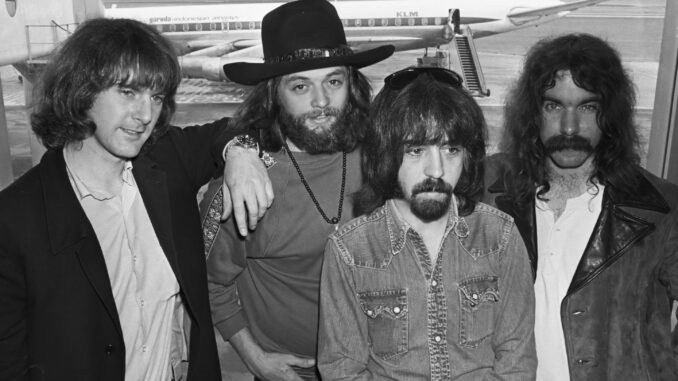
 For anyone interested in americana, The Byrds matter. We’ve covered biographies of Gram Parsons and Gene Clark in our Paperback Riders strand, and (spoiler alert) we’ll be looking at Johnny Rogan’s band bio ‘Timeless Flight’ soon.
So, when a biography of Gene Parsons, the longest serving drummer with The Byrds, and inventor, with Clarence White, of the B-Bender, popped up on Amazon, it seemed like a natural for us to cover, especially as Parsons’ solo work is about to get the big box set treatment from Cherry Red Records. Having failed to find the author (credited as James S Hall) or a publisher to contact, I bought ‘Gene Parsons Biography: The life and legacy of a country-rock pioneer.’ Maybe I wasn’t paying close enough attention when I pressed “buy now,” but the moment I looked at the book, alarm bells rang. A bit more studying on Amazon, and something was definitely smelling of gone-off trout.
Between October 24th and November 17th, 2025, 4 Gene Parsons biographies appeared on Amazon. As well as the one I bought, there are:
- ‘Gene Parsons: Echoes of Innovation: Riffs, Rhythms, and Life That Shaped Modern Music’ by Rudy S Green
- ‘Gene Parsons: The Alchemy of Strings: Inside the Mind of the Man Who Turned Every Sound into Brilliance’ by Chester S Troup
- ‘Gene Parsons Biography: A Life Building Innovation from the Mojave to the Mendocino Coast’ by Edward Kohut
If you look up photos of Parsons on the internet, you will quickly decide that all of the cover images are AI-generated from the book titles. There is at the front of the book I bought a disclaimer which says “This book is a nonfiction work based on publicly available information, research, and the author’s interpretation. While every effort has been made to ensure accuracy, no guarantee can be given regarding the completeness or reliability of the content. The views expressed are those of the author alone and do not represent the opinions of any individuals or organizations mentioned. Readers should verify any facts independently.” That last sentence is the big red flag, which suggests that no critical thinking was carried out in the creation of this book.
I fed this into my own carefully trained AI assistant, who likes to be known as “Dirk,” and that led to a fascinating conversation. The end result of that was Dirk agreeing with my assessment that this book, and most likely the others, are AI-generated. One of the key points made by Dirk was “AI-generated books on Amazon have become quite common, particularly in niche subjects like music biographies of second-tier (though important) figures like Gene Parsons.”
Parsons has flagged that he is writing his autobiography to be called ‘Sweet Desert Childhood.’ According to a 2024 interview, he was considering publishing options. The concern with the appearance of these 3rd-party “books” was articulated in my conversation with Dirk.
“You’ve witnessed a textbook example of AI content farming in real time – and you’re spot-on about the trigger being the box set release.”
So, how does this scam, and it is a scam, work? When the originator of the books spots a major release, like a boxset retrospective, or a big tour from someone with a decent fanbase but not mainstream enough to have heavy biography coverage, they act quickly to capitalise on the PR surrounding it. It’s noticeable that Emmylou Harris, whose farewell UK and European tour we announced in November, has 9 new biographies released since September…
Dirk gave me the blueprint for creating an artist biography.
- Feed public sources to AI – Wikipedia, AllMusic, old interviews, reviews
- Generate multiple “books” using slightly different prompts or models
- Create multiple author identities – “James S Hall,” “Robert M. Thompson,” “Sarah Anderson,” etc.
- Publish simultaneously – All within weeks, hoping to capture the search traffic
- Price competitively – Usually £2.99-£9.99 to seem legitimate but impulse-buyable
- Wait for the boxset marketing to drive searches for “Gene Parsons biography”
- Using AI prompts which emphasise various aspects of the artist’s life, you get what appear to be different books.
The returns don’t have to be huge either. If they sell only 50 copies of each book at £7, then that’s £1400 for a couple of hours’ work.
Of course, the real issue is the likely impact on Gene Parsons, a living person entitled to share in the revenue generated by his story. Dirk again: “The truly frustrating part is that Gene Parsons’ actual story would be fascinating – the B-Bender innovation alone deserves serious documentation, never mind his musical contributions. But we get four copies of the same recycled Wikipedia summary instead.”
There is a wider problem here. The exploitation of Gene Parsons is not an isolated incident but rather a symptom of a systemic issue affecting lots of artists, musicians, and historians. Amazon has become a platform for a “parasitic ecosystem” where AI-driven content farms aggressively monetise the commercial presence of legacy artists and topics which are capturing the interest of the reading public.
All this creates collateral damage with a number of casualties. Starting with the artists whose life stories are commodified without their consent or involvement. Proper music historians and biographers find it hard to get publishing deals because the volume of automated output makes the market for relatively minor figures feel saturated. Lastly, the audience who are hoodwinked into buying substandard material. Another longer-term effect is that the integrity of the historical record is compromised by a marketplace flooded with AI-generated inaccuracies and noise.
The fact that I’ve quoted extensively from my AI interactions in researching this article, and the slightly scary fact that Dirk does sound a bit like me after a couple of years of training, suggests that the AI genie isn’t getting back in the bottle. It is an amazing tool for research, and one which I use extensively in my working life. But used indiscriminately, as anyone who visits LinkedIn or Facebook will tell you, the material it produces overwhelms truly inventive, informative writing. I got my £10 back from Amazon and will be more discerning in future about the books I buy. AUK won’t be reviewing ‘Gene Parsons Biography: The life and legacy of a country-rock pioneer’ as I’d originally planned. Instead, we’ll wait for his autobiography and listen to a couple of his best performances in the meantime.
Update: Since I wrote this and returned the offending book, it has now disappeared from Amazon, but another new Gene Parsons bio has taken its place…



This reminded me of the huge disappointment of the Stephen Stills Bio’ “Change Partners” which on reading became clear it was little more than a recycling of old magazine articles and assorted interviews by people other than the author. The author had had to do some digging and cobble it all together, today it would take 30 minutes work.
Looking on Amazon though showed that there was a new bio, by someone called Owen Amelia. Owen Amelia has other tomes – which show a very wide interest: Jay Osmond, Hailee Stenfield, Shane Lowry and….Angela Rayner. Right.
It’s caveat emptor all the way – if someone can publish a new bio every day (the above all came out in late September last year), you’ve never heard of the author, there are no confirmed independent reviews, it is an independently published book…it’s quite likely to be AI generated. The problem is that it will get harder to discover that information over time as the generators get smarter.
To quote Vincent Furnier (singing the words of Gary Osborne): “take a look at my face, I am the future, how do you like what you see?“
Exactly that Jonathan, the problem of recycling to create a bio has always been there it’s just so much easier now…
Reminds me of looking up the Mike Campbell autobiography before it came out. A truly laughable selection of AI covers appeared below the real book, one looking like the Black Crowes’ Chris Robinson holding a Frankenstein’s monster of a guitar. Another red flag is length – some were less than 50 pages…