
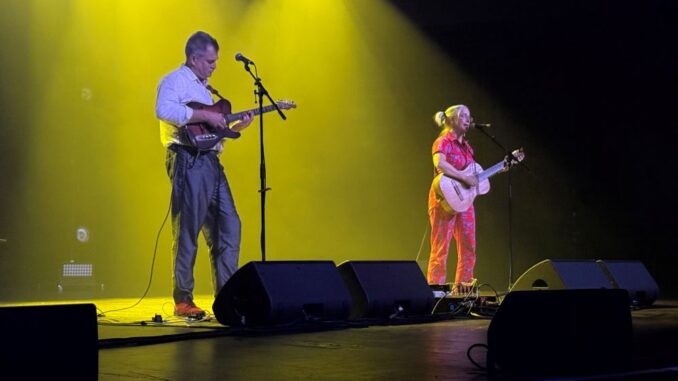
Laura Veirs has an impressive back catalogue, with 14 solo albums across 27 years. She began by announcing that she would play some new songs. Her latest album, Temple Songs, is excellent but, for me, part of its appeal lies in the depth and complexity of some of the arrangements. Tonight’s performance was just Veirs on acoustic guitar and Karl Blau, who also acted as her support, on electric guitar and backing vocals. I was intrigued by how those new songs might be rendered live.
Veirs began with Feeling Returns. One of the more easily stripped-back songs from the new album, it is a lovely, reflective number about coming back to life after pain. What struck me immediately was the quality of Veirs’ voice. It has aged wonderfully, gaining an even greater purity in maturity. Here, it also gave the suggestion that Veirs may have processed some of the suffering contained in the song: sad lines such as “I was singing a silent song / When you came along” were given a breezy feel, as though their emotional resonance might now belong to the past.
One of the great things about the evening was the time Veirs took to give some background to many of the songs. She introduced No Masters as being about dealing with the things that control us, from the small, internal ones to the larger forces outside. The context added depth to the performance. The cry of “No more masters” felt even more plaintive, while the vocal, without the double tracking of the album, sounded more childlike and vulnerable. Meanwhile, the guitars of Veirs and Blau began to weave into and out of each other.
Sword Song, from Found Light, was as delicate as the flower mentioned in its lyrics, its quietness and simplicity again showcasing the richness Veirs’ voice has developed. She introduced Arc Still Bends by explaining that Found Light was the first album she had made on her own. The song explores a quote associated with Martin Luther King Jr. and questions its certainty: “The arc still bends towards justice right? / I’m not so sure in the middle of the night”. There is a political weariness to the words, but the performance was as beautiful and floating as the album version, with the guitar work seeming even more intricate. That interplay was developed further on Golden Seams, which became hypnotic live. Veirs explained that it was written during a writers’ retreat in Alaska, its gold rush history providing inspiration for the lyrics.
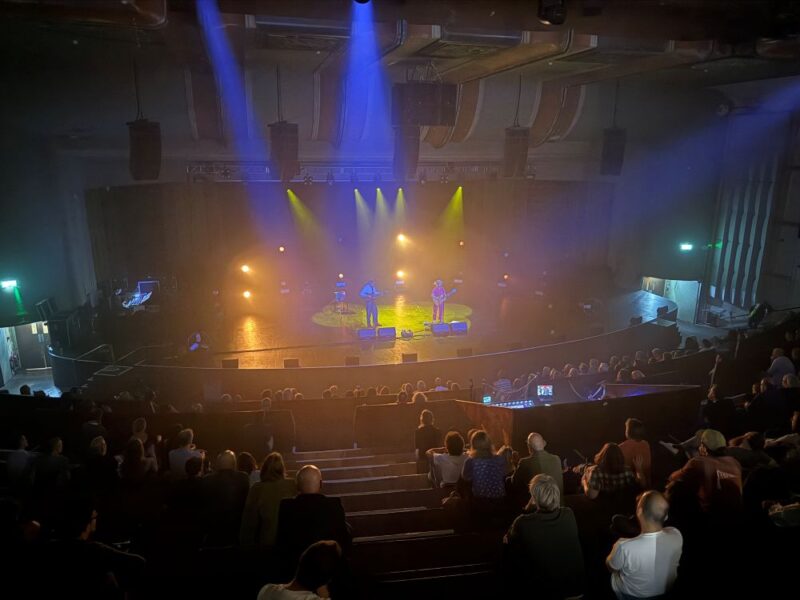
Veirs then took time to acknowledge the venue. “It’s a cool room,” she said. And it is. EartH is an old cinema repurposed as a performance space. Wonderfully atmospheric and stripped back, with largely bare walls and steps where the original seating once stood, it has something of the look and feel of a Roman theatre. The surroundings also suited the older Lonely Angel Dust, from Carbon Glacier, where guitar replaced the original piano part, and Blau’s voice came more to the fore, creating a wonderful duet.
Veirs explained that River’s Song, while appearing on the new album, is actually an older song. Poignantly, it had unlocked her writing process after a couple of years without writing songs and, as she put it, opened her heart again. The higher notes made the song feel even more ethereal live.
Pulse provided quite a contrast and perhaps the biggest test of how the more complex new material could work in this setting. One of my favourites from Temple Songs, it is jazzy, unpredictable and far removed from conventional acoustic singer-songwriter territory. A recording of the drums and saxophone parts was used to help recreate the arrangement. It could easily have felt awkward, but instead it worked brilliantly, with Veirs almost shredding her acoustic guitar as the song became one of the most exuberant moments of the evening. Veirs also urged the audience to watch the video for Pulse. The dog is the star.
When You Give Your Heart, from July Flame, and Swan Dive, from Phone Orphans, were both gently and beautifully performed before Veirs asked the audience for requests. Carol Kaye and Sun Song were chosen. The former, a tribute to the remarkable bass guitarist who performed on thousands of recording sessions, emphasised the simple and compelling folk nature of the song. Sun Song, introduced as being about the joys of children and the return of the sun, demonstrated the breadth of Veirs’ vocal performance: what initially sounds like a simple singalong part is surprisingly complex.
There briefly followed a short Q&A with questions from the audience before a tribute to Dolly Parton with a cover of Islands in the Stream, where the crowd was encouraged to join in the chorus. Blau was particularly convincing in the Kenny Rogers role.
The wistful If You Could Hold Someone and Flying Into Darkness finished the main set. The latter brought real energy to the close and somehow felt fuller than the album version, with Blau’s backing vocals adding another dimension.
Sunlight and Doom provided the encore. Veirs explained that the song was inspired by the Greek poet Sappho, known for the intensity and intimacy of her words. It was a fitting choice and a reminder that this is what we had also witnessed throughout the concert. Veirs’ voice had haunting moments and was pitch-perfect, bringing a thoughtful end to a warm, welcoming and intimate evening.
It also provided an answer to the question posed at the beginning. Stripped of some of the complexity of the recorded arrangements, these songs had not become smaller. If anything, Veirs’ voice, the words and the interplay between two guitars revealed a different kind of depth. It was an evening not only of high-quality performance, but of insight into the songs and the experiences that had shaped them.
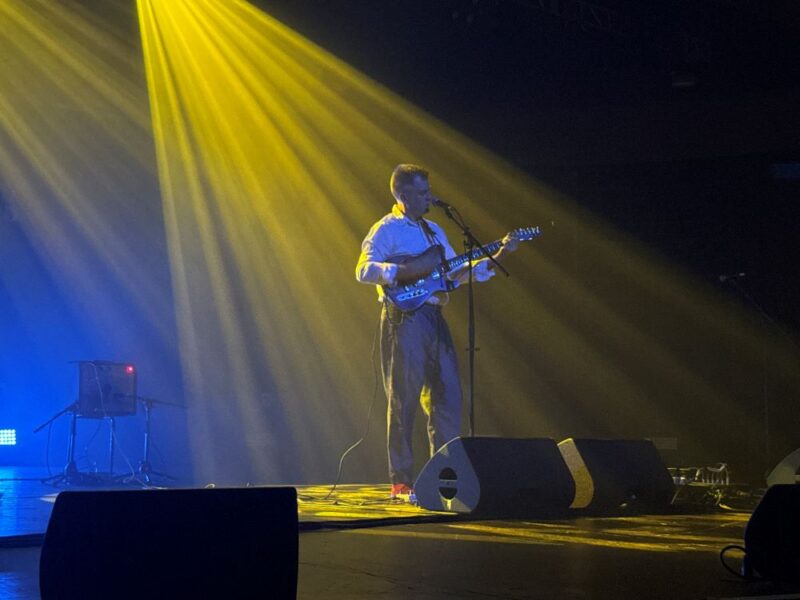
The evening had begun with a solo set from Karl Blau. He based much of it around tracks he had covered for Introducing Karl Blau, including Townes Van Zandt’s If I Needed You, the Gibb brothers’ To Love Somebody, an upbeat version of Tom T. Hall’s That’s How I Got to Memphis and Link Wray’s Fallin’ Rain, which particularly suited Blau’s voice. And speaking of his voice, what a gift it is: deep, resonant and reminiscent of Bill Callahan.
Blau also included a couple of his own songs, both based on cities. Chattanooga featured some wonderfully rolling guitar, while Pasadena was rendered simply and movingly. For me, Blau’s voice could have sung almost anything, and I would have loved it, but more songs like Pasadena, from the excellent Vultures of Love, would have been a treat. Tom Rush’s very singable No Regrets finished the set, Blau once again making the song his own. It whetted the appetite for what was to come, not least because Blau would prove such an important part of Veirs’ performance.

