
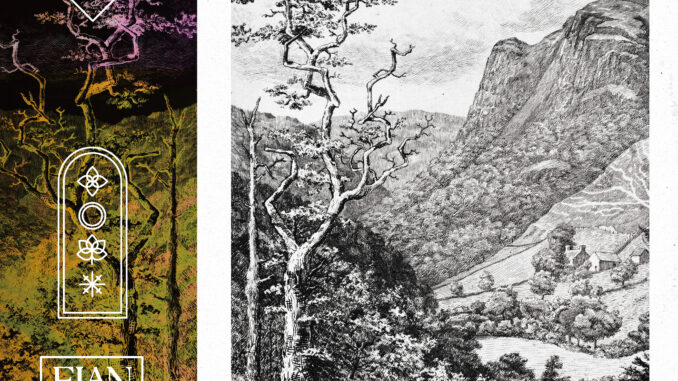
Welsh folkie’s haunting yet glorious concept LP contains multitudes.
 Gareth Bonello, aka The Gentle Good, has a captivating back catalogue of recordings – his own, collaborations with many other artists and work as a session musician – amassed over 20 plus years of writing and performing. In releasing his 6th full-length album project “Elan”, he’s taken all of these past histories and used them to help him create what may just be his defining artistic statement so far.
The record was originally conceived as Bonello lived on and off for a year in the off-grid Penygarreg cottage in the Elan Valley (Cwm Elan) in Powys, Wales. He was the recipient of the Elan Valley Trust Fellowship and spent the time, without Wi-Fi, television or phone signal, immersing himself in the landscape, culture and communities of the Cwm Elan. The purpose of the fellowship was to conduct creative research on the theme of “connection to nature”, to explore communities’ relationship to nature and how to reconnect with it.
Bonello himself was intimately connected with, and immersed in, the project, noting how “going for long walks… getting to know the landscape was a big part of what was inspiring me to write the record” and how “it took shape quite gradually” as he would research and write. What emerged from this period was an intoxicating and magisterial musical portrait of the Elan valley, its landscape, its nature and its political and social history. The trustees who awarded Bonello the fellowship certainly got value for their gift, and not just in the quality of the finished record. Its sheer heft (a 63+ minute running time), the many collaborations with which Bonello engaged during its production, his employment of a full band to record with, and the myriad styles and approaches adopted make “Elan” an engaging and thrilling evocation of this parcel of Wales.
Those familiar with his work will know that the previous Gentle Good record was a modestly lovely guitar/vocals recording of traditional Welsh songs, also birthed in the same remote cottage hideaway. For “Elan”, he has spoken about how he “wanted it to be different, to be adventurous with it,” and he has certainly achieved that goal, in spades. He has created something from an infinitely broader and more varied sound palette, one that has frequently been described as psychedelic in its intricate and experimental use of sounds, an epithet it wears lightly but also with pride.
“Elan” was recorded in Tŷ Drwg Studios, Cardiff, with support from engineer Frank Naughton and a ‘band’ that included contributions from Naughton, along with guitarist Toby Hay, drummer and vocalist Andy Fung, Fiona Bassett, Ivan Moult, and Laura J Martin. Along with the layered vocals, distorted electric guitars, uncanny vintage synths, scrubby piano, and splashes of flute and French horn, there are audacious string arrangements by composer Seb Goldfinch, performed by the Mavron Quartet and even a collaboration with Asin Khan Langa and his Rajasthani folk innovators SAZ.
That’s quite a cast list for an artist more used to working on a much smaller scale. And it is to Bonello’s infinite credit that he has pulled off the project in such an emphatic way that does justice to the immense and dramatic landscapes of the Elan Valley. “Elan” explores issues of culture, politics, and identity through the history and folklore of the valley, and each song is an evocation of a particular feature of the valley, its history, or people’s response to it.
In order to tell such a wide-ranging story and to surface the array of fluctuating emotions and affects that attend it, Bonello offers up 13 songs to reference or represent distinct elements. There is the eerie and mesmeric piece of piano music ‘Drygan’ interpreting the stark wide-openness of the landscape’s highest peak, the distinctly psych tinged slow burners that are ‘Dark Skies’ and ‘Ten Thousand Acres’ and the perfect summery Gorky’s pop bliss of ‘Tachwedd’ and ‘To be in Summer’. He even strays into full-on americana territory; ‘Cofiwch Gwm Elan’ coming across as a Welsh language Ron Sexsmith, with the bounteous melody that that implies. With the final title track, Bonello returns us to the bleakness of the landscape itself with a 6-minute-plus instrumental that presents as if Johnny Greenwood had been around in the 1980s scoring Peter Greenaway’s more outré cinematic excursions and acts “a tribute to this elusive river (Elan)”.
Each of these songs is coloured with its own array of found sounds, orchestral and string flourishes, field recording scraps and synthesised/treated embellishments to accompany the faultless playing of the main ‘band’. All these disparate pieces and styles, additional sounds, collaborators, etc., combine to make a uniquely coherent whole, one that is a fitting homage to the strange, austere and magical landscape that is Cwm Elan. It also makes the record uniquely difficult to classify or put in a neat genre box. Much of what has been written about it talks of its psychedelic nature and its folk origins – fine if we have Skip Spence and John Martyn as psychedelic folk. Wherever we put it, “Elan” is operating at the very edges of AUK’s genre confines, in some kind of new weird-folk scene as written about beautifully by James Hadfield in 2022, among others.
Devotees of the folk world may roll their eyes in despair at this taxonomy and Martin Simpson may castigate such classification as “very very lazy” but to these ears, largely devoid of the wax of folk puritanism, it is very much in a lineage with Richard Dawson, Alisdair Roberts, the drone-folk of Lankum or John Francis Flynn. Indeed, Bridget Hayden and the Apparitions released a set of traditional song interpretations (‘Cold Blows the Rain’) which offered a very similar take on the West Yorkshire moors barely months previous.
“Elan” is as much a record as it is a history lesson, activist pamphlet and eerie disembodied love letter to the area that inspired it. It is both unsettling and strangely comforting, much like the landscape and history it depicts. Wherever (or if at all) “Elan” ends up being classified, despite its nuance, complexity, and odd weird-folkness, it is still a very accessible record. It doesn’t come easy; it’s not designed for immediate, trouble-free consumption, but it is worth, and will handsomely reward, every second of the effort you will devote to it.


