
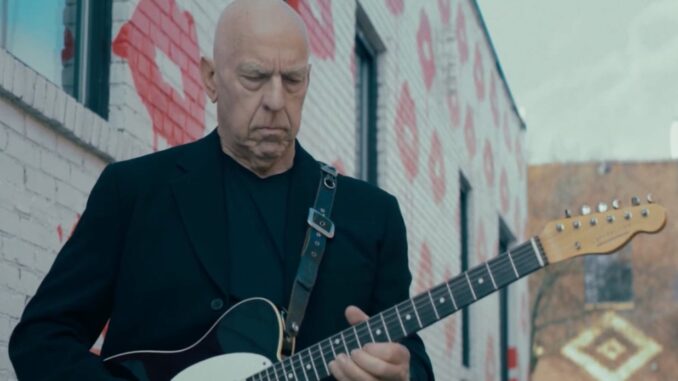
When pigs can fly and cows jump over the moon …. when hell freezes over …. when an NBA player gets called for “palming the ball” …. when George Costanza picks up a check … when California tumbles into the sea …. as Buddy Holly sang, ‘That’ll Be the Day’ when Bernie Leadon, founding member of the Eagles, puts out a new album. Well, that day finally arrived, twenty-one years after the release of the last album under his own name, “Mirror,” in 2004. His latest effort is the ambiguously titled “Too Late to Be Cool,” and at age 78 one might have wondered if Leadon would indeed have another record in him. His reply to that was, “As long as I have the desire and the means to write and record songs, I’ll still do it.”
“Too Late to Be Cool” is an album of seeming simplicity, but there is more going on under the hood than you may hear upon first listening. “I wanted to make a record with a live feel without studio gimmicks,” Leadon noted. He did just that, creating a natural, spacious sound with actual human interaction, the result of a meeting of the minds between the musician and his former producer with the Eagles, Glyn Johns, who convinced him to sort through the 100 or so songs written over the past decade and whittle them down to eleven choice cuts for the album.
The songs are affixed somewhere between the green of Leadon’s time in Laurel Canyon and a 300-acre farm South of Nashville, where he can walk around without anyone to bump into. The location also afforded easy access to Music City, where studios and ace musicians are as plentiful as orange shirts at a Tennessee Vols football game. “Everybody is so good at what they do in Nashville,” Leadon said, “and it made the recording process smooth and easy. The record came together in four hours, from recording to mixing.”
Leadon began to make his mark in the late 1960s as a member of Dillard & Clark and the Flying Burrito Brothers, before getting in on the ground floor of the Eagles with three other guys he had played with in Linda Ronstadt’s backing band. He was the first one out, reportedly due to a disagreement with Glenn Frey about the band infusing more rock into the country rock equation after their second album. Every party eventually comes to an end, but in 1975 after their fourth album, it turns out Leadon left on his own terms for his own reasons. In a 2013 Rolling Stone interview, Leadon said he had no regrets about leaving the Eagles, while pointing out that he may have been right about needing a break. “It was a great time in my life, but everything since then has been great, too.”
The rock direction other band members sought to take was not, in fact, the main reason for his departure. Leadon had strapped on a Telecaster and co-wrote ‘Witchy Woman’ with Don Henley, who had this to say in an email to Americana UK. “Bernie Leadon is a consummate musician and a good guy. He is one of the true pioneers of what some have called, ‘Country-Rock’ music.”
He and Frey finally buried the hatchet, bringing about Leadon joining the massive “History of the Eagles” tour in 2013-14. Preparing to embark on his own tour in support of “Too Late to Be Cool,” albeit on a smaller scale – “I’ll only have 16 semis instead of the 17 on the History tour,” he joked – he will be taking it easier.
Americana UK: Bernie. There you are. Thought you were in Tennessee, but that looks like the beach behind you.
Bernie Leadon: I’m embracing AI. I am in Tennessee, South of metro Nashville.
AUK: The title of your new record is “Too Late to Be Cool,” which can be taken two ways. Either you’ve been cool once and can’t be again, or you never were cool and now you want to be.
BL: Sometimes a phrase or words just sound good and you go, that’s neat. The phrase was cool. But my joke about it is, that I realized the exact moment when I wasn’t cool anymore, when my then 13-year-old son informed me that now he was cool and I wasn’t. Except now he’s 45, and he thinks I’m cool again.
AUK: After two decades, what got your juices flowing to make another record?
BL: You may be aware that I went back out with the Eagles from 2013 through 2015, playing 175 shows around the world. So, my chops were up, and my ability to play was good. I was writing more and decided I would build a new building around a bunch of vintage recording gear that I had. It took me four or five years to find the right builder, design the building and get it built. And that was done in 2021. Glyn Johns is a dear friend of mine, and we’d been chatting about the progress in the studio, and he decided he wanted to come over and help me sort it out. So, a little over a year ago, he came and we did five songs and decided we wanted to continue.
He wanted a full band, so I got three other guys, a bass player, drummer and keyboard player. And we did the tracks live, looking at each other, reacting to one another, which is how he likes to work. We recorded all analog, 16-track, but there’s a hidden benefit to that, which is you have to make decisions as you go. That way you don’t end up with 45 vocals and 12 guitar parts that you have to figure out what you intended two months from now when you mix. It’s really a much better way to work, the method of flow. You want to preserve the excitement, the immediacy and the freshness. If you go beyond that, sometimes you’ll go back and listen, “No, we already had it. We went past it. ” I’m willing to settle for almost perfect. This is how records often used to be made, like when my brother Tom was in the band Mudcrutch with Tom Petty.
AUK: They recorded live?
BL: Yeah. I’ve been reading about Petty and listening to his commentary. He said they usually had him singing live. If you are playing acoustic guitar and singing, and you want to fix a line, you’ve got to play the guitar again, too, because it’s leaking into the vocal mic. So, there’s some funny things like that, but it’s really the best way to go because everybody’s hearing the song, not just reading a bunch of chord names on a chart. I’m really happy with how it came out. I think it’s a very honest record, and we had a lot of fun doing it.
AUK: What was it that struck a positive chord with you about having Glyn Johns produce?
BL: I met Glyn when we were doing the first Eagles album February ‘72 in London. At that time, we were all 23, 22, maybe Randy Meisner was 24. Glyn was only five years older than us, but he’d been doing it full-time since he was in high school. So, he was just way more wise to the ways of it all. Anyway, we were very efficient, did the whole Eagles album in three weeks, mixed and everything. The second album took only four weeks, and then it started taking longer and longer. Around that time, we stopped working with Glyn, and then it took six months, and then a year to make an album.
Glyn is really good at cutting through nonsense and getting down to it. He kept workday hours. He had two young children, and we arrived at 11 o’clock in the morning and went home by six o’clock because he wanted to get home to put his kids to bed. It was very disciplined and efficient. Then he started having me come and stay with him, and we became really close friends. For years, he used me on other people’s records. We’re like family; we’re brothers, and so it was a joy to get back in the studio with him.
AUK: He worked with the Eagles on the first three albums?
BL: The first two for the whole thing, and then we spent six weeks trying to get the third record going, but it became our version of the sophomore record doldrums. You’re very busy on the road and don’t have time to write. We arrived in London to do the third album with only two songs completed, neither of which was mine. We kind of struggled, but we did ‘Best of My Love’ with him, which was the first number one. And then the Eagles didn’t work with him anymore, but we stayed very close friends.
AUK: Switching to the new album. Do you have a favorite song on it?
BL: Lately I’ve been hearing the title song because it’s uptempo, but it’s in a minor key, which Tom Petty used to do that a lot. It has a really nice pocket groove, really locked in. I don’t write enough uptempo songs, but that one sounds very fresh and live to me. There’s a lot of songs on the record I really like. The width or the breadth of the styles is pretty wide on this record.
AUK: ‘Telescope’ reminded me of a ’60s psychedelic song in a way.
BL: It’s kind of silly, just taking a normal object everybody’s familiar with, but every kid knows if you turn the telescope around, it makes everything smaller. And I thought, that’s weird. So, I just imagined what if I was driving around looking at the world through the telescope? Well, I would miss my turn because it would look like it’s far away. Again, there is a really cool groove on the acoustic guitar, and it’s built around that.
AUK: You would have wanted to stow the telescope taking that long drive on ‘Coast Highway.’
BL: That was my version of ‘Route 66,’ where the singer starts in Chicago or St. Louis, drives out and name drops all the towns along basically what’s now Interstate 40 through Flagstaff out to LA. In this case, on ‘Coast Highway,’ I started at LA and went up to Ventura and all the way to Prudhoe Bay. He gets up there and is not sure what winter is going to be like, but he brought his bicycle just in case.
AUK: Does the coast highway actually run all the way to Alaska?
BL: Technically, no. In California it is Highway One, and then there’s a US Highway 101, but then the big artery became Interstate 5 that goes all the way to Seattle. Then you get on the Alaska Highway, which is a two-lane road that goes through three provinces of Canada and finally gets to Alaska. I’ve driven that a couple times. It’s an adventure. To get to Prudhoe Bay, you’d have to go all the way to Fairbanks, which is the last big city or last any city. Then you follow along the Alaska pipeline all the way to Prudhoe Bay, which is where the oil comes from. If you look at it on Google Maps, it’s basically all oil rigs and a couple of hotels. Looks like a moon base.
AUK: What brought you to Tennessee besides no state income tax, and it’s a great state to live in? No coastline, however.
BL: I was confused on that point. I actually brought a surfboard and drove around for about a year and a half with the board on my roof. I found a bunch of lakes and a couple rivers, but no beach. So, I finally took the surfboard off my car, resigned myself to being away from the ocean.
AUK: ‘Just a Little’ is reminiscent of ‘Vile and Profane Man’ from the “Mirror” album.
BL: I guess I have to have one of those on every record. That came out of the riff. And the idea went: “Oh, this is kind of fun. It’s 2025. I guess it’s okay to say pissed off on a record now.” Because, I mean, you couldn’t do that on a commercial record, at least in the bands I was in. Of course, heavy metal and then eventually rap came, and I don’t think there’s banned words anymore. But I thought it was kind of cool to say I’m pissed off, but just a little pissed off.
AUK: Speaking of cool, you made “cement-jacketed” into a verb.
BL: That’s a good one. And it mentions Jimmy Hoffa, too. In all the verses, I try to come up with every way I could possibly say I’m really ticked off and upset without being actually profane and saying something that would potentially keep me off the radio. I guess I’m trying to be middle of the road, truth be told.
AUK: The guitar part sounds a little Eagles-ish, Joe Walsh or Don Felder.
BL: More specifically, Keith Richard and the Stones. It’s similar to a Keith Richards riff, except it’s one that he never did that I’m aware of. And Glyn, who was the engineer on all the early Stones stuff, went, great, I know how to do this. That was a lot of fun.
AUK: ‘Too Many Memories’ sounds like a let bygones be bygones song.
BL: What it basically says is whatever baggage that you’re carrying around, whether you’re right or wrong, none of that’s really relevant at a certain point. Like, hey, just let it go, man, whatever it is. I was doing an amends with Glenn Frey in mid-’06, ’07, and he wasn’t willing to talk to me on the phone at that time. So, I wrote him a letter, sent it to his office and heard nothing. Then in early 2013, his manager Irving called me and said, “Hey, Glenn wants to talk to you about doing this history tour where you’d come back out, and maybe Ronstadt and Meisner, too, but they couldn’t do it.
It was only me from the past that showed up. The setlist was a two-and-a-half, three-hour show. I did an hour. We took an intermission, and they did an hour without me. Then I came back for the encore. But at the end of all of that, after 25 months, Glenn gave me a big hug at the last show and said, “Hey man, it’s been great having you out here. And this isn’t the end. We’ll do more at some point.” But unfortunately for him, it was the end. So, I’m very glad and gratified that I got to do all that with him.
AUK: Without getting into the details, what brand of beer did you pour over Frey’s head, or was it a draft?
BL: I hate to disappoint, but it was an aluminum can. It was cold, which does help. I describe it as a perfectly good beer, and that’s all I’m taking responsibility for.
AUK: You’re going out on tour in support of the album. Will you play some songs from “Mirror” as well, maybe some Eagles songs, too?
BL: We have a 75-minute show with three Eagle songs. I did ‘Take It Easy,’ my version which is lower. And I did ‘Hollywood Waltz,’ which my brother and I helped co-write with Frey and Henley. We showed it to them, and they rewrote all the words except the first verse. And I did ‘Train Leaves Here This Morning.’ People are going to ask for that.
AUK: I went to see Daryl Hall last year (2025) when his latest album came out. Of course, he is older and has pretty much lost his falsetto voice, but he still sings in the same range.
BL: Typically, people’s voices drop maybe a whole step as they get older. Back in the day, I could sing higher and everybody sang pretty high. I mean, Meisner was in the stratosphere, but Frey and Henley could both sing pretty high. I’m a natural baritone, so I usually sang on the bottom of the vocal stack. I won’t even try to do ‘Witchy Woman.’
AUK: That’s what they make capos for.
BL: Yeah. I’d like a human neck capo, please. That’s an interesting idea though. I’ll have to try that.
AUK: Speaking of back in the day, you were in Dillard & Clark. Gene Clark wrote some amazing songs, particularly on his “No Other” album. What can you tell our readers about Gene?
BL: First of all, I loved Gene and I loved Doug Dillard. Before them, I’d been in a band on Capitol Records called Hearts & Flowers, and that lasted about a year. They were making their second album when I joined. I needed a place to live, so I started sleeping on Doug Dillard’s couch, and that went on for about a year. During that period, he and I wrote a bunch of instrumentals, banjo stuff, and we’d just sit around and play all the time without singing much except for some bluegrass. Anyway, Gene lived nearby. He started dropping over and playing harmonica, but then he’d come back the next day with a set of lyrics for what we’d played that day. I suggested the chords for the B-section. And that’s how ‘Train Leaves Here This Morning’ came about.
Gene was a prolific songwriter. Tom Petty was also. I know during Mudcrutch, they’d be recording and Tom would come back the next morning, after being up half the night, with two or three new songs complete, and Gene Clark could do that too. The whole Dillard & Clark album was written and rehearsed in about two-and-a-half weeks while Gene was making a solo record for A&M, but that was slow going. His producer heard about us and found we could make a record pretty fast. We did it in 10 days. And Gene was just fantastic. He was hard to read sometimes, and he died an alcoholic. That’s part of his story, and it got in his way, I will say. As with a lot of other heavy and consistent drinkers, as the day would wear on, he would’ve been drinking more and become more affected. That was one reason Dillard & Clark did not survive doing shows. The band pretty much broke up on stage at the Troubadour.
AUK: From what I’ve read, back in the day with the Eagles there were quite a lot of extracurricular activities.
BL: Basically, I would say we did age-appropriate behavior largely, but one thing really the band should be commended for, and this had something to do with … before I joined the Burrito Brothers, I had seen them play an open mic show at the Troubadour, and they had their nudie suits on. They looked fantastic, man. They started playing, but they had forgotten to rehearse. It was a complete train wreck. They couldn’t start on time together. That’s all I can say. And I thought, what a waste. Later, I joined the band, and Chris Hillman and I were able to make that a working band, where we would rehearse and do competent shows. So, when the Eagles started, I had that experience in mind, but none of us wanted to not do a great show. We had a band policy that we called LCD for Lowest Common Denominator, which meant we would be rehearsed enough that if two people had the flu and the other two weren’t talking to each other, we could still do a great show because we were rehearsed. We were professional. I was always happy about that.
AUK: You went out on tour some forty years later with the Eagles. How did that go?
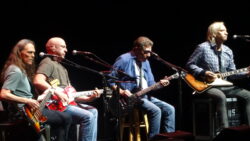
BL: We joked it was only 38 years, but it was 40 by the time we were playing. Well, what was different is they still were highly rehearsed. And at soundcheck, we would always rehearse three or four songs, and Glenn would always listen to a house tape from the previous night or the night before that. There were five people in the band singing plus five other vocalists that were in the second tier of the backing band. Ten people on stage singing, and we were a really tight band.
We would sit around in a circle and go over vocals. And if Glenn had heard something wrong, we would rehearse it. Sometimes we’d have to change our part. It didn’t matter what I sang in the ’70s, my part then would be whatever the group needed to fill in or strengthen. You had to be highly arranged. There was a click track that started each song. The count off was in your ear monitor. There was a great sound system, great crew, I mean, the best of everything as far as infrastructure was concerned. It was at the highest level of touring, a hundred people traveled plus the band on an airplane, 17 semis and 10 tour buses. It was quite the thing.
AUK: I’m guessing your tour will not be exactly like that.
BL: No, only 16 semis.
AUK: You wrote ‘My Man’ as a tribute to Gram Parsons. Complicated person, I’m supposing. What can you tell me about him from your time with the Burritos?
BL: Okay, I’ll tell you what really stimulated the song. So, we went over to England to start the third Eagles album in ‘73, I guess. Gram had been out of the Burrito Brothers for a couple years already. He’d been over to the South of France hanging out with the Stones and teaching Keith Richard about country music. Anyway, he was back and he had done two solo albums, and I played on songs on each of those albums. I was doing overdubs with him down at Capitol Records in LA right before we flew to England to start the third Eagles album. It was evening after dark at the Capitol studio in the back in the parking lot. And I said, “Okay, see you, man. See you soon.” And by the time I flew to London, got over my jet lag and resurfaced, and this is pre-internet, he’d already passed away. And that hit me hard because I’d just been working with him.
We were over there for a number of weeks and didn’t have a lot of material, so we were all trying to write. I started writing ‘My Man,’ and it didn’t get finished until we started recording in LA with another producer, but it was written because of the immediacy of his passing and the impact on me. That’s the how or the why of the song.
When I joined the Burrito Brothers, Gram was a really upbeat, fun guy, a very charismatic person. If he walked in, he always wore something dramatic. I mean, after the nudie suit thing on stage, he took his cues from what the Stones were doing at the time with their clothing, which was to wear some colorful scarf, maybe a woman’s scarf, but colorful. He was always a colorful guy and dressed interestingly, and he could stop conversation in a room. He had that kind of charisma. He also was a prolific songwriter. He was always writing, but his writing slowed down, so the “Burrito Deluxe” record was a little short on songs. And that was because he’d been partying with the Stones a lot and kind of lost interest in the Burritos by the time I was in it. But he was a lot of fun; he would do crazy things. He would hold his mic like Elvis Presley used to do. We would start a song in one key, upbeat, and Gram would come in singing a ballad in a different key. The band would crash to a stop until we figured out what he was doing, and then we would just fall in. He used heavy gauge strings, and he would play til he broke about three strings. And then he would take the guitar up at the front mic by the neck and throw it over his head. I’d watch it go spinning up over the drummer and crash in the back of the stage. That was an old Gibson Epiphone. It was such a stout guitar that it never broke anything off of it. It was pretty funny. He was comical, but ultimately tragicomical.
AUK: Did you have something to do with bringing Don Felder into the Eagles?
BL: Felder was in my high school college band, and in that band I played mostly rhythm guitar while Felder played most of the lead. By the time of the Eagles, we’d already started the third album without him. We made the change to the new producer, Bill Szymczyk. They had met Felder backstage at a show in Boston, and they made it clear that they wanted him in the band. Felder had moved out to LA., and I introduced him to all the people at David Geffen’s management company. Felder got a gig playing for a solo artist, David Blue, who was on the Asylum roster. The band got to hang out with him more.
He had a very young family. I’d known his wife back in Florida. But it did change the dynamic in the band, and that has more to do with the fact that it was five-piece now instead of four-piece. With a four-piece band, there’s air still in the arrangement. There are holes, and I liked that actually. We had the vocals handled, so Felder didn’t have much to do except offer more guitar licks. He did start writing and famously wrote the music for ‘Hotel California’ among others. But the whole thing had changed. Me leaving had less to do with the things we just talked about than the fact that I’d been on the road for two years with the Burrito Brothers full-time, and then four years of it with the Eagles.
The Eagles blew so fast that everything and everyone in the world showed up by the second year. There were drug dealers around that had nothing to do with the band. It’s just that we were a magnet for whatever, and it got to be too much. We’d be out for a month, and then I’d think we’re going home in 10 days or a week, and they’d hand you another sheet of paper with thirty more dates on it. And to me, that’s a bit strong. I was arguing with the band, “Look, I’m fried,” I said, and I think that we would all benefit from time out. Let’s take six months off, get really healthy, write songs, get back together and we’ll kick ass. They didn’t want to do that. They didn’t want to hear it. So, turned out then I left, and after bringing in Joe Walsh, they took six months off anyway, but they didn’t want to while I was there. Walsh is a good fit for them, and we’re friends. So, it’s all good.
AUK: When was the last time you played ‘Early Bird?’ I saw you play it once with the band. There was a very long instrumental passage.
BL: Well, so the interesting thing about the Eagles instrumentation was on ‘Early Bird,’ Glen Frey played slide guitar. Electric guitar was kind of a first for banjo players, really. That was cool. Later, there was the ‘Journey of the Sorcerer’ instrumental, which is banjo and orchestra. Pretty much nobody else will ever be able to afford to do that again, maybe Mark O’Connor or Bela Fleck. The only reason you could afford it was because if you were putting strings on the album, and you get to that sweetening part of the project, the mixing, you had to pay the union a minimum of three hours for the string section. And they often could get the first thing you wanted done in an hour. The producer realized we would have extra time with the strings, and so why not put strings on this instrumental? It was a cool thing. And then completely by accident, it became the theme song for “Hitchhikers Guide to the Galaxy.”

AUK: Is there another record in you, hopefully before another twenty years goes by?
BL: Yeah, I built this expensive studio around all my vintage recording gear. I have a full-time tech, and he assured me last week, it’s ready to go now, boss. I wrote a song this morning, actually.

