
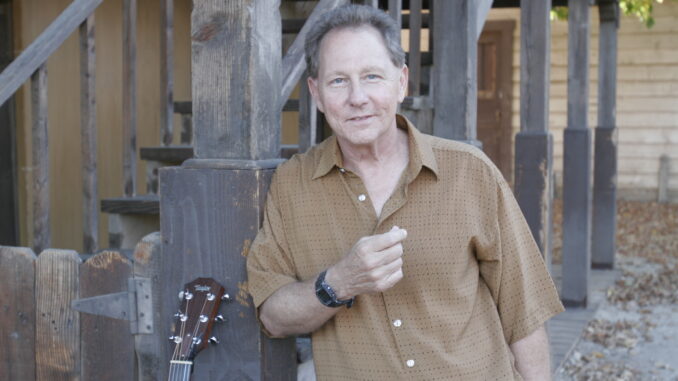
Folk icon talks life, hope, and his 2026 record.
Bob Lind recently released his fourth studio album of new material in the past fourteen years, “It Oughta Be Easy,” a characteristically literate, introspective, and often humorous collection. Four albums in 14 years: it’s not a bad clip for a songwriter who took 41 years off. In Lind’s 1966 song ‘Drifter’s Sunrise,’ he wrote that though “the echoes in your mind are fading slowly into time/you can’t look back and still face your tomorrow,” and today, Lind is resolutely facing the future with renewed vigor and even optimism.
Lind remains best known for ‘Elusive Butterfly,’ a song that launched Lind into international folk rock prominence, charting at #5 on both the UK and U.S. charts. The song began life as a B-Side to ‘Cheryl’s Goin’ Home,’ which achieved little airplay, but when the Miami radio station WQAM flipped the disc, ‘Elusive Butterfly’ took off, enough for Liberty Records to re-release it in 1966 as a single in its own right. The song was recorded in 1965, in sessions produced and arranged by the legendary Jack Nitzsche, who was Phil Spector’s arranger, conductor, and right-hand-man, and who is credited with co-creating the “Wall of Sound.” Lind has said that he knew little about recording, and that working with Nitzsche was “perfect.” Nitzsche’s signature style suited Lind’s songs, fleshing them out with orchestration, as Nitzsche wrote arrangements to accompany Lind’s spare acoustic folk tunes.
Though ‘Elusive Butterfly’ brought Lind chart success, he’s just as well known for walking away from the music business. His initial recording career was fruitful, but brief and turbulent. Lind released two Nitzsche-produced albums in 1966 for World Pacific Records, “Don’t Be Concerned” and “Photographs of Feeling” (he prefers to forget a third album, the Verve Folkways/MGM Records release “The Elusive Bob Lind,” essentially a collection of demos that was more a case of label interference than an artistic statement of his own). He then moved to Capitol records in 1971, releasing the underrated “Since There Were Circles,” which expanded Lind’s sound into country-rock, and featured some of his finest work. The album died on the vine, as Capitol didn’t know how to market it, and Lind, in frustration, hit the bricks. In a 2015 interview with Goldmine, Lind explained why he walked away from recording new music for 41 years. “The bottom line is, I have to be listened to; I have to be heard,” he said, “And the execs who were in charge of my career back in the ’60s wouldn’t listen to me. So I said, “F**k it.”
The short version of the years that followed involve Lind getting sober, moving to Florida, and becoming an award-winning playwright, screenwriter, and novelist. He inspired his buddy Charles Bukowski’s character Dinky Summers, had a hand in creating “Bat Boy” at the Weekly World News, and along the way saw his songs covered by more than 200 artists, including Cher, Dolly Parton, and Aretha Franklin. Pulp name-checked him on their 2001 record “We Love Life.” In thhis oft-told tale of exile and triumphant return to the music business, Lind’s pal Arlo Guthrie asked Lind to play at his Guthrie Center in 2004. Then, in 2006, “Since There Were Circles” was re-released to the warm critical reception it deserved, and Lind self-released a live album featuring new songs, “Live at the Luna Star Cafe.” With veteran producer and new collaborator Jamie Hoover (of North Carolina’s Spongetones) on board, Lind’s album “Finding You Again” was released in 2012, and the renaissance man was back.
It’s easy to frame Lind’s career as a comeback story, but in many ways, Lind never left. He simply applied his artistic instincts to different projects, and eventually the world caught up with him. In 1966, Lind gave us some prescient lyrics in ‘Truly Julie’s Blues:’ “When at last your bitter problems all ignore you/and you’ve come out clean and everything is done/and you realize I’ve been through it all before you/Come down and walk beside me in the sun.” AUK writer A. Francis Tritico tried to follow just that imperative and join Lind along his journey via email. One gets the sense that there’s a lot of road left, but that we might all do well to tune in to some of Lind’s hard-earned wisdom in this moment and “walk beside him in the sun.”
On Longing – The theme of longing recurs throughout this set of songs.
Q: What does longing mean to you now, and why do you continue to examine longing in
your songs?
I’d have to ask a shrink about that. I only know that it’s been with me all my life. I seem to
have been born with this idea that every moment of every day should be joyful and trouble-free –
– that life should be one long and constant orgasm. Just about every alcoholic/addict I know
suffers from the same sad and immature demand. The cliche is that an artist should write about
what he knows. So I guess that’s what I’m doing. As far as “It Oughta Be Easy” is concerned, the
theme is most clear, I think, in the song, ‘Easy to Be Happy’ (which contains the phrase that
gives the album its title). The song’s narrator is a fictional character whose exterior life is far
different than my own, but who suffers from the same childish desire. He’s a successful man who
has a life most people give anything to have (Love. Productive Work. All the gadgets that TV
advertising tells us make life worthwhile…). And yet none of it fills the deep need for constant
euphoria that he senses should be present within him.
On Truth – in the liner notes for your debut album, Jack Nitzche wrote “there isn’t one lie in the
contents of his poetry,” and here, on the latest record, you open with a struggle with honesty. In
‘I’m Wearing You,’ the character says “you’re the most revealing lie I ever wore,” and later,
“You’re the most revealing truth I ever wore.”
Q: What is Truth, and how does one live truthfully?
I think we just have to do the best we can. I’m certainly no authority on self-honesty, despite
Jack’s kind sentiments about me. I carry lies and secrets just as most everyone does. But in my
work, my need to communicate the truth of my life is stronger than my wish to keep my dignity
and hide my heart. ‘Wearing You’ is fiction, but the feelings are, I believe, experienced by a lot
of married men: that volatile mixture of fiery passion and relentless guilt.
On Love – ‘Sophia’s Lullaby’ is achingly beautiful, averring that “not many trust those sunny
proverbs anymore/but sometimes love still finds a way.” The second verse reads “Out there the
wounded world is struggling/we turn our backs and let it die/but you will sleep tonight protected
and secure/’cause someone cared enough to try.”
Q: In this couplet, love affects both the world and the individual. How can we, in small
gestures, show others that we care, that they are valued, and how can that small act of love
change the world?
It would be presumptuous of me to even try to answer this. I’m one of the most ego-centered
creatures on this planet. I can only tell you that I know graciousness and courageous giving when I see it in others. Several years ago, a friend of mine and his wife made the selfless decision to
adopt a Chinese baby girl. At that time China had a law in place that stated that each married
couple was only allowed to have one child. Men wanted a male heir to carry on the family name.
As a result, many baby girls were abandoned and left to die, or shunted off into those horrible
orphanages to languish under inhumane conditions. So, at considerable sacrifice (tedious red
tape, the expense of flying to Asia…), my friend saved a life. The thought of it still touches me.
The song is dedicated to that little girl (who is now a healthy robust post-teen American) and
other fortunate baby girls adopted by American parents.
On Lust – There’s no talking about this record without mentioning the ribald and rollicking
‘When Love is New.’ Contrast that song with the refrain of ‘Nature’s Sweetest Lie,’ which is
“This fire will never die/that’s nature’s sweetest lie.”
Q: Is ‘When Love is New’ only about that first spark of chemical attraction, or is it a
requiem for lust and longing? At what age does lust stop motivating men?
You’ll have to ask someone else about that. I’m only 83.
On Coping – In ‘Feel My Heart (That Other World),’ the narrator exhorts his lover to “turn away
from madness/take my hand/we can fly over dying things.” Later, there is a dire prediction for the
madness of the world: “That other world won’t last/can there be any doubt/anger may burn it
down/indifference may freeze it out/the other world is just a dark and fading lie.” He finds
protection, security, and home in love.
Q: How do we activate love? How can love save us?
I believe every open-eyed thinking person on earth realizes the world is in serious trouble. I
believe we should all stay informed. But I know people who live in the news. They wake up in
the morning and turn on CNN or MS NOW and soak in the horrors afoot in politics and the
environment. Then they go online and commiserate with others about the gloomy future, with no
hope in sight. By noon they’re angry and depressed and they can find no joy the whole day. I feel
that if we have someone to love, and someone who loves us, we don’t have to live in
hopelessness and anger. It’s not so much that love can change the world at large. Maybe it can;
maybe not. But it seems to me that it can keep misery and insanity at bay when I keep it in my
consciousness. Love is where I choose to live. That’s what I’m getting at with ‘Feel My Heart.’
On Living – in ‘Happy (Mantra),’ you close the album with “my ships have landed on a warm
and sunny horizon/I think I stand on the spectacular horizon/of happy…”
Q: It’s elusive, being content. Any words of wisdom?
‘Happy (Mantra)’ is just an affirmation I sing/say to make myself feel better. Sometimes it
works, sometimes it doesn’t.
On Touring – Your play “Broken Strings,” part of the THE ROAD PLAYS trilogy,
opened in Hamburg in June, 2025, as part of the Festival of European Anglophone Societies, winning Best Original Script. At the time, you said that some “mad souls…forsake the warmth
of the home fires and the nearness of the ones they love, driven to bring what they have to
strangers who wait for them in faraway corners of the globe.”
Q: How has the life of a troubadour affected your perspective on the world?
I know and understand the good and bad side of touring. I’ve been doing it all my life.
“Broken Strings” is part of a trilogy called THE ROAD PLAYS — three short plays meant to
run as a single evening. Each of the plays examines a separate aspect of being on the road.
“Broken String” is about an aging blues singer who is coming to the end of her career, not
because she’s lost her talent or her ability to entertain, but because the music industry has passed
her by and no longer holds a place for her. Esteemed director Charles C. Urban, based in
Stuttgart, Germany, is a long time fan of my music. When he heard about THE ROAD PLAYS,
he asked to see the script. It resonated with him and he presented it at his venue, The New
English American Theatre. The production was well received and he submitted “Broken Strings”
for acceptance in F.E.A.T.S. — the largest most prestigious English-language play festival in
Europe. I was bowled over when it won the Best Original Script Award.
On Home – Florida is a strange and mystical place in the modern imagination, producing writers
like Carl Hiassen (with whom you share an acerbic sense of humor).
Q: Why did you choose to live in Florida, and what does Florida mean to you?
Politics aside, I love Florida. Not everyone in this sunny, temperate state wears a MAGA hat.
Some of us are here because we enjoy the ocean and the Everglades.
How I got here is a long, convoluted story. But I’m glad I got here.
On Influence – Richard Hawley, who recently issued the 20th anniversary version of his ‘Coles
Corner’ record and played a triumphant hometown show at Sheffeld City Hall on 26 December,
2025, said that you are one of his all-time favorite songwriters, “with a sharp eye for observations.”
Q: Hawley and Jarvis Cocker admire your songwriting. Why do you think your songs are
so revered by writers of their generation, specifically writers from the UK?
I have no idea why some people feel my music and others are indifferent to it. I just write what I
feel. I put my music out into the world and hope it touches sensitive people. It means the world
to me when artists I respect like Richard and Jarvis respond with passion and respect to what I
write and sing.
The two of them have been immensely supportive to me, bringing my songs to the attention of
British music fans who might not know anything about me if not for the inspiring things they’ve
said about me in the press.
On Process – Since your 2012 record ‘Finding You Again,’ this is your fourth collaboration
with Jamie Hoover.
Q: What does that creative partnership look like?
Before I found Jamie, I used to hate recording. I don’t have the ears for it, or the patience. And
with the exception of Jack, I was always guarded and defensive with producers who tried to help
me. Because of my grasping possessiveness about my songs, I was antagonistic and combative
with producers. I always feared they were trying to take over and control my music. Working
with Jamie was and is a completely different thing. For one thing, he’s a dyed-in-the-wool Lind
fan who has proven time and time again that he respects my work and only wants to help me
express it in my recordings. For another thing, he’s immensely talented. He DOES have the ears
and the patience and there’s no instrument he doesn’t play well. His work on all four of these
collaborations — particularly this one — has been top-notch. He has never tried to assert his ego
in our sessions and I always have the last word. But his ideas are dazzlingly imaginative. They
enhance the music and make it work. I should also add that in addition to my good fortune in
working with Jamie, I’m doubly lucky in getting to work with George Wurzbach, whose stunning
piano work on this album is downright mind blowing.
Finally, if you will indulge, Questions about “Bat Boy:”
-When Weekly World News editor Dick Kulpa approached you about doing a story on the
enigmatic Bat Boy, what was your initial reaction?
-How did Bat Boy develop?
-Did you expect Bat Boy to have such a lasting cultural impact?
The press keeps getting all that wrong. I see myself being credited with inventing Bat Boy.
That’s simply not true. When Weekly World News was at its best, all of us — the layout people,
writers and editors — all worked together as a team. We ‘bounced” ideas off each other. And
when a concept got solidified, Eddie Clontz. the editor-in-chief, would assign it to a writer. In the
case of Bat Boy, Dick Kulpa, our brilliant layout artist, was trying to design a space alien for
another story. The managing editor, Sal Ivone looked at Dick’s drawing and said, “This little guy
looks like a kid with a bat’s face.” And the two of them, Sal and Dick, came up with the idea of a
cross between a human toddler and a bat who lived in a cave and was always up to some kind of
mischief. There was a whole series that grew out of the idea. I think at one time or another, all of
us writers wrote at least one story about his many arrests by — and escapes from — the FBI.
Nobody expected it to have any cultural significance.

