
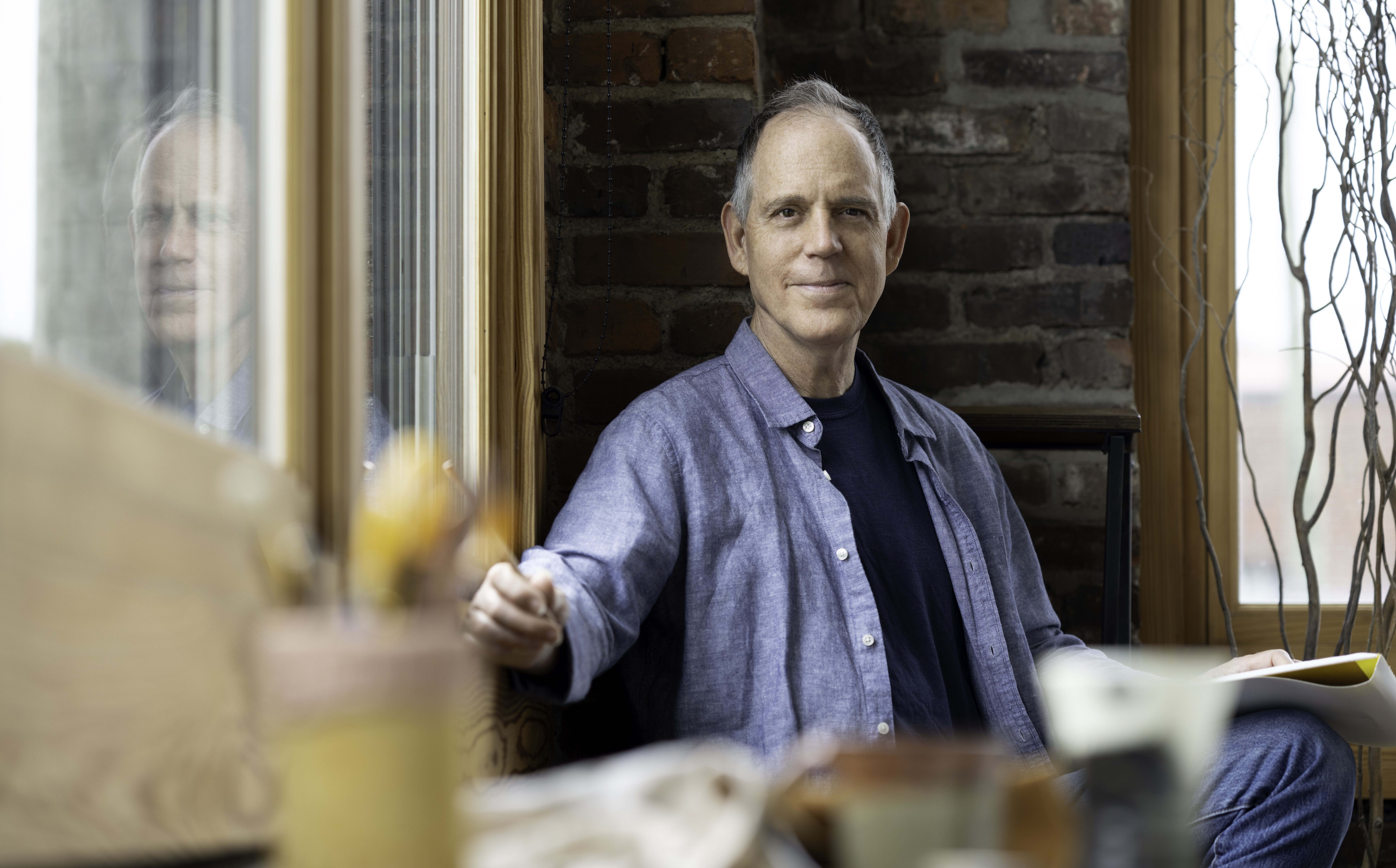
David Wilcox makes records that are masterful in the way they prompt people to feel things deeply and heal themselves. To put it another way, his songs act as chicken soup for the soul. His music invokes the tantalising concept of getting “out beyond ideas” to a place we can all meet, so beyond ideas and language that even the phrase “each other” doesn’t make any sense. His voice is sadder, deeper, fuller, more knowing as life goes by with all its happiness and sadness.
Wilcox planted the seed from which whole songs would be sprouting in a few short years while attending college in North Carolina. This stellar songwriter’s new songs contain an edgy power, lyrical depth, and aural displays that may have indeed leaned towards attention and approval the way a potted geranium will lean toward the sun. He gets beguiling sounds using open tunings, a melodic, creamy-rich sound with only six strings and one voice. examines storms and stars with incredible intensity and sees relations ordinary folk miss, sculpting these into emotional tour-de-force numbers which explore life. In Perfect Storm, he leaves a cave’s safety and walks outside to feel the frightening lightning – an unexpected but powerful metaphor which captures the jolting thrill of life. Several songs explore the breakdown of politics and needless religious conflict.
The Way I Tell the Story (Freshly Baked Records, August 2025) is his latest album, and it is a masterclass in feeling things deeply, quietly devastating, filled with cleanly delivered lines that land exactly where you live. There is a promise of rewards outside of the normal range of expectations. His choices of metaphors and adjectives can floor you with admiration. The record isn’t trying to be zeitgeisty. It’s not chasing virality. Instead, it trusts that what’s personal is also what’s lasting. That honesty matters. That craft still counts. And that if you tell a story the right way, it can change the way people hear their own.
He grew up in Mentor, Ohio, but now lives in Asheville, NC, where the air is as clean as freshly laundered bed linens. “I’m all in for using music as a way to gain clarity and emotional maturity,” Wilcox said during an interview with a smile as wide as the nearby French Broad River. “I believe that doing the work of exploring your heart, really going into the dark parts where the light hasn’t reached, creates emotional fitness that gives us access to strength of character.” As listeners can tell, there are few layers to his musical onion. His songs come to you like a paper aeroplane coasting on a whisper before landing gently for us to savour.
Americana UK: It wasn’t until you were in school that you learned to play guitar. Isn’t that unusual for a musician not to pick up an instrument earlier in life?
David Wilcox: I knew that I loved that sound, but it hadn’t really registered as something that was accessible. I guess early on, I pictured that music was something to be left to the professionals. I just had this strange revelation that music was something I could use for my own internal communication, opening that channel between heart and mind, and that’s what changed everything. I had always loved music as a passive listener, but I claimed it as a way to know my own heart.
AUK: Growing up in Ohio, who did you listen to?
DW: Very early on, I was listening to CKLW, which was all Motown, and it was lovely. That was second grade on until about maybe 15 or so. Then it was Steely Dan, Joni Mitchell, John Martyn and Nick Drake. There were certain songs that just gave me this window of possibility of how my heart could feel, and that was my main use for music. It was just a way to navigate life, a way to set my sights for how I wanted life to feel.
AUK: What drew you to college in North Carolina from Ohio?
DW: A friend and I were riding the length of the Blue Ridge Parkway on bicycles, and we were traveling without any instruments. So we wanted to find where the musicians were and asked another traveler on the parkway. He said there was this little hippie school in Asheville. Get off at exit 70, go East, you’ll see the signs. We did, and both of us wound up going to that school.
AUK: Around that time, you played a regular set at McDibbs, which is described as a non-smoking bar.
DW: The owner was a real visionary by making a place that was good for the whole community. The music he booked there went according to the direction he wanted the town to go. It was very different. Most people just want to sell beer. I had a good long run there. Ten years and it seemed like forever.
AUK: You are still running a music camp in the Asheville area. How long has that been going on?
DW: There have been 17 camps. They are not all about learning to play music or play it better. There are conversations about how to stay inspired, and a lot of different creative people come. Yes, there are gatherings in the evening where people will share a poem or a song, but it’s not the focus of it.
AUK: Were there any guitarists who particularly inspired you while developing your style?
DW: Not that I can emulate their style, but I spent a lot of time trying to play like some beautiful guitar players: Pierre Bensusan and Tony Rice. I spent a lot of time transcribing Tony Rice solos, and I can play ’em note-for-note but not at speed. Note for note slowly.
AUK: You are mostly a solo performer, rarely with a band. Is that because of the financial aspect?
DW: A band is more fun. Solo is better for the audience, for my music. There’s something about the intimacy of the lyrics that my people just like it simple.
AUK: Your early songs never come across as dated.
DW: Even that first Night Shift Watchman record, it’s fun to come back to those songs. I love how the songs seem to evolve their meaning as I grow, and I can hear ways of finding the heart of the song now that I couldn’t imagine before. It feels like the song was a beacon I was navigating toward, and it keeps drawing me toward it. I’m smiling because it feels I’m so lucky that music could give me a taste of the way life could feel and then make me hunger for that not in song, but in the rest of my life. And that’s why I have such a deep love of this humbling craft, because it really makes life worth living for me.
AUK: It’s interesting how you once traversed the country in an Airstream motor home with your wife, which became the title of an album. There was a song about coming out of a cave and seeing the lightning called “Perfect Storm.” Could you tell me a little bit about that song?
DW: It has a whole lot of electricity metaphors, and I love the craft in that song. But most of all, what I love is that it still challenges me to look at adventure and even uncomfortableness or a little bit of fear. The image that I use about that is there’s an experience that started the song, which was walking back to the campsite in the dark in the rain; lightning struck close and the bright flash illuminated like daylight, but blue. Closing my eyes and focusing on the image, I could see the way a path went through the woods.
You get a lot of scornful looks when you play a song called Perfect Storm after the hurricane here. But what I’m talking about is the ways that living a life in the midst of really difficult times is, in some ways more satisfying because it’s a stark contrast, and it’s more of a real aikido move emotionally to not just react, but have a little emotional alchemy to be able to realise that yes, I can live a life of dignity and work for change. I want to trust that it makes for a great story, a great life, no matter if the world changes or not. So, that’s why I called it Perfect Storm, but all the metaphors in there, the words that refer to electricity, also refer to emotion. I feel the voltage of that yearning for the circuit to complete. I feel no resistance to the current that will strike. Now, this is about a dangerous epiphany that says to me, I can live a life that feels juicy, deep and high.
The chorus keeps coming back to life has changed, and change looks frightening. Watch that wind! Lightning can be spelled another way, as in less heavy. By the time you get to the bridge, it washes me down to my soul when a storm of these tears pours, but it carries me into the flow. I’m saying that life would not be the adventure if it was somehow safe and boring and easy. This is all about why I chose a humbling craft, an impossible goal, and I can’t spend my whole life hiding where no soul could ever thrive. I can’t live with just surviving. My heart wants to feel alive.
AUK: Out Beyond Ideas is interesting in that it has a lot of religious or mystical texts. What did you want to portray by the title?
DW: The event that stirred me was 9/11, getting all these different voices in the same conversation. It comes from that Rumi poem, the actual experience of feeling that your life is bigger than your own skin and your own personality, feeling that life has a playful, adventurous interaction with things that are bigger than we can name. Having that experience rather than just an obedience to some dogma, to me, is all in that poem. Instead of the Santa line, “you better watch out, you better not cry.” Instead of having just the rules, you have the experience of wonder and bliss and a sense of being part of a much more interesting adventure. There is the openness of the field out beyond ideas of wrongdoing and right-doing. Instead, there’s a field, I’ll meet you there. I think it’s the invocation and the invitation of this bigger, wonderful, confounding, scary, blissful life.
AUK: That seems to relate to My Own Mind from the latest album, The Way I Tell the Story. There is some electricity in that song.
DW: In this song, there’s a storm coming, which portends scary stuff happening right now all over. This song is a challenge to me, saying if I’m just afraid all the time, is that doing anybody any good? And what if my fear is just going on and on like some annoying car alarm down in the street that I should know how to shut off, especially because it’s mine, not the car, but the fear. Do you see what I’m saying? The fear is mine to hack, and I use the word “hack” because it feels transgressive to come to a fear, which is sending these neurochemicals through my bloodstream and making me react as if there’s actually a sabre-tooth tiger about to bite my head off.
Yet, wait a second. I have choices in this. So what if your keys are locked in the car, and you’re trying to jimmy the window to get in, and the car alarm goes off? Well, it’s no crime to break into your own car. That’s the piece that I was trying to compare to. The fear seems so real, like the same kind of alarm, and yet there is a way to say, okay, I hear you, and I’m not going to be terrified because it’s not doing me any good. So, this lovely comparison, starting with that silly little metaphor of the car alarm, just helps me remember that when it feels so real, I still have a choice to scooch it aside for a second and realise this is not the world. This is my emotional reaction, and it’s in my own mind. I have control. And that emotional autonomy has been a great adventure. It’s made life so interesting because it’s kind of meta in a way. It’s kind of realising that instead of thinking of changing the world as something that requires wars and politics, oh no, if I change myself, I’ve changed the world, my experience of it, and I’m much more effective to actually bring on the changes I want to see.
AUK: That’s the way to tell the story, in effect, your story. Doesn’t the whole album have similar songs to tell your story?
DW: In The Beautiful, I use the art museum as a metaphor, but really, the song was about a guitar. And if there is a place where my heart feels right, that’s like the way a little boat can hold back the whole ocean. It will keep you afloat. You don’t have to drown in the ocean. That’s not going to work, but you can rise above it. And I love that image of the boundaries of what keeps us afloat, like the frame around the painting in that song. It felt like there is a way that my simple practice of steadily every day coming to the studio, coming to the quiet room, pretending I’m writing a song, but really, I’m just asking my heart what’s up? See if there’s anything I need to know before it gets to the level of chaos. It’s a simple practice that, and there are some songs on this record which don’t do that. The song, The Next Right Thing is just about the reaction, the sorrow, the grieving of seeing my partner go through this debilitating neurological decline. Other songs bring the medicine for that, take it apart and learn how to heal.
AUK: Do all your songs come from an internal or external inspiration rather than a melody or chord riff?
DW: There are a lot that start with noticing a particular juicy metaphor and seeing a way to tell the story to set up that little parable. There are some that start story first, and some just with a phrase, some with a beautiful guitar thing that just captures my attention. Whatever it is, it contains an emotional signature. For example, I may have a beautiful guitar thing that stirs my heart. And what I do is I imagine: what if that were the soundtrack of a scene in a movie? What’s the scene? It’s the subtle discernment of sorting those possibilities. That has been the best thing about being a songwriter, because obviously I’m not after songs. I’m after a life that sings.
AUK: You talk about finding a scenario, a memory. What is it that brings back memories? For example, my memories are often brought from odours, what something used to smell like, homemade bread by my grandmother or the smells at the stock car racetrack.
DW: That’s wild. I remember the smell of grandma’s cooking, and that’s a powerful memory. It makes me wonder about animals like bears and dogs whose sense of smell is thousands of times more intense than ours. We are on our second dog, and her name is Bhutan because Bhutan is a country that has a Department of Happiness, and she’s the happiest creature in the world.
AUK: What do you imagine is the mandate for a Department of Happiness?
DW: I think about the goal behind the goal. For example, when you go to a hardware store to buy a drill, it’s not a drill that you want. It’s a hole, and when you think about policy, when you think about how we come together as communities, when you think about the function of government, wouldn’t it be happiness? This is why I love writing custom songs, actually, because people come to me knowing that there’s something in their life that they want clarity on, or there’s something in their life that they want a sort of accountability. They want a song that will take them back to this conviction that they have about what their life is going to be about. The song basically writes itself.
AUK: The song about the aeroplane going into the haystack is so vivid.
DW: The way I tell the story and the playfulness of that is really fun. Taking childhood trauma and visualising it as if it’s a small plane crash, and you crawl out of the wreckage, you’re okay. And then you realise you’re the only one who made it out alive. That has some advantages because if someone asks you what happened, you have a lot of leeway. I think the way we tell the story about events in our past, it doesn’t change the past, but it definitely changes the meaning of the past. And if it changes the meaning of the past, then it puts it in a context of a bigger story and not so much about where you’ve been, but about where you’re going. All of that stuff is in that song. I just love it.
AUK: People often ask what a song is about. For some of us, it can relate to a personal event or experience that could be completely different from the way you intended. That’s because your songs are so evocative, like Disappearing Man.
DW: It is a fascinating thing. Lately, there has been a lot of death around me. My brother just died two weeks ago, and I’m getting calls about what’s to be done with this and that, and I’m going to drive up there and go through his things. I’ve been asked to sing at various services, like my friend Trent just a month ago out in L.A., a beautiful service. Finding a way to talk about a life lived and what it meant to the people around it is a really fascinating way of drawing my attention to what matters. I love that it is one of our remaining rituals to honor a life like that and let it draw us into deeper conversations.
On the song, obviously the Irony Meter is in the red, and I’m stating the case that take a look how you’re wasting your life. But instead, I made it first person and talked about, sort of, the reasons why. Here’s someone who is disappearing into watching the ridiculous reels on Instagram, and I don’t know how to be inside my body and face the stuff I don’t want to feel. So, I hide like magic anytime it’s getting too real. Of course, I’m on the side of not disappearing, and yet I thought it was funny to write the song from the other point of view and take it like a cheesy magician, the hat trick with the rabbit that disappears. I’ll be gone like the rabbit when we talk like that, when you ask for more. Ask for More is the title of one of my songs, which is talking about wanting to make the conversation deeper and more memorable. This is a play on that and pushing the devil’s advocate side.

AUK: Why do you think We Call It Freedom has been misinterpreted?
DW: I guess people just didn’t listen. Or maybe they don’t have an irony detector. It’s pretty obvious. Imagine people like Randy Newman, who are always getting misinterpreted. I was at a Randy Newman concert years ago, and I heard three different songs happening at the same time, according to how people were able to hear or not hear his message. There was a group of guys in the back, kind of drunk, who were requesting the song Roll with the Punches, which is a white supremacy song. Great idea. They apparently heard the song and thought it was rooting for their team. And then there are other people in the room who are horrified, like, good God, Randy, that’s a white supremacy song. And there are other people in the room who are saying, have you listened to Randy before? This is what he does. He’s setting you up, and hopefully you’ll feel your own reaction and push back. Mine is a homoeopathic song. There are some people who will just hear the metaphor and argue, not argue the point I’m making, but argue the way I’m making it, and that’s a hopeless conversation.
AUK: That reminds me of a song on the Reverie album, Let the Wave Say.
DW: I played it for a big wave surfer, and it was such a satisfying thing because he leaned back and closed his eyes. It was a brand new song I had just written for him, and then he kind of opened one eye and said, dude, play it again. I guess the simplest way to describe it is, there are things we can change and things we can’t and the wisdom to know the difference. What’s portrayed as the wave, you can’t fight it, but you can ride it, and you can find a way to make it through that curl. One way to say it is: what is God making here, and how can I be a part of it instead of thinking I can change the universe? It’s full of mystery.

