
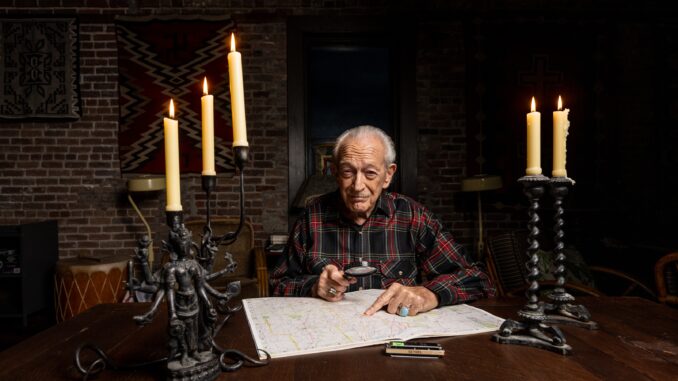
At age 82, Charlie Musselwhite continues to put out relevant and meaningful albums. Sweet. While his body of work may not conjure memories for some of our younger readers, it’s great to see him continuing his seven-decade career without missing a beat, literally.
The conversation with him was everything you would expect from a legend: the Chicago blues scene of the ’60s with Muddy Waters and John Lee Hooker; working at a record store; California flower power; murder in Oklahoma; Mike Bloomfield; Martin Scorsese; Elwood Blues; and a wedding with Hell’s Angels.
Musselwhite has done a lot since his youth in Kosciusko, Mississippi. And here’s the math. It goes back to when he rode the “Hillbilly Highway” to Chicago, where Big Walter Horton told him he should make an album, and Sam Charters signed him to Vanguard Records, leading to Stand Back! Here Comes Charley Musselwhite’s South Side Band released in 1966. He has since made 45 albums and appeared on many others with not only blues artists but also Bonnie Raitt, The Blind Boys of Alabama, Tom Waits and INXS. He toured with Hot Tuna and Cyndi Lauper. He has won 33 blues awards, been nominated for 13 Grammys, and won six, the Mississippi Governor’s Award for excellence in arts, a harmonica instructional book, appeared in three movies, and has been inducted into the Blues Hall of Fame.
Scorsese’s 2023 film Killers of the Flower Moon is about the murders of Osage Indian tribe members in Oklahoma and what happens when oil is found on their land. The director was intrigued when Musselwhite told him the story of his grandfather killing a man in Oklahoma. Musselwhite played Alvin Reynolds and outshone expectations, gaining several lines of script after the woman in charge of casting saw him in a video.
But it’s not the details you’ll want to read; it’s his stories about a life of hard-won joy. When he’s onstage, he only stops smiling to play the harmonica, and that’s only because you can’t see his mouth. He continues to flourish with his passion for the blues and his constantly on-the-road lifestyle. His latest, released in 2025 on Forty Below Records, is called Lookout Highway. About the album’s title and opening track, Musselwhite explains, “The beat came from an old Gospel tune, and I just had it rolling around in my head until I caught the scent and found the trail that led to the melody and lyrics.”
As he sings on Rambling Is My Game, I am a natural born rambler; my bags are always packed. He is singing about chasing the blues and rockabilly to Memphis. On the road to Tennessee, my baby took my car, and the blues took me.
While blissfully living my music life in the wayback machine, I had the good fortune to have an interesting and revealing conversation with the harmonica great, recorded from his Mississippi home.
Americana UK: Hello, Charlie. And where are you on this fine morning?
Charlie Musselwhite: I’m home in Clarksdale, Mississippi, looking out my window at Sunflower Avenue.
AUK: Is that where you were born and raised?
CM: I was born in Kosciusko, which is almost like dead center. If you drew a big X on the map of Mississippi, it’d be right there in the middle on the Natchez Trace.
AUK: I’m not sure of where that is exactly. I’ve been to Mississippi once, to the bar where R.L. Burnside played in Holly Springs.
CM: R.L. is gone, but his kinfolks are still carrying on. I just saw a lot of them last weekend at the North Mississippi Hill Country picnic.
AUK: What are your thoughts on the Hill Country way of playing the blues. Isn’t it quite different from traditional 12-bar?
CM: It’s all valid. It’s all about the feeling. I’m sure BB King could sing Mary Had a Little Lamb, and you’d swear it was blues because he put the feeling in it like a 1-4-5 chord change. I just think that’s a convenient way to express blues. But you could express blues in any chord change, like what the jazz players did. Most good jazz players start out playing blues, and then they take that grease and put it into everything.
AUK: Jimi Hendrix once said, “The blues is easy to play but hard to feel.”
CM: He had a point. I mean, a lot of people seem like they don’t ever get that point when you hear ’em playing. They’re okay; they’re playing all the notes in the scale, and they’re playing the 1-4-5 chord change, but where’s the feeling? If it is not there, I don’t call that blues. It’s like a counterfeit blues.
AUK: Your album Look Out Highway is like a travelogue of places you’ve been, not only touring but living.
CM: There’s a lot of miles I’ve been, so I sing and play about what I know and boy, I sure know the highway, and it knows me.
AUK: You got started in the sixties, which was a time when music began to get a little freer. People were collaborating from different styles. The point is, you got to play with musicians that weren’t necessarily blues players.
CM: When I was in Chicago, it was just all blues. And then, when I went out to California to play a few gigs, I saw that there was so much work all up and down the West Coast that really paid way better than Chicago, that I ended up staying. And the culture on the West Coast, with the hippies and the underground radio, they were open to everything. Say, at the Fillmore Auditorium, it wouldn’t be just a blues show. They might have BB King and Ravi Shankar, and Pete Seeger together. Those people would hear each other and play together. It was quite a scene.
AUK: How do you think the music of today differs, or does it? You’ve been out there for seven decades.
CM: No wonder I’m tired. Well, one thing that really drives me crazy is a lot of musicians seem to treat music like it’s a sport. How fast can you play? How many notes can you cram in? It is like they forgot about the music, and it just became all about technique with all kind of gizmos and pedals and this and that. And I hear these guys play, and they can play really fast, but it reminds me of somebody that has a huge vocabulary, but nothing to say.
AUK: Well, instruments are much easier to play now. My first guitar, you had to have a luthier adjust the action.
CM: But it would make you play better because you had to force the music out.
AUK: Obviously, the harmonica is different from a stringed instrument or almost any instrument.
CM: Well, it is the only instrument that you cannot see how it’s played. Every other instrument, the hands are somehow employed, but the harmonica is all covered up. You can’t watch somebody and see what they’re doing. It’s also the only instrument you breathe in and out of. You just blow into horns; you don’t draw on them. A piano has the same notes, the same pattern all the way up and down the keyboard. But on a harmonica, every octave the pattern is different. So that can be kind of confusing, but it’s a wonderful instrument. It has such a great tone. And of course I like it.

AUK: The accordion is the only other one that comes to mind where you draw in.
CM: I was with Flaco Jimenez one time, and he had all these, call ’em combs that go in his accordion, and each one is a different key, just like different harmonicas are in a different key. He handed it to me, and I could play it like it was a harmonica.
AUK: Going back to your first album, Stand Back. Do you remember what it was like making that record?
CM: I remember that Sam Charters, who produced it, was working for Vanguard, and whenever he came through Chicago would look me up. I knew where everybody was playing, and I could take him around to all these different clubs. At that time, Elektra Records came out with the Butterfield album, and Charters thought Vanguard ought to come out with a blues album. He asked me if I was interested in recording. I had already done that tune with Walter Horton on the Chicago: The Blues Today series. Anyway, I said sure, and we got in the studio and were told we had three hours to knock it out. We did. The reason they didn’t want to go over three hours is because they would have had to pay double-scale on account of union rules. Today, people spend three hours, sometimes 30 hours, on one tune, and still it’s wrong.
AUK: When did Charlie with an “ey” change to “ie?”
CM: It never did. That’s just what Vanguard put on the cover. I never spelled it that way. They didn’t ask me, and they didn’t care. I’ve been told that Charlie Patton didn’t spell his name with “ie” either. But as long as it starts with “C” and sounds like “E”, what do I care.
AUK: You’ve lent your playing to so many different artists. Are there any that you were surprised to be playing with?
CM: Cyndy Lauper was kind of a stretch because she’s a real rocker, and it was a surprise to me to find out that she was a huge blues fan. She had started out singing blues, but she got into rock, and then her managers told her, you can’t be doing blues. You’ll confuse your audience. You got to stick with rock. So, when she made that Memphis Blues album, it was at a point in her career where she decided she would do what she wanted to do, and everybody on it was from around Memphis or somehow connected to Memphis. It was a lot of fun, and it was great being on the road with her. We would do her hits and blues them up. In Girls Just Want to Have Fun, I had a harmonica solo. It was a lot of fun for me to adapt to her rock tunes. Same for the whole band. We were all basically blue skies out of the south.
AUK: After all the years, how do you manage to stay current and fresh?
CM: Sometimes people will mention some song that’s a big hit, and I’ve never heard that. I don’t even know what they’re talking about. I just listen to my records, but I have no idea what’s popular and trying to figure out what people want to hear. I just like to play what I believe in and follow my own path, and hope for the best. I know you can’t please everybody, so you might as well start with yourself and hope that there’ll be other people that like what you play.
AUK: At a gig, is there any particular song that people would be disappointed if you didn’t play it?
CM: Yeah, it’s Cristo Redentor. It was on my first album, and I’ve recorded it another four or five times since then. At one point, I thought people must really be getting tired of hearing this song. I would always close my show with it. So, I quit playing it, and then people got angry with me. They’d say, I waited all night to hear Cristo Redentor and whoa, I’m sorry. Now I play it every night.
AUK: Something that Leon Redbone once said: “You can’t play authentic blues unless you known sorrow and misery. But the blues ain’t nothing but a good man feeling bad.”
CM: I’ve heard this before, and I say if that’s true, I don’t want to get any better at it. I’ve had enough rough times. But I think there’s some truth to it that you have to be able to feel it. Maybe you don’t have to be hungry to understand what it might feel like to be hungry, but actually being hungry would help.
AUK: Muddy Waters once said, “The blues had a baby, and they named it rock ‘n’ roll.” Is there truth to that?
CM: That kind of wraps it up. A lot of music has blues in the base of it. You had rockabilly, which was like blues and hillbilly music combined, and then along came rock.
AUK: Do you ever get ideas for riffs and solos from guitar or horn players?
CM: I don’t really listen to other harmonica players to learn improvisation. I listen to, like you say, horn players or violin, any instrument that’s playing. I love melody, and if I hear a melody that appeals to me, I’ll try that out on harmonica and see how it comes across.
AUK: You’ve played with some of the old masters: Muddy Waters, BB, Albert Collins.
CM: All those guys, every one of them. I mean, when I was first in Chicago and hanging out in all the clubs, they thought I was just a fan. I wasn’t holding up my harmonica and asking to sit in, and I didn’t even tell anybody I played anything. But a waitress I had gotten to know real well told Muddy that you ought to hear Charlie play harmonica. And that just changed everything because Muddy insisted I sit in. A lot of musicians hung out at Pepper’s Lounge, which was Muddy’s home club when he wasn’t on the road, and he lived just around the corner. When they heard me playing with Muddy, they started offering me gigs, and boy, that got my attention. You’re going to pay me to play harmonica? Well, I had never really entertained any ideas of being on stage. I didn’t have any desire to be in the spotlight, but this was my ticket out of the factory. If I could make a living playing music, wow, this is pretty cool.
They were all real supportive and would push me to sing and play, make me sit in with them and really encouraged me. These were really rough places that I would go to see them play, but it didn’t bother me. I knew Little Walter did two tours with BB opening for him. Anytime Muddy saw me after that, he always had me sit in. I have a tape of a radio show we did. I don’t know where it is, but I’ve seen it around here. And Albert Collins was a good friend. John Lee Hooker was my best man when I got married to Henrietta.
AUK: Did you get married in Mississippi?
CM: No, I got married in a part of San Francisco called North Beach in a bar called Mooney’s Irish Pub. That bar was usually closed on Mondays, and they opened it up just for us to have a party and the ceremony right there on Grant Street in San Francisco. They had a band, and everybody was sitting there and playing. And the Hells Angels wanted me to go out and party with them. No, fellas, I think that’s a bad idea. It would have been a short marriage.
AUK: How did you meet John Lee Hooker?
CM: I met John in Chicago. He lived in Detroit at that time, but he would come to Chicago fairly regularly to play, and I’d always go see him if I possibly could. And the first time I met him, we became instant friends. It is like I’d known him forever, and we stayed close friends ever since then. When I moved out to the West Coast, I remember calling John and telling him, man, you better come on out here and check out what’s going on. I don’t know if that’s why he moved, but he shortly moved to Oakland.
AUK: What can you say about some of the rock musicians you met that also played blues?
CM: I knew Johnny Winter. I remember when I was in Chicago, there was a little folk club called, gosh, I forget the name of it right now. This was back during the folk era, but they would hire Big Joe Williams and Sleepy John Estes and Blind John Davis to play there. This is the kind of a place that didn’t even serve alcohol. Of course, in the back room, there was plenty of alcohol. Mike Bloomfield was booking the blues into this place. I would hang out there, and one night Johnny Winter wandered in. He was playing at a rock club somewhere on Rush Street, which was like a tourist area. When he came in, he had a big pompadour – he had hair back then – and was wearing a sport coat and tie, a way different look than he had later on. He sat in with us, and we had a great time, a lot of laughs playing the blues together. We were friends from then on. The last time I saw him was in Scandinavia somewhere. He would sit on a stool and only stand up once or twice. When I went to talk to him on the tour bus, you could tell he was frail.
AUK: You grew up near Memphis, so you must have heard some blues there.
CM: I got to know a lot of the old timers before the whole Chicago era, like Will Shade, who had the Memphis Jug Band back in the 1920s. There was Furry Lewis and Gus Cannon, and a guy named Willie Borum, Willie B, they called him. He played harmonica and guitar. These were the original guys, and the guys in Chicago learned from these guys. Walter Horton learned harmonica from Will Shade, and so did I.

AUK: That’s great, you met Michael Bloomfield. He was my favourite guitarist back in the day.
CM: We were real good friends. At one point, I was living in a part of Chicago called Old Town, and me and Big Joe Williams were rooming together. Mike lived about a block away at what was called the Carl Sandberg Apartments with his wife, Susie. Me and Big Joe lived behind a record store, and I would run the record store during the daytime when nobody ever came in hardly. Mike would come over, and we would sit around and listen to records all day. Down the street from there was a little bar called Big John’s. It was just a neighborhood bar. They didn’t have music, but they knew Big Joe lived down the street. It was the 4th of July; they asked Joe if he would come down and play because they wanted to have some music for the holiday.
Joe had me come play with him, and at the bar, after so many drinks, they said, why don’t you guys come back tomorrow and play again? So it just turned into a gig. We were playing there every night. Mike started hanging around, and there was a piano, so Mike asked Joe if he could sit in on piano. Big Joe was on this nine-string guitar, and I was playing harmonica. Then Joe had to leave town, and Mike got a drummer and a bass player, and we had a band and just kept the gig going. On nights we didn’t play, we told the people that booked the bar to get people like Muddy and Howlin’ Wolf and Little Walter to come play. Now blues was on the North side, so the North side people could go and hear it without having to go to the South side, which they were afraid to go to. Big John’s was doing such great business that other bars started hiring blues bands, too. The whole blues scene flipped over to the North side because the clubs there were bigger and could pay more money.
Back to Mike, he and I had this band, and he actually got us a recording deal with Columbia. John Hammond Sr. produced it in Chicago, and then we did more recording in New York City. Mike really couldn’t sing, so they never put it out at the time, but they put it out later. Mike wasn’t really cut out to be a band leader. He just wanted to play, didn’t want to have nothing to do with business. Things didn’t last too long. Paul (Butterfield) hired him, and I kept on playing with other guys like Johnny Young, Robert Nighthawk and JB Hutto.
AUK: Bloomfield went on to play with Al Kooper. Their Live Adventures Of and Super Session were two of the greatest albums of their time.
CM: Mike went with Kooper, so he didn’t have to think about business. He liked to have a good time and was one of the funniest people I’ve ever met. He’d have us laughing so hard we’d start crying.
AUK: So he was a storyteller?
CM: Oh yeah, and a huge liar. He would forget sometimes that I had told him a story, and he’d be trying to tell me the same story. I’d say, Mike, don’t you remember I told you that story? He’d just laugh. So, a lot of stuff he told never happened, but he brought it to life.
AUK: Do you pay attention to any of the younger blues players?
CM: I try to. I don’t know all the young players, but there’s a few that have really knocked me out and give me faith that the blues is in good hands. One guy is Young Rell Davenport. Rell is short for Harrell. He plays guitar, harmonica, and drums, and sings, and I don’t think he’s even 20 years old yet. Man, he’s got it. He really loves country blues. He gets it and understands the subtleties in it. He’s not what you’d call a guitar shredder, thank God.
And there’s other guys like Jontavious Willis and Mac McDonald. There’s a whole lot of young black guys that are playing the real deal blues. It is wonderful. I remember when I first got to Chicago, and I’m playing and still working in the factory, black guys my age, when they found out I played blues, they’d say like, what’s wrong with you? That’s old folks’ music. You got to get up with the times, man. You’re crazy. You got to forget about that blues crap. They hated blues because that was their parents’ music. Well, I like it. So it is refreshing for me today to see young blacks really into blues.
AUK: How did your part in the movie Killers of the Flower Moon come about?
CM: Of course, there’s a backstory to it. I don’t know if you know the book, but in the book, which this part is not in the movie, there’s a photo of a guy named Al Spencer, who robbed trains and banks. I have Al Spencer’s rifle, and it’s got notches in it from all the men he killed. It has his name carved in it and some of his gang members’ names, too. The reason I have it is because he died in a shootout with my grandfather, who was also named Charlie Musselwhite. He was living in Osage County, Oklahoma. I never found out why my grandfather left Mississippi and went to Oklahoma, and then had this shootout business and went straight back to Mississippi. But I told (Martin) Scorsese about it. He thought it was remarkable because he was filming everything where it all happened.
The reason I got this role was the casting lady is a roots music fan, and she had seen this video, which was celebrating the 60th anniversary of Arhoolie Records. This video had all the artists that recorded for Arhoolie playing a tune and talking, and she heard me talking and thought I’d be good for this part. They had one line for me to say, and well, my wife, who is also my manager, sent the casting lady a little clip from another movie I had been in. She saw that and then sent me a whole page, a dozen lines. It was during the pandemic, so we did a Zoom reading, and she said, you’re perfect. You got the part. I went up to Oklahoma, and we did it in one day with Jesse Plemons.
AUK: Back to the shootout. What happened and why?
CM: Well, my grandfather was the sheriff of Osage County, Oklahoma, and he knew where Al Spencer was going to shoot somebody. He knew that Al was going to be crossing this bridge and was there waiting for him. When he saw him, he said, hands up. Al didn’t put his hands up. He started shooting. And that was the end of Al.
That was maybe 1922 or ’23. My grandmother told me years later, after my grandfather had died, that he didn’t like the idea of having a bullseye on his back, so he would never take credit for anything. Also, a lot of the guys in his posse had families and didn’t have much money, so he’d let them get the reward. I think my grandfather had a used car business and was doing okay. Anyway, he thought it was time to go back to Mississippi so Al’s relatives weren’t gunning for him.
AUK: Blues and good food seem to go together. What do you like to eat?
CM: I love southern home cooking, and I can get plenty of that right around here. One of my favorite restaurants is called Rest Haven, and they have a different special for lunch every day. It could be, oh, black-eyed peas and cabbage, and cornbread with fried chicken and iced tea. That place has been there since the forties.
AUK: Let’s say someone listening to your new album didn’t know your music but liked it enough to check out more. What album would you send them to next?
CM: I suppose the last one, called Mississippi Sun would be a good place.
AUK: So, like fine wine, you’re getting better with age?
CM: Well, I’ve been practising, and I think it’s starting to pay off.
AUK: How do you think people who are into americana or folk rock would relate to your new record?
CM: I always hope people will relate to it on some level and find enjoyment in the music, the lyrics or the feeling of it, to the point where they want to hold onto the record and play it over and over. I would be delighted if that’s how people felt about it. It is my music, and I hope they like it because I’m playing it for them and for myself, too.

