
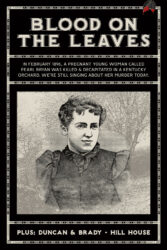
 A few years ago, at a local gig to see the Pennsylvania band The Stray Birds, the crowd was overall polite and receptive to the music; however, let us just say they needed to warm up. The band led by the wonderful Maya de Vitry launched into a version of Down In The Willow Garden. A traditional Appalachian murder ballad, also known as Rose Connelly. The crowd absolutely loved it, and band member Oliver Craven commented that at last they had found the audience’s level. Why are murder ballads so fascinating that onlookers will sit up and notice? Paul Slade has devoted much time and effort to answering this question. Blood On The Leaves is the third and final collection of his murder ballad essays. A volume that scrutinises four cases, the songs accompanying them and captures the moods and feelings of the people involved. Painstaking research has taken place, and Slade’s narrative puts you right in the middle of it all. You are able to draw your own conclusions, analyse the information and wonder at the forensic steps undertaken by detectives and prosecutors.
The idea behind a murder ballad was to spread the word of atrocities and to warn others so they did not fall into the same trap. As there wasn’t any widespread media at the time, certainly no social media, people found things out in a slow way, and with word of mouth, stories changed, were embellished, or important facts were forgotten. They tended to be written in a certain templated way. A country or naive girl taken in by the big city lights, or a charming man.
Over half the book is devoted to the brutal and intriguing case of Pearl Bryan. The story unfolds in Cincinnati, adjacent to the Ohio River. Slade describes how, in 1890, Cincinnati, originally a booming city, was now quickly being overtaken by larger metropolises such as Chicago. As the steamboat industry declined and railroads took over, Chicago became a central railway hub for the expansion of the United States. However, Cincinnati was a leader in beer production and increased production threefold. In 1890, it had 1,810 saloons for a population of 297,000. One for every 37 adult males.
It is not clear that alcohol was a factor in the Bryan murder; however, one element was clear once the military barracks moved from Newport and created Fort Thomas: industries moved with them. An area called the Midway opposite the Fort was created. A rowdy area, as one newspaper reported, “It was a fairly rough and wild area of town at night because of all the soldiers stationed at Fort Thomas“. Soldiers found bars, entertainment and working girls. They would use a local orchard owned by local farmer John Lock to entertain. This was where the headless body of the victim, Pearl Bryan, was found one misty morning, February 1st, 1896. Her head was removed in an attempt to disguise her identity. If the murder wasn’t shocking enough, Slade explains how the area wasn’t even cordoned off, as would happen nowadays. People were allowed to roam over the area, taking “souvenirs” and destroying vital clues. Slade’s re-telling of the case is riveting, from the identification of the body to the steps taken to secure a conviction. It reads like a novel and mines information from many sources. Slade’s forensic journalism, as it was in the previous two volumes in the series, is thorough. Slade ties up each section of the book with a list of ballads and where you can find them.
The next case covered involves the fatal shooting of a policeman in a St. Louis bar in October 1890. A brawl in the bar got out of hand, and the attending Officer Gaffney called for backup. The eventual victim answering the call was police officer James Brady. In the ensuing hail of gunfire and general melee, Brady was shot and would die from his injuries, leaving behind his wife and three small children. How, in all the furore, was there only one death is almost unbelievable and more like a Hollywood shootout. Slade again describes the incident in detail following the case. Local Harry Duncan was eventually accused of firing the deadly shot. The Murder ballads lamenting the Duncan and Brady case are many, and you will easily recognise some of the performers. As with the Bryan case, Slade describes the songs at the end of the chapter. As Slade writes regarding the Lead Belly version, “Harry Duncan, an accomplished bass singer in his own right, would have appreciated Lead Belly’s deep booming voice“. Bob Dylan recorded his version, which appeared on the Tell Tale Signs album in 2008. This version of the song is an out-and-out rock tune.
Monday, September 18th, 1893, in Glendale, Indiana, James “Bud” Stone carried out the most brutal of multiple murders all in one night. Slade’s description reads like a horror story, and indeed, that is exactly what it was, and all for the sake of money. Shirley Jackson adapted the story in the 1959 novel, The Haunting of Hill House. Jackson changed the murdered family name to Grattan rather than the actual Rhetton, but the poem used in the book clearly describes the Stone murders. Netflix also adapted the book with one of the characters’ ghosts reciting the ballad, making it all the more chilling. On the premise that he [Stone] was going into town to get a troublesome tooth fixed, he visited the Rhetton cabin and took the life of all within. There is a slight twist to that, but we don’t want to spoil the read.
If the Pearl Bryan case was tragic, the Duncan & Brady case was troubling, and Hill House was deplorable, the final one covered by the book is bizarre. This does not link to a murder ballad but to a piece of intricate folk art. Similar to a ship in a bottle, these bottle sculptures, known as whimsy bottles, depicted a full story in items and writings. Events happened in 1883, when a young Lawyer named Nicholas Dukes slept with a Uniontown girl called Lizzie Nutt. Dukes, for reasons Slade explains well, wrote a letter to Lizzie’s father, Captain Nutt, telling him of this fact and also that his daughter’s virtue may be suspect. This led to a confrontation, and Captain Nutt died. The story gets weirder from then on, with an acquittal and then a revenge killing. The case is a gripping read, and Slade’s delivery is informative and as gripping as any murder mystery.
What Slade does extremely well throughout the book is describe the court proceedings. It is fascinating to see how the justice system worked, or didn’t work, and how the defence and prosecution approached the case. Not having the forensic clout they have nowadays, relying on witnesses and sometimes just a hunch, the defence was up to the task of discrediting and redirecting. Slade has said this will be the final collection in this series. It is well worth searching out the original two Unprepared To Die and Gallows Ballads to complete the set. Blood On The Leaves allows no stone to go unturned or avenue unexplored across all four cases, challenging at times, still a wonderful read, and tracking down the songs is a bonus.


