
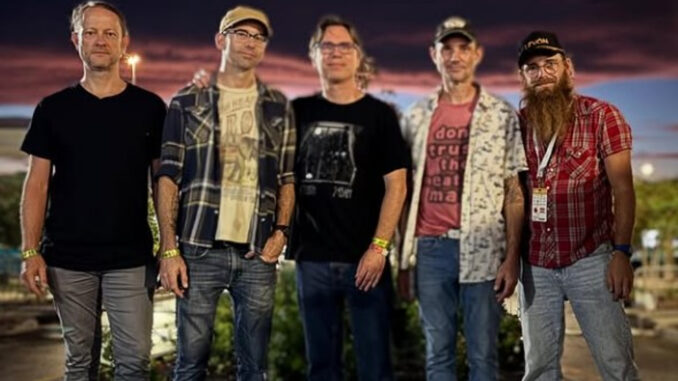
Have Gun, Will Travel is the name of the band with the emphasis on travel. Not so much touring all over the world, but exploration, whether in their three concept albums or the songs written for non-concept albums. Their latest is the Voyager Golden EP (Mile Wide Records 2025), a rock ‘n’ roll odyssey with a running theme that centres on NASA’s Voyager program and interstellar space exploration. Like its predecessor in the concept category, Science from an Easy Chair (Mile Wide Records 2015), it concerns travelling to unknown reaches, in this case the 1914 doomed expedition of British explorer Charles Shackleford to the Antarctic.
Concept albums have always been a staple of rock music, from Jethro Tull, Pink Floyd, The Who, and Genesis to modern bands like the Hold Steady and Mountain Goats to country as in Bobbie Gentry’s Delta Sweete. You could make the argument that HGWT’s Postcard from the Friendly City, which chronicles events in the mid-20th-century West Florida city of Bradenton, coincidentally where Matt Burke and his brother Danny grew up, falls into the concept category much like Car Wheels on a Gravel Road describes the events of Lucinda Williams’ early years in Louisiana.
In 1977, NASA (National Aeronautics and Space Administration) sent gold records into space aboard Voyager 1 and 2. The collection contained music as well as greetings, images, and sounds reflective of our planet. The music collected stretched from Bach to Chuck Berry. For HGWT’s imagination of the space journey, they used a cover photo from NASA archives that had a retro laboratory look and dialogue from the original space flight command centre handbook, all of which bore a resemblance to the TVA (Time Variance Authority) in the MCU TV series Loki. Of course, this was all built around the music, clocking in at right around 22 minutes; tight, focused, and impeccably performed. Listening to the record at midnight in a darkened room simulated travelling through space, and there was no struggling against the glue of sleep. It was mind-bending in the same way as Keir Dullea exclaimed from his stranded spacecraft in Kubrick’s stellar 2001: A Space Odyssey: “My God, it’s full of stars.”
Songwriter Matt Burke even gives a nod to Close Encounters of the Third Kind in the final track Everything Is Made of Stars with a synthesised approximation of sounds made when humans were using a keyboard to attempt communication with aliens. The Voyager and Shackleton wound up stranded, though in HGWT’s world they drift between two more-or-less incomparable strengths. On the one hand, it’s undeniable that the music’s charm lies in a sprawling canvas of ideas, and on the other, the songs stand on their own.
As a songwriter, Burke could be called a pragmatic optimist while instilled with a sense of hopefulness and idealism born from the exhilaration of searching out new frontiers in all the band’s music. He writes boldly, avoiding exaggeration or mind-boggling descriptions guaranteed to make you struggle to follow. That’s not to say the albums are lacking in the sense of making you think as well as absorbing the music, torn between coasting along with the flow or letting the jaw drop. The records positively vibrate with his perpetual playfulness and investigative drive. He is brash yet relatable, in a BS-free zone, a kaleidoscope of canniness with observations as sharp as a paring knife.
Americana UK: Let’s start with your earliest memories of music.
Matt Burke: When I was about a year-and-a-half old, my dad was in a band. My mom took me on tour for a couple months with my dad’s band in a converted school bus. It may be too early in someone’s development to actually have any sort of memories at that age, but I feel like I do have little clips of blurry images from being on that trip. Music was always a thing around the house. Growing up, it was our parents’ music. When my brother Danny, who is in the band with me, and I got old enough to start playing, my dad got us guitars, and we started right into it.
AUK: What was the first record you bought with your own money?
MB: There’s a funny little story about that. I would say it was a record that I bought for my mom’s birthday, but it was kind of a sneaky way of getting the record. My brother and I bought Michael Jackson’s Bad album and gave it to my mom, but that was really just so we could have it in the house.
AUK: How did Have Gun, Will Travel get its start?
MB: It was actually 2006 that I started Have Gun, Will Travel, and we’re actually coming up on the 20-year anniversary of the band being in existence. I started it as a solo project to another band that my brother Danny and I had, which was kind of an indie rock, punk-type band from the late ’90s through the early 2000s. I was writing songs and making home recordings, and I put out a six-song EP burned onto CDs and did the artwork myself. We would take those around and play shows solo as Have Gun, Will Travel.
AUK: What brought about the transition from you and your brother playing to a full band?
MB: I was getting into more singer-songwriter type music; Dylan, Johnny Cash, Willie Nelson, what you would consider to be in the americana genre. I was into bands like Son Volt, Uncle Tupelo and Wilco, which led me further and further into Gram Parsons and the earlier stuff that informed that kind of music. It was a journey that I was going on that the rest of the band wasn’t necessarily on. Once I got going, I realized that I really wanted to put a band together. Basically, I convinced my brother and our drummer, JP, to join me and change gears from what we had been doing prior.
AUK: You mentioned some influences but to my ears Have Gun, Will Travel doesn’t sound like any of those.
MB: I feel like with any musician or artist, you’ve got a collection or combination of influences that inform what you’re doing, but what comes out is your own personal sound, your own thing.
AUK: Have you been able to carve out a career with the band or do you still work a day job?
MB: My brother and I still have day jobs, as do most of the guys except Sam, who plays drums with a bunch of bands in the Tampa (Florida) area. But it’s always been something that I have strived to do as a career. Early on, when the first record came out, it got some attention and picked up a little steam, but it’s always been a situation where there has to be some other sort of income.
AUK: You did have a song synced into The Good Wife TV series.
MB: That song that was off the first record, A Blessing and a Curse, and then it was also in a Chevy commercial. We’ve had other songs that have been in TV shows over the years, probably a dozen licensing placements, and that definitely helps.
AUK: Turning to your latest EP (Voyager Golden), last night I turned off the lights and played it through twice. You can imagine being in space in total darkness. How did the concept come to you?
MB: You were totally focused. That’s really cool. I think it was a Nova documentary about the Voyager program. It was the idea, the audacity of the gold record that they sent out with both the Voyager One and Voyager Two, essentially trying to capture the sound of planet Earth and humanity, bottle it and send it out to an unknown recipient somewhere in hopes that eventually it would someday be intercepted and understood. That was Carl Sagan. Watching a documentary and then reading up on it and finding out what exactly was involved and how they did it. When we were in the process of recording the EP, I told a friend about it, and he said something along the lines of, “You must really be into exploration.” He was referring to the Science from an Easy Chair record, and I hadn’t made that connection until he brought it to my attention. I was like, “Oh yeah, that is exploration.”
AUK: This is your third concept album if you want to include Postcards from the Friendly City.
MB: There’s something that really appeals to me about the idea of making music with a bigger picture in mind. Ideally, you want the songs to be able to stand on their own, but I like having a theme in mind. And I enjoy records that are like that. There’s a lot of really great concept albums like Bowie or Pink Floyd, and Willie Nelson with the Red-Headed Stranger.
AUK: The Voyager cover has a cool retro look.
MB: It’s the Jet Propulsion Labs in California, and I think in that picture they were attaching a super long antenna that comes off of one end of it. That was in the NASA archives, and something about that photo and the retro vibe of it was really appealing.
AUK: Using the audio from an interview with Carl Sagan was a nice touch for the introduction.
MB: Yeah. All matter in the universe is essentially the stuff of stars. And I think that’s also a little nod to 2001: A Space Odyssey. At the end of the movie, he says something along those lines.
AUK: Keir Dullea’s character passes through a vortex of light and sound and says, “My God, it’s full of stars.” At the end of the EP on Everything is Made of Stars, it sounds like organised chaos, something like a nod to Close Encounters when they are trying to communicate with the aliens through a keyboard.
MB: That’s right. I love that movie, too. You could say I’m a big sci-fi nerd. You don’t know where the song is going or when the wheels are going to fall off. I mean, it’s got a similar feel to the end of 2001. You know what I mean? It’s the kind of unreality of where your mind goes when you go beyond what you can really comprehend.
AUK: Into the Distance and Mission to Nowhere sow the seeds of our own existence or extinction. The director Christopher Nolan examines those concepts in Interstellar, with the crew of a spaceship going through a wormhole in search of a suitable planet to populate.
MB: The whole thing is really unfortunate. It’s interesting to go out and search and check things out and obviously explore as much as we can throughout the galaxy and beyond, but we have a perfectly good planet that humans are adapted to living on. There are many who don’t seem to want to take very good care of it. Both of those songs have an element of touching on that subject.
AUK: Is there a different way you go about writing songs for a theme as opposed to a collection of disparate songs for a record?
MB: For the Science from an Easy Chair record, I studied the subject quite a bit, watched all the documentaries on Shackleton that I could find, read The Endurance multiple times, took notes on stuff that I thought I could weigh in on. It was a way to find some sort of common ground and relatability to the crew. Then I started putting together a little outline. I needed to have some sort of guardrails in place. There’s a novel that I’ve been trying to write for probably five, six years now, but I’m a big outliner. I like to have the ideas that, okay, by this point I need to get to this topic, and then I need to kind of touch on this one. I tend to like a linear path so that it’s telling a story. There’s a structured narrative that you can follow along with and understand where we’re at in the story.
It’s just a matter of keeping that in mind when the songs are being written and thinking about what it is specifically that you’re currently trying to focus on and what kind of sound does that evoke. For instance, the song Good Old Shakespeare on Science from an Easy Chair. I was focusing on the idea of how the sled dogs that were on the expedition were being taken care of. Ultimately, they didn’t make it. As a dog lover, I found a way into the story from that angle.
AUK: Is it the exploration of frontiers which gets your attention?
MB: Absolutely. Again, the audacity of it, you have to have a very optimistic way of thinking to even begin a journey like that because you have to think that you’re going to be successful. Otherwise, why would you do it in the first place? I like the idea of that kind of optimism and the willingness to really test your limits and put yourself through it to achieve whatever goal you’re setting for yourself.
AUK: In a way, doesn’t that describe what goes into starting a band?
MB: Definitely. There’s a parallel correlation between how I was feeling about the band when I was writing the Shackleton record in the song True Believers. I felt like it was us against the world. No one’s going to do us any favors. This boat has never been anybody’s flagship. We are doing this on our own, so we’ve got to have each other’s backs. Not that I can even come close to relating being in a band to going to Antarctica. Still, in my mind there is the idea of being in a band and of putting yourself and your art into the world to be judged and criticized, to even think that what you have to say is going to be interesting to anybody else.
AUK: It must be like stepping off a ledge. Having your brother with you must have been helpful.
MB: My brother Dan is three years younger than me. I was probably about 12, and he was about 9 when we first started trying to sort it out, trying to play guitars together. We had a record player in our room and lived pretty close to a great record store that had all kinds of punk and metal and underground music. And we’d listen to records and teach ourselves essentially how to figure it out by ear. There were always brotherly disputes, but at a certain point we were on the same path with the same goals with what we were trying to do musically. We’ve always just gotten along; there’s rarely any differing of opinions on what we want to do.

AUK: What is striking about the band is the structure and craft of the songs. The writing and arrangements are really tight.
MB: I’m glad to hear you say that. I do spend a lot of time. Most songs have a pretty standard structure of intro, verse, chorus, verse, chorus, some sort of bridge or instrumental interlude, and then come back around to either the last verse or the last chorus. Essentially, that’s what your ears are accustomed to hearing when you’re listening to music. It goes back to the Beatles. They were the masters of song structure. But then sometimes a song doesn’t follow typical structure because the riff that I’m working with is a little less straight down the middle. It wants to go somewhere else to do something a little more interesting. It comes down to a lifetime of listening to music and having ingrained how songs work. I feel like anyone who I look up to as a songwriter is essentially a listener first.
AUK: Back to where you’re working on a concept album, some people, probably fewer these days, will listen to an album all the way through. But you can’t experience the whole of it by listening to a track randomly on streamers.
MB: 100%. Those are the two kinds of, I wouldn’t say competing, but parallel lines of thought when you’re doing a project like that. The songs need to individually stand on their own, have their own identity, and then they also need to fit into this arcing narrative. Most of the time that doesn’t really present a problem because whatever specific subject matter you’re trying to address with each song is going to fall in line with this linear narrative you have. But the vibe and the essence of the song, what the sound evokes, needs to fit like a puzzle into this linear narrative, though I’m fully aware that most people aren’t going to be listening to this front to back.
AUK: But lyrically don’t you have to be ambiguous to a point where people can relate if they’re not into space travel? I’m thinking Gravity Blues.
MB: Exactly. That song is talking about getting off the planet, but it’s also a metaphor for feeling stuck or shackled. I think the line you’re probably referring to is “tethered to the ground by the souls of our shoes.” It’s like: here is the linear narrative that this particular song is trying to fit into, but also the metaphor stands on its own as something that I think everybody can ideally relate to.
Americana UK has ongoing running costs. If you have enjoyed reading this post, please consider supporting us for £2.99 a month.

