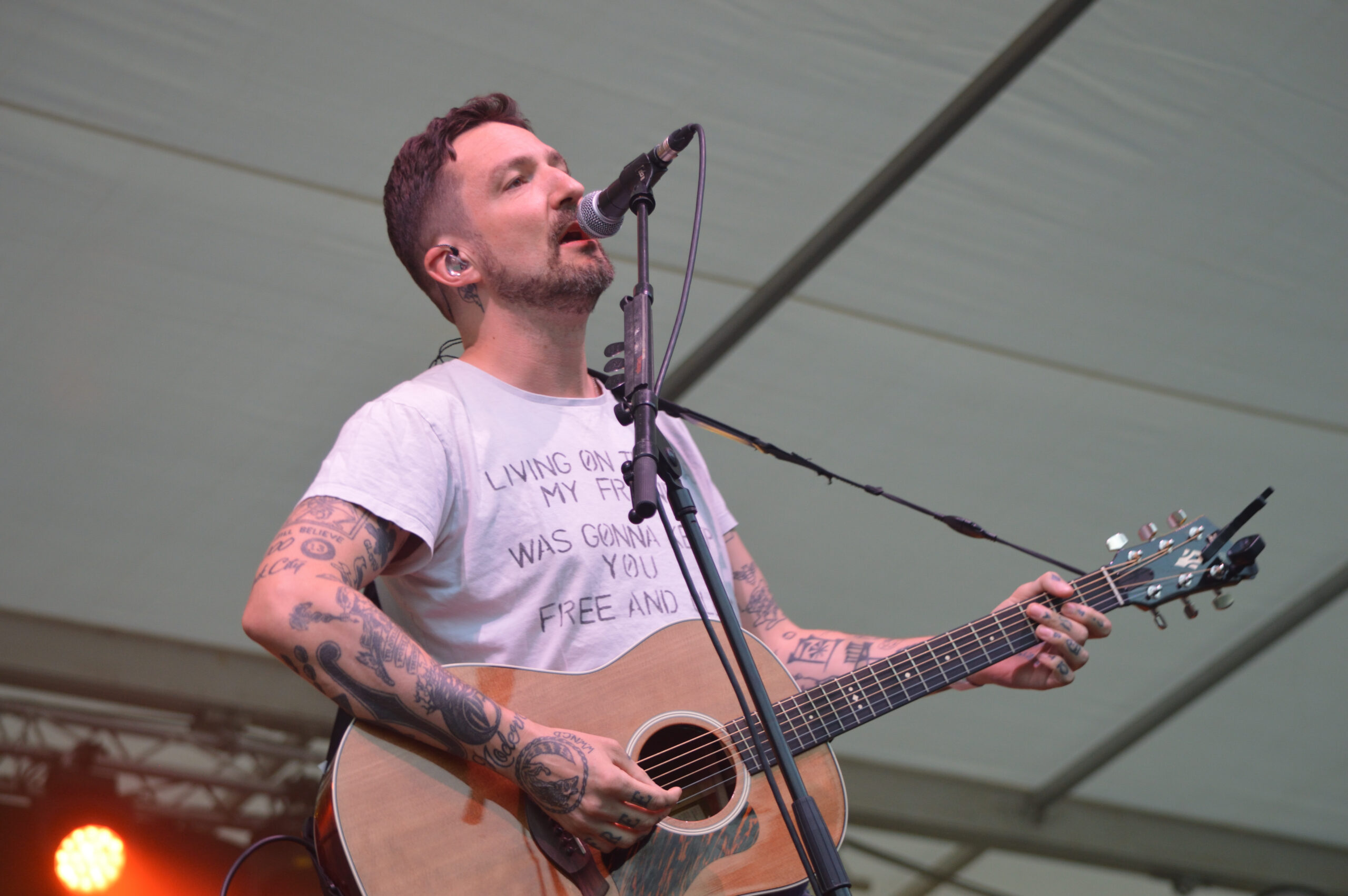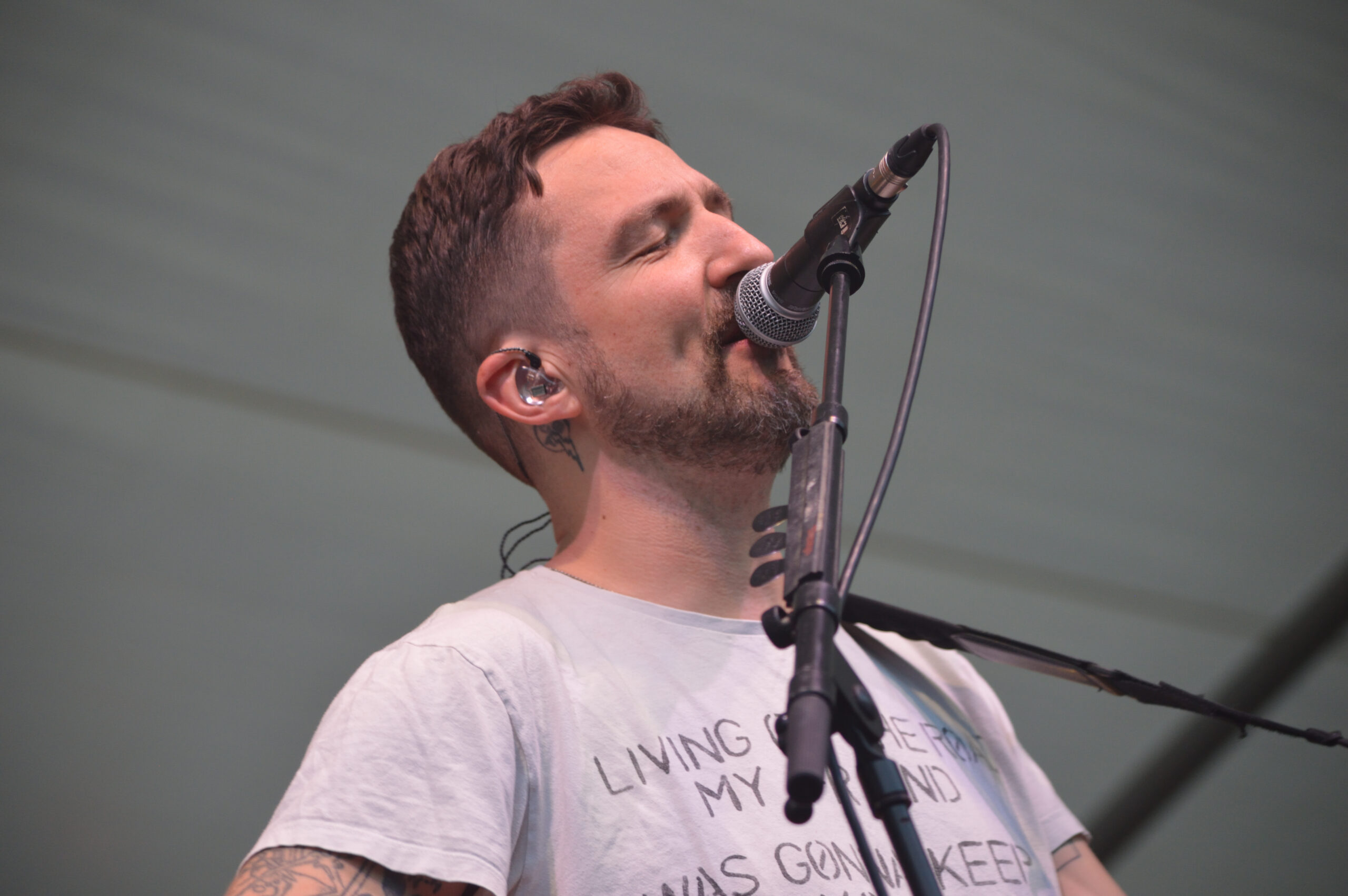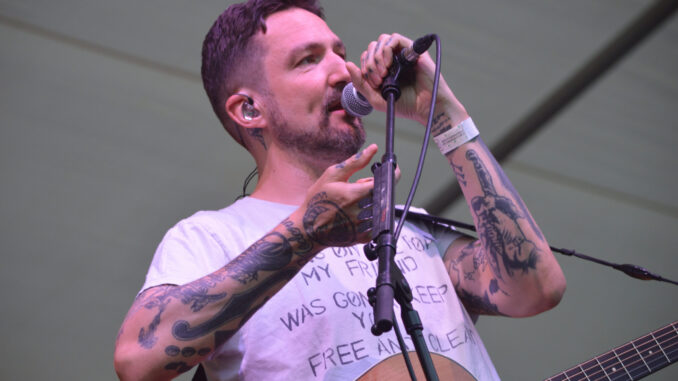
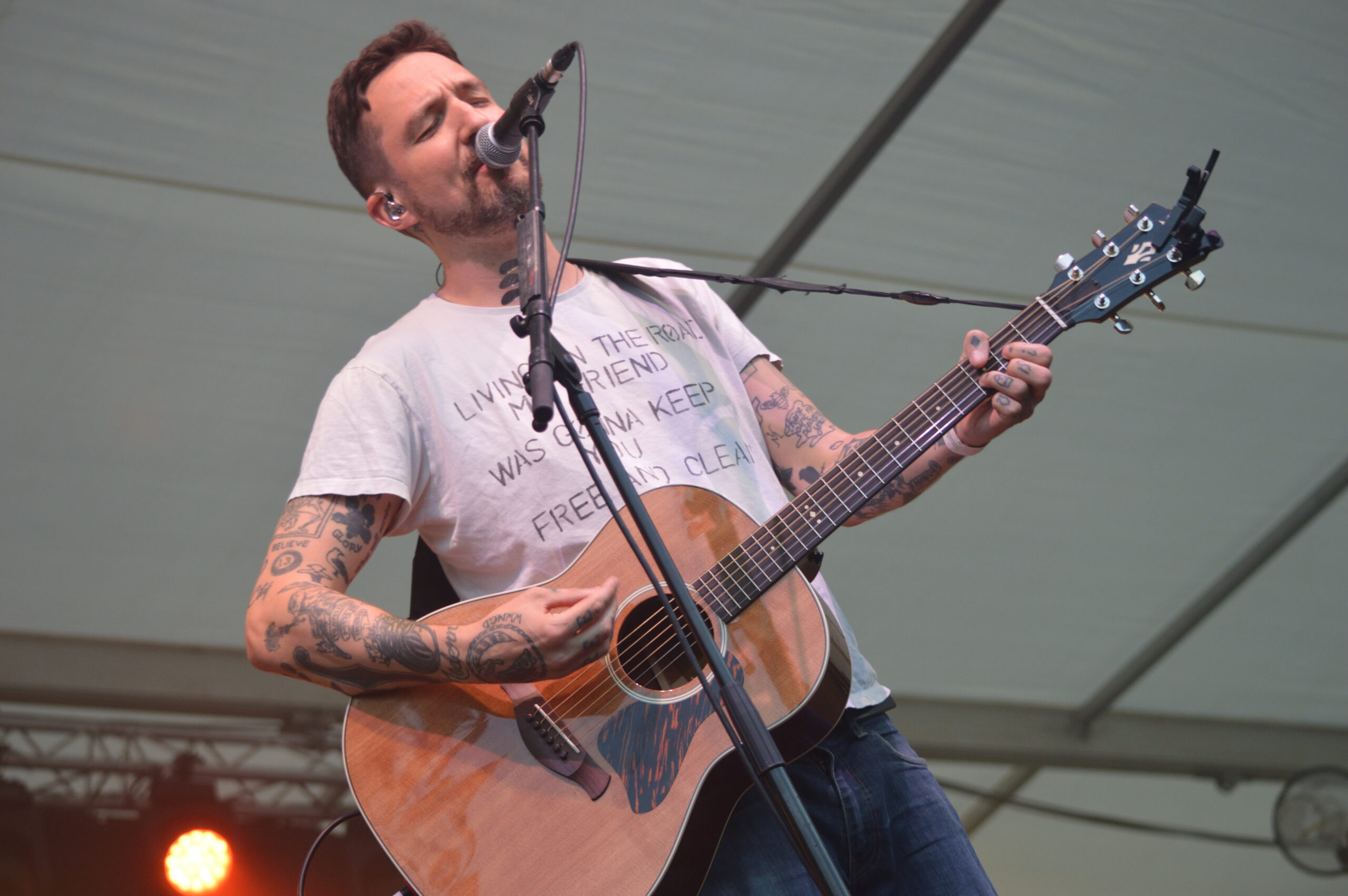
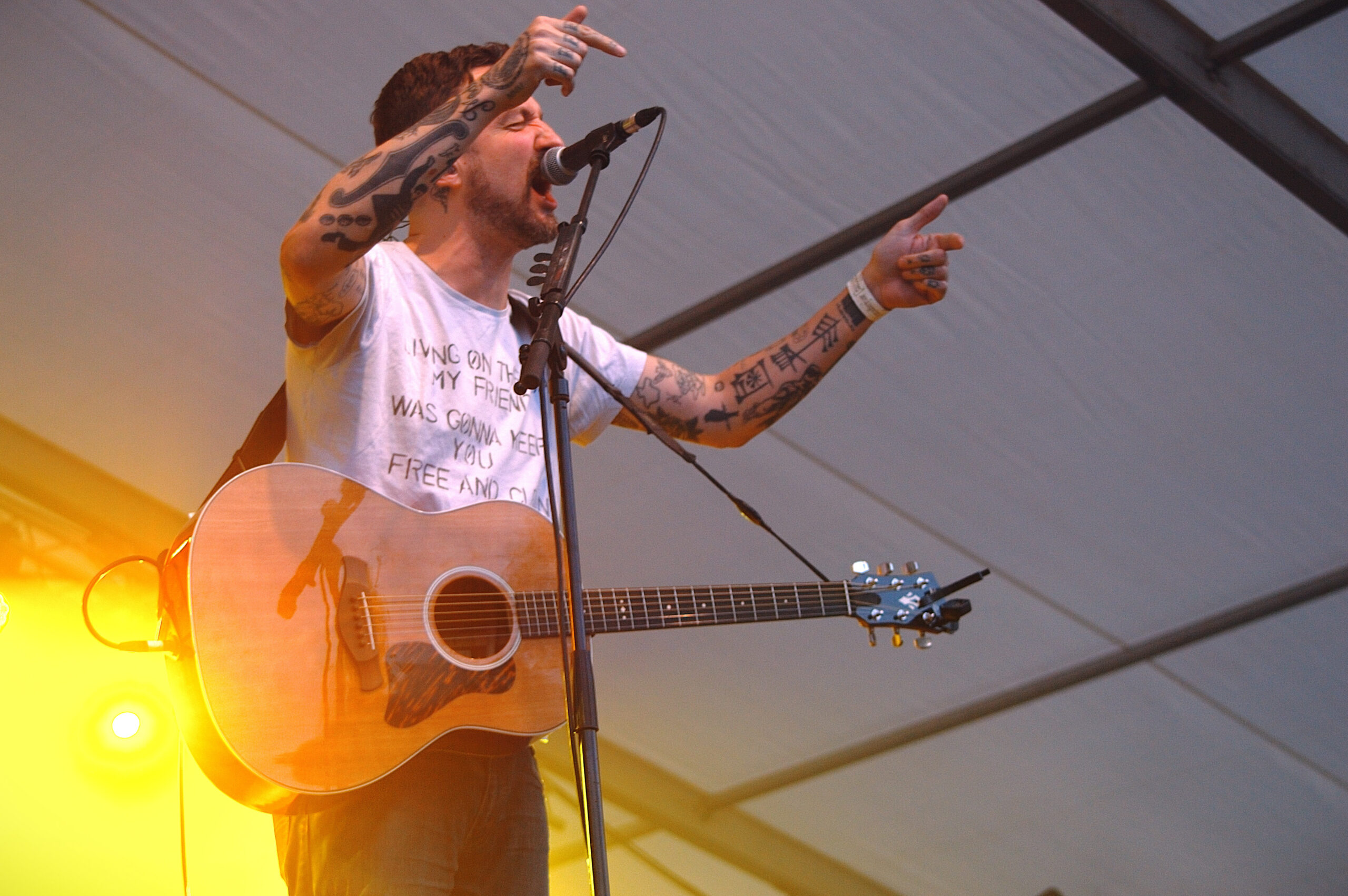
Remarkably, it is twenty years since Frank Turner released his first solo EP: Campfire Punkrock. The very title was both a statement of intent and a conscious identifier, defining his sound and the purpose of his songs after the members of the punk band Million Dead parted ways. Over the intervening years, his writing has matured from documenting youthful uncertainty, strummed on an acoustic guitar, to examining memory, identity and survival. AUK writer Andrew Frolish explored these ideas with Turner before he took to the stage for a solo headline show at the Cambridge Folk Festival 2026. As an artist who has headlined at Cambridge, a world-renowned folk festival, on multiple occasions, Turner has a fascinating take on the genre and the nature of folk music itself. Certainly, this year’s festival celebrated a varied musical palette, from more traditional sounds to punk-infused, barnstorming performances. Throughout this chat, which included much laughter, Turner’s engaging observations emerged on a range of themes: ageing, songwriting, his first release, Campfire Punkrock, his most recent album, Undefeated, live music, and grassroots venues. He also discussed Lost Evenings, the annual four-day festival curated and headlined by Turner that rotates around locations in the UK, Europe and North America. The latest edition will take place in Dallas, Texas, in September 2026. Always good-humoured, interesting, thoughtful, insightful, Frank Turner was, once again, compelling, captivating company.
The first thing I wanted to talk about was that it’s twenty years since Campfire Punkrock, and you’ve just had the re-release of that. Back then, that very much seemed like an identity. Do you still feel like that’s an identity you associate with? How do you reflect on that now?
That’s a good question, actually. I feel like, in some ways, it kind of lies at the heart of what I do and who I am, but I’ve definitely moved quite far away from it. The last couple of studio records I’ve made have been, not entirely, but mostly, quite self-consciously more like punk rock, should we say, rather than campfire punk rock. Kind of noisier, more band-driven, all that kind of thing. You know, I reserve the right to do whatever I want creatively. But I found that the process of getting the re-release together, listening through old live sets, and then doing the tour I did in April this year was a nice little refresher, almost, on first principles. I still think there’s a powerful statement in Campfire Punkrock, and it’s certainly turned my head a little bit in terms of writing and stuff like that; that’s all I’m going to say about it right now!
Ah, we might come back to that…where next! I thought it might be a nice idea, twenty years on, to reflect on three of the songs in particular from Campfire Punkrock that strike me and actually do still come up in your live sets. The first one is the opening track, The Real Damage. One of the key lines from that is: “You’re already halfway through the best years of your life.” How do you feel about that now?
I’ve taken to editorialising that line a little bit live! You’ll hear me do it tonight. That is some mid-twenties horseshit right there! I mean, funnily enough, with that song, a large part of the lyrical framing is actually a reference to a film called The Football Factory, and almost nobody, anywhere, has ever spotted that, which really surprised me because it’s not exactly an unknown film. It’s Danny Dyer’s breakthrough movie, which I love. There’s a whole thing running through that film of: “Is it really worth it?” and that line is kind of a nod to that. But definitely, I can look back now and see that I’m in a different phase of my life. One thing I’m always at pains not to do is become one of those… I’m not going to name names… but there are bands in their mid-to-late forties who are still writing songs about high school or whatever, and it’s like, fuck off! I don’t want to dissemble about where I am in life. One of the reasons I’ve always loved writers like Loudon Wainwright, or Richard Thompson, or indeed Leonard Cohen, is that they write adult songs. Do you know what I mean? Where they are now. I don’t want to pretend otherwise. I’m aware that so much of rock and roll specifically was predicated on that sixteen-to-twenty-one sugar-rush era, but that was a long time ago. That was more than half my life ago now. It would just be kind of seedy for me somehow to still try and write songs like I’m nineteen. That would be lame.
But it is still a song that’s powerful in your live show.
Yeah, well, I think that’s one of the things I’ve learned over the years. Songs are Polaroid photographs, or they’re butterflies pinned on a board, or whatever. I think a lot of people, including me, have a moment at the beginning where they imagine that every song that comes out of their mouth has to be immediately relevant to them as they stand on stage singing it, and that’s just not true. It’s quite nice singing that song again. I’m going to play it tonight, as I say. It’s a snapshot of a moment in my life that I really enjoyed, and the point of songwriting is communication; maybe there are people in their mid-twenties who are kind of wreck-heads who can find something in it, whilst I just have a nice old reminisce. It seems mad to expect Billy Bragg to be the guy who wrote A New England forever. We all change. We should change. If you don’t change, you’re doing something wrong!
That takes me on to the next song I wanted to ask about, Nashville, Tennessee. Another of the classics that you still play live now and again. There’s the line: “The only person in my band is me. A simple scale on a guitar and a punk rock sense of honesty.” Again, it goes back to identity. Do you still identify with that guy? Is that still you?
Yeah. Again, these are deep questions because I definitely have a little bit of a dissociative thing with some elements of my past. Not so much the music thing, but a lot of my childhood. This is something I talk to my therapist about regularly.
I’m willing to take on that role!
Right, okay, you could be cheaper, perhaps!
I’m free!
Well, then definitely do it. There’s definitely a feeling that I’ve disentangled myself from, or dissociated from, various phases of my life. I don’t think I’ve done that with my early time, but at the same time, any human being in their mid-forties looking back at who they were in their twenties recognises themselves, while also recognising that they’re not the same person. That said, I do still play pretty simple scales on the guitar. I’ve yet to become a jazz musician! I’ve got a new guitar now; I’ve got my Taylors now, they’re beautiful guitars. And a punk rock sensibility? Yeah. Last year at Lost Evenings we had Arab Strap on the bill, which was such a huge deal for me because they’re one of my favourite bands of all time. What I love about Aidan Moffat’s art is that he just excoriates himself in front of you in the most brutally honest way imaginable. I fell in love with that when I was a kid, and I still love it now. He does it with a wry smile. There’s that line at the end of Packs of Three: “You said I’m an arsehole. What was I thinking? It’s far too easy to blame it on the drinking.” It’s funny, but it’s also one of the most crushingly raw lyrics I’ve ever heard in my life. As a listener, I enjoy emotionally raw music. So, it’s not a surprise that I attempt to do that in my own writing. I think Undefeated and Somewhere In Between are amongst the rawest songs I’ve ever written.
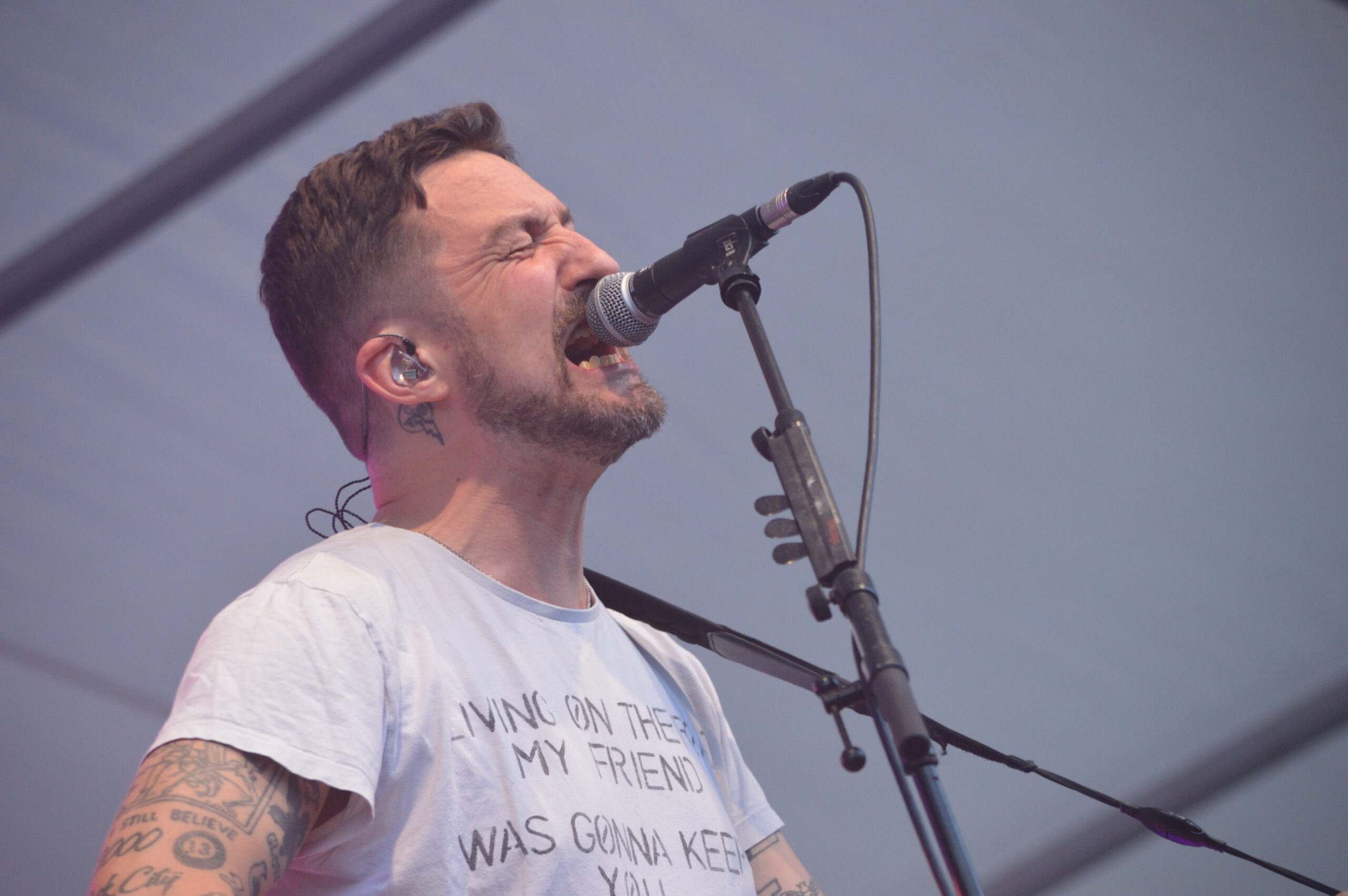
I’m going to come back to the rawness of the songs on Undefeated. One more song from Campfire Punkrock that I think has to be spoken about, and anybody who comes to see you live will be very familiar with, is The Ballad of Me and My Friends. Again, you still play it live, and it sounds different with the band. But that whole thing about “Everybody’s got themselves a plan…” and “…none of this is going anywhere…” and “…we’ll all be old soon…”
Yes! It was slightly knowingly ironic when I wrote it. I wasn’t quite as defeatist as the song makes it sound. I remember finishing that song and playing it to my friend Jay (Beans on Toast), and he took me to task. He was a bit like, “I’m not planning on stopping doing this.” He was like, “I’m going to keep doing this forever. What are you fucking talking about?” It was a “Chin up!” kind of thing. But there’s hopefully a kind of joyous irony in it now. I mean, I’ve played that song in arenas, which was very much not what that song is about. But it’s a reminder. That one’s slightly different to me from The Real Damage because it still stands as a very conscious reminder of where all this started, in a way that’s really healthy to me and not surprising to me. It’s just like, yeah, this is where it came from. It came from Nambucca. It came from a bar that held two hundred people if it was full and rarely held more than twenty. And that’s where all of this began.
Yeah. It’s a bit like a Sliding Doors moment, I think, that song. It could have gone this way, it could have gone that way, it could have been like the video for Somewhere In Between.
Exactly. And I’m still friends with Adam Killip and The Tailors, who I still regard as one of the best bands this country has ever produced. They’re definitely in my top three biggest influences. They were the house country band at Nambucca. They never played to more than about a hundred people, released one-and-a-half albums, and broke up. Adam works for the council these days, but he should be on every pedestal in this country as a songwriter, in my opinion. For whatever different reasons, it didn’t work out for him in the way that it did for me. We’re still very good friends. I see him pretty regularly. I don’t mean this to be patronising in any way, but I feel slightly driven to work harder because I got the luck. Because there’s a mixture of hard work, luck and talent in anything you do in life, and I got the luck part of it. I just sort of feel duty-bound to do it properly and enjoy it while I do it. I don’t want to say “on his behalf” because that sounds patronising. But I want to make sure that I do it properly.
Well, the truth is there are scores of people out there with talent. There is a degree to which those who have a degree of success are almost doing it on behalf of others. I think that’s very true. And I think recognising it is actually quite an important thing.
Yeah, right, exactly. There are so many great songwriters out there. Some people have got one great song in them, but that’s still a great song. What a wonderful thing: to have a great song in you. You can walk into an open mic night anywhere in the country and probably hear at least one person who should be doing more than that.
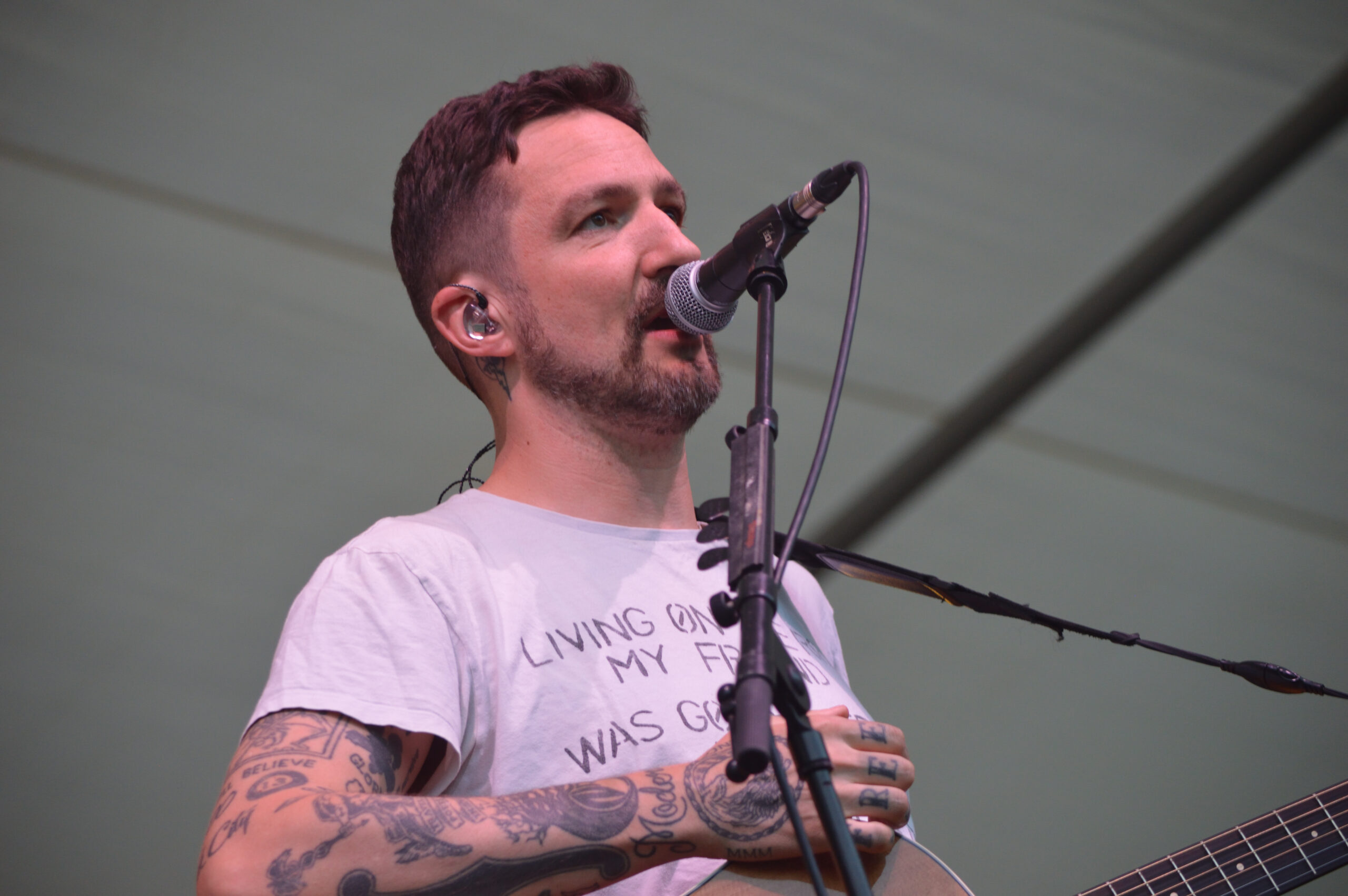
Indeed. Well, those were the three songs from that first EP that still stand out today as almost linking that past with your future.
Well, I’m definitely playing at least some of them this evening; that’s all I’m going to say!
You mentioned Undefeated, and that was something else I wanted to ask about. It’s two years since those songs came out. Those songs, and the previous album too, are pretty raw, pretty exposing. Two years on, when you reflect on that record, does it still feel like an act of survival?
Yeah, definitely. I mean, I think the fact that I’m still standing up and doing this is something that I’m proud of, to the extent I’m allowed to be. I still think Undefeated is the best record I’ve made. I genuinely do. To an extent it’s slightly paralysing in terms of what comes next, because it’s a bit like, I’ve got to fucking top that now. A lot of times in my career I’ve been driven forward by dissatisfaction with my previous work. I’m not feeling that currently, which is a nice place to be. I was definitely trying to be kind of raw. A lot of that record was inspired by a songwriter called Pedro the Lion (Dave Bazan), who I think is one of the great songwriters who’s ever lived. He’s been writing this suite of records about his childhood, basically one album for every five years of his younger life. There’s some real excoriation on those records, to use that word again, and I found that incredibly inspiring. There’s a song about his first kiss which has the line: “As electric as the kiss was, the way you told me no when I leaned in for another thrilled me more.” Funnily enough, my partner likes Pedro the Lion, but she says it’s a bit of a boys’ club because it’s all about being an adolescent boy. That’s fair enough, in the same way there are bits of Kate Bush that don’t necessarily land with me. There are gendered parts of identity in adolescence. But I was trying to pull the skin back a bit, if you know what I mean, and be raw and exposed and all those kinds of things. I think it went well. I’m still really proud of it.
Indeed. Undefeated is really exposing. Songs like Somewhere In Between and Ceasefire, all of those songs really are about looking back into yourself and your life and pulling those experiences into the light.
Well, a lot of that goes back to what I was saying earlier about that dissociation thing. Ceasefire in particular, but Somewhere In Between as well, is about not feeling fully connected to parts of your past. That has a lot to do with the fact that there are times in your life when you’re the captain of your own ship, you’re in charge of your own fate, and there are times when you aren’t, and that’s generally when you’re younger. I look back at the teenage me who had massive issues with suicidal ideation and self-harm, and I feel really sad for that kid. But I also slightly struggle to associate that person with myself now. There’s that thing where every time you recite a memory, it becomes one step further removed from the actual event. You remember the last time you told the story, rather than the thing itself. I’m slightly haunted by that idea as I get older; do I actually remember the time I got beaten up at a Sick Of It All show? Or do I remember telling people about the time I got beaten up at a Sick Of It All show? You get further and further away from the original experience. So, I did my best to explore all of that on the record, and I think I did it as well as I could. I know for sure that whatever I do next will be different. I’ve covered those topics for the time being. Maybe I’ll come back to some of them again when I’m in my sixties. But, for now, I’m always at pains not to repeat myself.
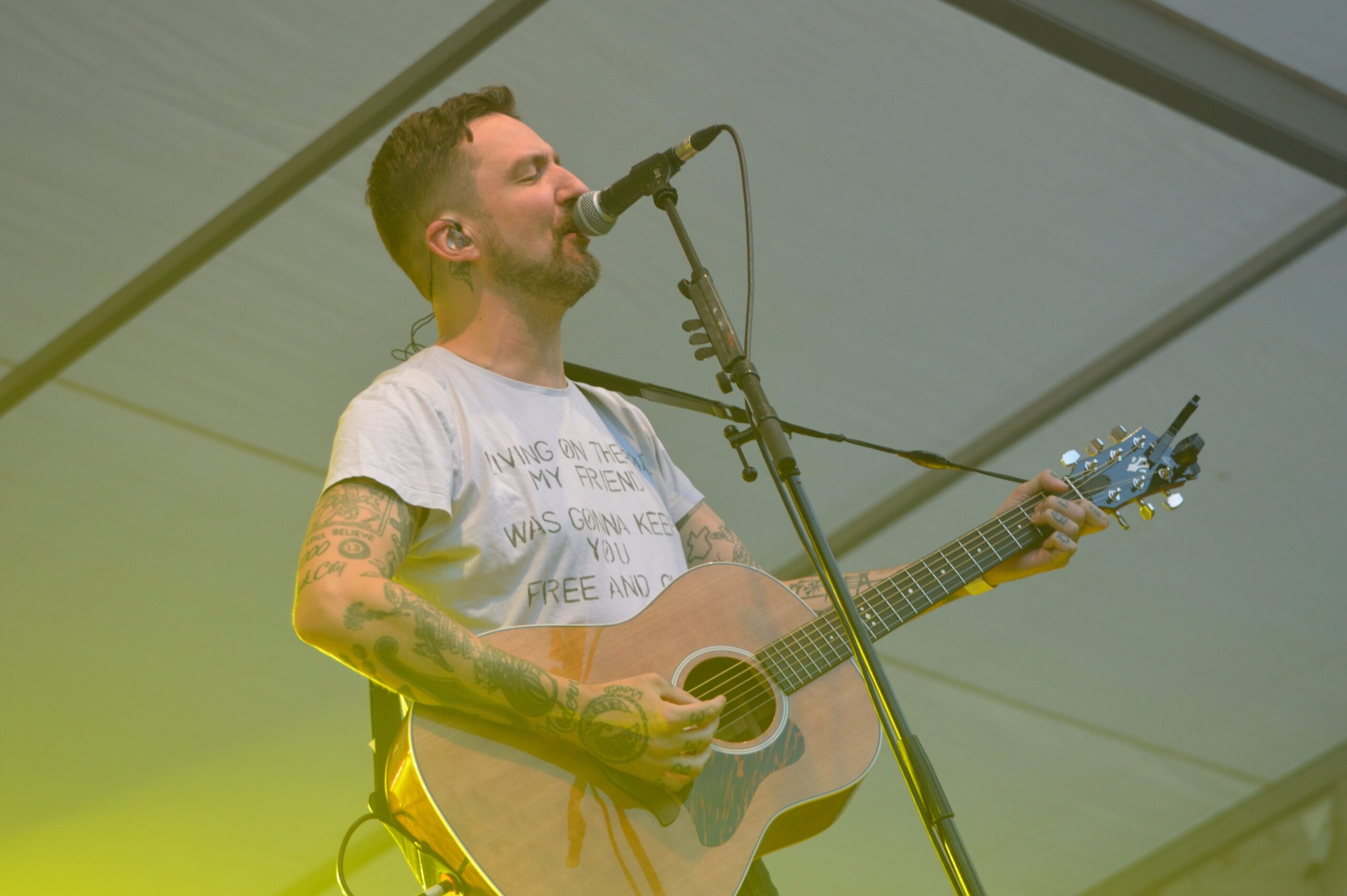
As difficult as it is to associate with your past, I suppose, those experiences are the building blocks of who you are now. I suppose that takes us on to what might be next. Is there anything you can say about it?
Not really, is the short answer to your question! The main thing I would say is that I’m enjoying the fact that I feel like ten albums is a lot of records. I’ve worked very hard. I’ve been on tour for more than six months a year for twenty-eight years now, and I feel like if I’m not quite as nose to the grindstone for the next couple of years, that wouldn’t matter. That would be okay. I have personal reasons for that, which I’m not going to go into detail on, but they’re all happy things, I should say. All positive things. The other thing is that I spend a lot of my life being slightly haunted by Henry Rollins, who I’ve met and interviewed and who I respect more than I’ll ever be able to express. But there is a little part of me that feels like Henry’s just done one thing his whole life, and it makes him ever so slightly one-dimensional at a certain point. Do you know what I mean? If I wish to be a songwriter of any kind of depth, I also need to live at some point, because otherwise you end up writing songs about writing songs, and the snake eats its own tail. It becomes very boring. I also think something people don’t always register is that I have a life that nobody who listens to my music knows about. I wish to water that a little. Some of that will emerge in songs and some of it won’t.
Maybe there’ll be some happy songs. Songs of joy. Those are hard songs to write!
Definitely. I had a conversation with Dave Hause the other day, a very dear friend of mine, and I said to him, “I just keep writing love songs, man. I don’t know what I’m doing.” He basically went, “That’s what we do. What are you fucking talking about? That’s about eighty per cent of the fucking gig.” I was like, “Oh, okay.” So there might be a soppy record coming. I don’t know!
There’s nothing wrong with that!
No, absolutely not.
I think that may extend to instrumentation as well, like Be More Kind.
I love my band to the ends of the earth, but I’m really enjoying playing solo shows at the moment, not because of any disrespect to them, but because there’s something that goes back to what we started talking about. There’s a kind of Campfire Punkrock reinvigoration in there for me somehow. For a long time, once I had the band, I tended to think that any solo songs had to be quiet songs. It doesn’t have to be like that. It wasn’t like that for me at the beginning. You can have raucous songs as one person.
Exactly. Campfire Punkrock wasn’t all quiet.
Exactly. I had dynamic range within my solo act, and I think that’s a lesson I could stand to relearn.
Indeed. You mentioned one of the acts from last year’s Lost Evenings earlier. One of the things you’ve got coming up, of course, is Lost Evenings in Dallas. Is there anything you’d like to say about that?
Yes. I’m excited for it. I actually think it’s going to be the most important Lost Evenings yet. We’re in Dallas because The Ally Coalition (supports LGBTQ+ youth) asked us to do it. Obviously, there’s been a bit of grumbling from some people about the choice of location, but I think if you wish to be an ally in life, it does actually require doing something. It’s not just something you put in your fucking Twitter bio. I’m not saying this about anybody else; nobody has to do anything. People can do whatever they want. But for myself, if I wish to support communities that are under threat and that I care about, then you actually have to go to those places now and again. We’ve got an incredible line-up. We’ve got a ton of community activism around the festival. Some big names are getting involved that I can’t talk about just yet, but I think it’s going to be a defiant festival. Among other things, I think it’s going to be punk as fuck. Punk was never supposed to be safe. It’s a punk festival. It represents a resistance to mainstream currents. There are people in Texas who need some succour in this moment in history considerably more than people in London do, in my opinion. So, we’re going there. If people don’t want to come, they don’t have to come, but lots of people are coming. Happy days.
I remember sending you a message about that at the time. I thought it was really just the internet showing itself up.
Yes. If I had a switch that could turn off social media, I would. I don’t think it’s contributed much to culture or society. Among other things, I think Donald Trump is a creature of social media, and so… fuck that. I think his entire political candidacy is a function of social media, and that’s not something I’m in favour of, to put it broadly. But this is the world we live in. You can’t really complain about being alive.
It’ll certainly be something to look forward to.
Yeah, it’s going to be great. I’m really excited for it. As usual, we’ve also got announcements for next year in the pipeline that I think are going to blow everybody’s minds. But I’m not going to tell you what they are!
That can all wait! Of course, here we are at the Cambridge Folk Festival, so we shouldn’t talk about festivals without mentioning where we are. Do you see yourself as a folk artist?
Yes, I see myself as a wannabe folk artist. It actually said that in, believe it or not, my Twitter bio for quite a long time. I’m aware that I don’t play traditional music, and I’m aware that I didn’t grow up surrounded by this sort of culture. I’ve gravitated towards it. I use the word folk to describe what I do more in the American sense of the word, I think, when I was starting. There was a moment in my career when I got slightly castigated for doing so because people would say, “Well, you don’t play traditional songs.” I understand that distinction. I’m not really part of the great river of traditional songwriting or song communication. I’ve sung a couple of traditional songs in my time. But it’s a community, an ethos and a style that I respect endlessly, and I’m honoured to be here. I think this is my third time headlining, so I must be doing something right. Somebody told me earlier that this festival started in 1964. To be headlining it for a third time, that’s a percentage point or two on its scorecard. That makes me proud, and I’m really, really happy to be here. It’s also just such a lovely festival. Katacombs played earlier, and she was saying beforehand that she was a bit nervous about playing a bigger UK festival. I just said, “It’s Cambridge Folk. Everybody’s lovely.” There’s just a vibe in this field where there’s a will to succeed; everyone wants everybody else to do well. That’s not always the case at festivals or gigs or indeed in the music industry generally. But it should be. It’s just really nice; people go and see a band because they’re interested in hearing music. If they like it, they’ll tell you. If they don’t, they’ll just wander off somewhere else. All of the competitive horseshit just seems to go out the window at this festival. She had a great show.
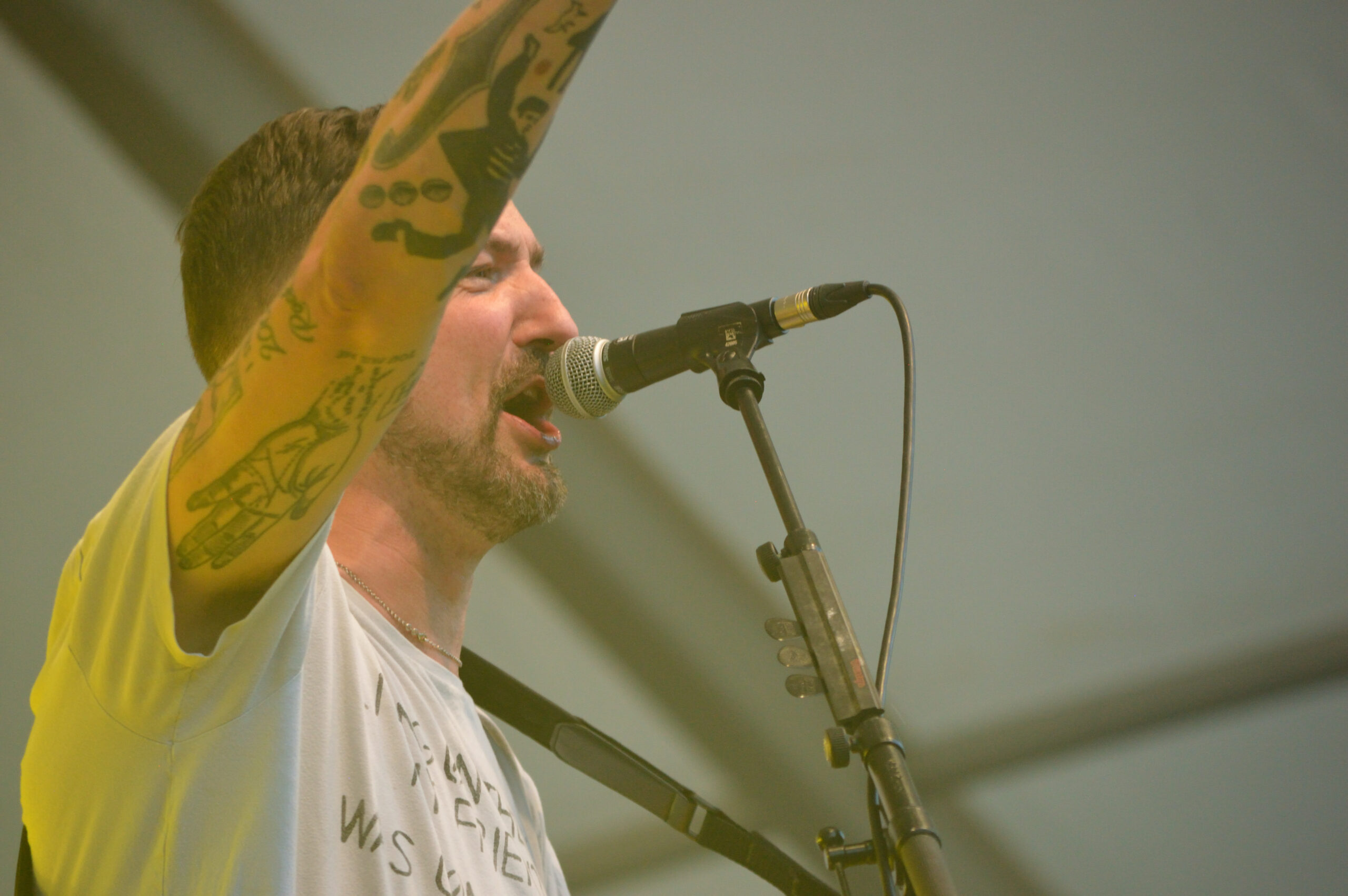
She did indeed. I was having a debate with myself earlier about what folk music actually is. A lot of musical genres are defined by their sound, but folk can almost be defined by its purpose, who it represents, what it represents and who it speaks for. In that sense, almost any sound could be folk music. Anyone who is saying something about their world.
I actually wrote an essay in the liner notes to my Rock & Roll EP, which came out in 2010, about this exact topic. It pissed a lot of people off, which was partly my intention. Still a punk in me somewhere! But if folk music is supposed to represent songs that belong to people, then here’s the thing. If you walk into almost any pub in England and start singing The Banks of Sweet Primroses, people are probably going to look at you like you’re out of your fucking mind. If you walk into that same pub and start singing Angels by Robbie Williams, everybody will join in. On a purely functional level, that means Angels is more of a folk song in the twenty-first century than Banks of Sweet Primroses is. I think there’s something really interesting about that. At the moment, I’m currently knee-deep in a project about music hall, and it’s fascinating how many songs like The Man on the Flying Trapeze, The Man Who Broke the Bank at Monte Carlo, Any Old Iron, My Old Man’s a Dustman; there’s so many songs that come from that era, people don’t even know they come from that era, have become sort of folk songs. You can sing My Old Man’s a Dustman and people know the song. It’s been transmitted. It’s been communicated. It’s become part of the culture.
It’s the music of the people, for the people.
Exactly. As much as I’m not especially a fan of their music, Oasis represent folk music to some degree. Again, you can sing Wonderwall almost anywhere in the fucking world, and people will join in. At some point you have to make a distinction between what’s merely popular and what’s folk music, but it’s not an especially clear-cut distinction.
I think there’s a really interesting discussion to be had there and people should be aware of it.
There’s a slight librarian, archivist approach to folk music that some people have. I understand it, and in many ways I’m grateful for it because it preserves this incredible body of knowledge. But at the same time, it’s also supposed to be fun. You’re supposed to get pissed. You’re supposed to get rowdy. My favourite traditional song is Drink Old England Dry. It’s a Napoleonic-era song about how the French are about to invade. They’re obviously going to win because we’re rubbish, so our only solution to this problem is to drink all the beer in England before they arrive, so the French don’t get our beer. That’s literally the song, and it’s fantastic. It contains all the aspects of the English character that I love and respect, a slightly self-deprecating cantankerousness, and I back that enormously.
And an absolute determination to drink all the beer.
Exactly! A deeply deranged sense of alcoholism.
When you talk about music hall, it reminds me of one of my favourite songs of yours; Balthazar, Impresario, which is really about how ephemeral it all is. Things that seem huge eventually fall away, and it is all about legacy, popularity, all that sort of thing.
Thank you. Totally. To me, that song is about counting what matters and what matters is the time that you spend on stage. As an entertainer, you’re engaged in an ephemeral trade. Your job is to create something in one space, for one evening, and then it goes away at midnight. You can spend time being sad about that, but you shouldn’t because that’s the whole fucking point. That’s the gig. That’s the game. My whole vibe is just to enjoy those moments. What a joyous thing to do for a living; to create moments for people. That’s a fucking pleasure. It’s a privilege.
Interestingly, one of the things that’s happening at the moment with artists like Phoebe Bridgers and Bob Dylan is the banning of mobile phones at concerts.
I sort of back it. Philosophically, I back the gist of it. I’m generally opposed to banning things in principle. I’m quite libertarian in my social politics, so I’m always a little wary of telling people what they can and can’t do, but I completely understand what they’re going for and it makes sense. Be in the room. Put your fucking phone away!
Although I have to confess, I’m one of those people who goes to the front and takes a ridiculous number of photos!
I’ll usually take one. That’s me! One for the memories.
Talking about things being ephemeral and music being important in the moment, one thing I wanted to ask you about is live music itself. Music venues and the grassroots live scene in the UK, and probably everywhere, is something that people perceive as being under threat. I know you’ve done a lot of work with the Music Venue Trust. Is there anything you’d like to say about that?
Yeah. There are so many things to say about the logistics and the technicalities of running venues; business rates, inflation, the cost-of-living crisis and all of those things, and they’ve been said a million times already. I think there’s a broader issue, though. It’s about the culture of going to gigs. I feel like that’s on a bit of a downswing at the moment, particularly among younger people, and I think that’s at least partly related to lockdowns and the pandemic. One of the roles I can play is to evangelise for that culture. Just go and fucking take a punt. Go and see a band you’ve never heard of. Spend a tenner. Support a venue. Go and watch somebody you’ve never heard before. They might be awful, and then you’ll laugh about it afterwards. Or they might be fucking amazing, and you’ve just seen the next Arctic Monkeys, or whoever it might be. You’ll never know until you take the chance. When I was younger, there was much more of a culture of going out for a few beers and then seeing a gig. I’m sure it’ll come back. If you want to get really nerdy about it and go back to the sixteenth century, entertainment per se was illegal during the English Civil War for a brief period of time. So, these things come and go in cycles. I hope we’ll see it swing back again. We’ll see. I can’t make people go to gigs. But I can certainly tell them how fucking great it would be if they did!
And that is a great point to end this on! Many thanks, Frank.
It’s a pleasure!