
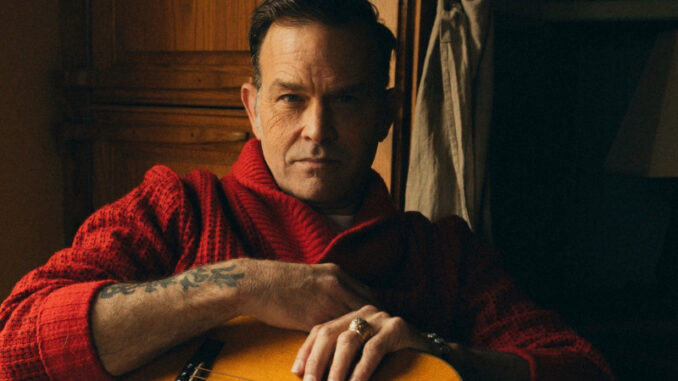
Americana UK’s Ian Rothery caught up with Waylon Payne via Zoom at his home in Nashville on one of the few days of the year when it might actually have been hotter in the UK than in Tennessee. Payne has just released his third album, Wayward, and the fact that it’s only his third in a 22-year recording career is a story in itself. Payne comes across as relaxed and affable. He’s clearly enjoying having a new record out, and he was very happy to discuss the making of this album and also talk about his not-so-easy journey to where he is today.
Payne, as he describes in the interview, is in the ‘family’ business. His business is music, country music and his family extends to many of the great and the good from the outlaw tradition. His mother, Sammi Smith, is a GRAMMY® Award-winning singer probably most famous for her 1971 crossover hit, Kris Kristofferson’s Help Me Make It Through The Night. His father, Jody Payne, was a long-time member of Willie Nelson’s band, and to top it all, his godfather and namesake was Waylon Jennings. When you look at the artists he has collaborated with, you can get a sense of what he means when he talks about the family. It’s a country music family, supporting, inspiring and collaborating in order to make great music.
Payne has travelled a rocky road to get where he is today. He has a well-told history of being abused by his uncle, being rejected because of his sexuality, and then many years of drug abuse. As Payne said in a previous interview, he is just glad to be alive after all he has been through. His first album, The Drifter, was released in 2004 and then followed a 16-year gap before the second, Blue Eyes, the Harlot, the Queer, the Pusher & Me: The Lost Act. His latest album, released in July 2026, was, as I found out, recorded during the pandemic. His producers Frank Liddell (Miranda Lambert, Lee Ann Womack) and Eric Masse (Parker McCollum) assembled a stellar team of musicians and this, combined with Payne’s songs, both solo writes and collaborations with artists such as Miranda Lambert, Ashley Monroe, Charlie Worsham, just to name a few, produced a varied, powerful and deeply personal record.
For the last 4 years, Payne has been playing guitar and touring with Willie Nelson. He is wrapping that up later this year and hoping that his new record will gain some more traction and allow him to play it for more people. In the 20 minutes that we had, I was left feeling that Payne is loving what he does and just wants to share his music far and wide. There are some great songs on this and his previous albums, so hopefully we’ll get an opportunity to hear him live before too long.
Hi, Waylon. How are you doing?
Good, how are you doing?
Yeah, great. Whereabouts are you at the moment?
I am in my living room in Nashville, Tennessee. And you are?
Well, I’m in the UK, so just about 20 miles north of London.
Wonderful.
It’s crazy hot here. It’s in Fahrenheit, 90-something. It’s unbelievable.
Crazy hot here, crazy hot here too.
Thanks very much for taking the time, Waylon; I really appreciate it.
It is my pleasure. Thank you for talking.
So it’s been six years since your previous album, before this new one which has just come out, and I just wanted to know really how you were feeling about things, you know, musically and life in general.
So, well, we made this album during the pandemic, and everything had pretty much ground to a halt. We went back into the same studio that we did the Blue Eyes record in, which was the same studio that my mom, Sammi Smith, recorded all of her music in, so it was kind of a familiar place. We had just picked out some songs, and I think that we were so glad to see each other in a room together, and he brought together a great group of pickers and legends, and we just sat down for five days and made a record. And I love working with Frank and Eric, Frank Liddell and Eric Masse, because they’re just easy to work with. By now they know how to set you up, and it’s all very much of a dance. And here’s where you sit. Here are your mics, and okay, let’s go, and we just work and make music. It’s a beautiful way to live.
One thing which really struck me about the album when I first put it on is just that the musicians you’ve got on this are off the charts, aren’t they?
It’s a dream; it’s a dream album. It’s, you know, Matt Chamberlain, Glenn Worf, Charlie Worsham, and Jedd Hughes, Nick Bockrath, and Chuck Leavell. It sounds dreamy to me, and it’s very cinematic to me.
It really comes across when you hear it. I first of all just played it on my computer, which was sounding great, but then when you put it through the full stereo, it just sounds fantastic. When I heard the bass player…
That’s Glenn; it was a beautiful, everybody wanted to make something. When Frank pulls together groups of people to make albums, he is very, very aware of his artist. He’s very aware of who he wants to put with his artist to get what he wants, and he hit a home run on this one. It just is one of my favourite things I’ve ever done.
One of my questions was whether making the album was a happy experience, and I think you’ve answered that question pretty much. But I suppose just thinking about your musical heritage and connections with, really, famous, legendary artists, does that help you, or does that like sort of constrain you, or do people then expect you to be something?
I think there are several caveats to that. I think it gives you first a really firm foundation of our family business. Because that’s what it is. I’m in the family business. My family did it. They did it with other families. I’m part of other families now, and if you pay attention, it’s a learning experience. I play guitar for Willie Nelson right now, and it’s like a master class. Willie has guided me through my entire life. Earliest memories I have of life are sitting on his lap playing with his beard, and I still sit next to him. He doesn’t let me play with his beard now (laughs).
Fair enough. You really couldn’t have a much better teacher and mentor, could you? I mean, in this musical genre, that is just amazing.
Amazing, yes, sir.
In terms of the music that you make, how would you describe it?
You know, I’ve always called myself a country singer, because I know what that means and it’s that. It’s Bobby Gentry, it’s Willie Nelson, It’s Billie Jo. That’s what I do. Now it’s got my own particular sound, and I’ve definitely leaned more into some rock and roll territory in this record. I like that a lot. But I guess I sing American music. I’m an American songwriter, but I like americana. I’m not mad at that at all. I sing soul music because I write from my soul, but it’s not the soul music that most people would know. It’s hard to describe.
I like what you said there about rock and roll because some of the songs are what I would think of as having a more traditional country feel to them, and then some of them go away from what I would think of as country into southern rock. On the second track, Postcards, I was just thinking of the Allman Brothers all the way through.
Boy, what a really great record, and I think that we should be able to drive our car fast down the road, you know, and listen to good music. I was driving down the road yesterday, and Darla came on the radio just randomly, and it was such a neat experience. I’ve not had much experience hearing myself on any radio format ever, but this album over the past few months has given me many, many opportunities to experience that, and I love it. I think it’s really fantastic.
That must be a great feeling when you’re in your car, and your record comes on.
It’s pretty amazing, you know. And I watched it all my life because it happened to my mom a lot. And you know, my dad was all over the radio as well. He was Willie’s harmony singer throughout the 70s and 80s. So they were, you know, I just assumed everybody was my friend.
I’m doing a review of your album for Americana UK. So one thing which I really wanted to mention is that whatever you think about the type of music or whatever your preconceptions are, there are so many different things in here. Some of the guitar work, you know, slide guitar, almost extreme guitar soloing; it takes you to a different place.
I hope so. I hope it just feels good, though. And thanks in advance for a review. I’m pleased as I can be; I hope this thing takes off over in the UK. I really do because I want to come over and play for a few years. I want to come experience it over there. I did my ancestry recently, and I’m a hard 55% from the UK and Ireland; it’s half of me, and the other half, I’m not sure. I guess it’s from Scandinavia; maybe I don’t know. But whenever I’m in London, I do feel something. It’s just nice, and all over the UK, really, it just is fantastic.
Do you plan to come over?
I plan on getting there as soon as I can. I was telling the last guy that I was talking to. I’m a huge fan of variety shows. I want to do a Bobby Gentry-style variety show so bad for this album over on the BBC. I dream of playing the Royal Albert Hall. I’ve dreamed of it for years. I loved touring over there in ’99 and 2000. I was on the road with Shelby Lynne. We toured really heavily over there. And Jools Holland, if you’re listening, I would love to come on your show. We love him. The night we played, it was like us and Jeff Beck. I don’t remember who the other person was, but it was amazing enough that it was us and Jeff Beck. So I plan on getting over there as soon as I can. I hope that this record finds a heart over there, and absolutely I’ll be over there.
Yeah, absolutely, that would be great.
Well, you won’t be able to get rid of me.
Well, I’ll look forward to that, and so hopefully you make it before long. Coming back to the album more specifically, I know you made the first album going back quite a long time, and then you made the second album, then the third album, which you explained has been in the can for quite a while. Do you see those albums as related in some way? I think I read somewhere you said they were like instalments.
That’s what I’ve been joking about. I kind of loosely call it Volume Three in a ‘Life Well Lived’ series, but they do seem to, and it’s quite unintentional. But I mean, maybe not. Maybe it’s just my style. Maybe I have a very specific style of music that I make. So maybe that makes it feel like they all flow. I think this is a much more adult record than I’ve ever done, and I’m at peace with myself on all levels. So I’m just kind of passing along what I know and maybe it’s wrong, but if it helps somebody, then great. I love getting people together in a room and singing these songs for them because they seem to enjoy it so.
Yeah absolutely. In terms of the individual stories in the songs, would you say they are largely biographical or are they sort of representative of things in your life?
Some of them, most of my solo writes are extremely personal and usually real. Caramello is the only thing on this album that came completely out of my mind and was a total piece of fiction. It was just a sunny day in Los Angeles, and we were having margaritas, and we had the guitars, and it just fell literally out. I was using my telephone and saying, okay, this is what I want to say. What is that in Spanish. It was so primitive, and so it’s probably all wrong; the Spanish is totally wrong
Yeah, well, I’m not capable of checking that in Spanish.
I’m not either. No one’s told me yet that it’s not.
Yeah, I was going to ask specifically about that song because it sort of stands out as a slightly different style.
Postcards too, as well is fictitious. That’s Miranda Lambert and Aaron Raitiere, and myself. We sometimes have camp weekends where we go off, and a group of us will go write together for a weekend, and that was the fruit of one of those things. But again, you know, Rosa Marqueta, she’s not real. She came straight out of the mind here, and it was fun to have a group of people that know what you’re doing when you want to go on a ride and create something. That’s what I love about being a songwriter. I love that about records. That used to be a principal part of records, a cool story.
Another song I was going to ask you about, and you mentioned it earlier on, was Darla. Is Darla the same sort of thing?
Darla, so when I turned 18, I was kind of discarded from the family because I was gay, and I had a 16-year-old drag queen named Carrie take me in. For a while we were hustlers, and it was a crazy time when you’re, when you go through something traumatic like that, and finding you’re out of a situation for something you can do nothing about. You, as a man, have to go many, many different paths to find out what’s right for you, and some of them last a little longer. Some of them last not at all. Some of them you don’t attempt. But that was just an experience where the drag queens took care of me, and we had some stories to tell (laughs).
Okay, yeah, I’ll leave it there.
Leave it at that (laughing). Yeah, would make a great video.
So obviously this album’s only just come out, and I guess you’re going to give this a little bit of time to come to fruition and for people to enjoy it. Do you see that you’re now in a position where you might get into a more regular recording pattern?
I will start a new record tomorrow if Frank says it’s okay; I’ve got a nice thick catalogue. I’m playing around right now with the idea of this fall, since I’ve been working with Willie for the past four years, and we’re wrapping it up this year. I’ve got about 15 solo writes that I can’t really stop listening to, and over the past couple of years, three, four years, and so I’m going to sit in my living room with a little studio and just do an acoustic man and a guitar, maybe drink a couple glasses of wine every now and then, and see what comes. But I love it. I love making records. I love it because again, it’s like songwriting; it’s creating something that wasn’t there before with people that love each other, and they try really hard to make something pretty.
Well, hopefully you’ll get to do that. I’m enjoying this record, but it would be great if you could do some new stuff as well.
I’ll get on that as quickly as I can. Did you hear that, Cayleigh, (record company) were asking for more music. Well, thank you very much, Ian. I appreciate it. Anything else you need?
I don’t think so; that’s been brilliant.
Let me know if they start liking that record over there. I’ve already got my bags packed.
I’m sure they will.
Thank you very much for listening, and I hope you enjoy it. And please reach out and let me know how you feel as you listen to it more. Yeah, let me know if people are liking it because we’ll get over there.
Will do.
Thanks, Ian.
Thanks, Waylon. Appreciate your time. Thank you very much.


