
World Circuit Records, celebrating 40 years, reissues world music’s most iconic album for its 30th birthday.
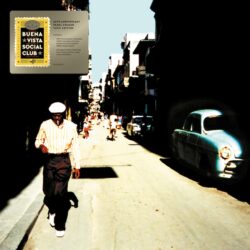 When world music shot out of the blocks into the consciousness of a fascinated listening audience, one album, for various reasons, became the most commercially successful album of the genre of all time. That album was Buena Vista Social Club, and it celebrates 30 years with the re-release of a ‘pearl sunrise’ colour vinyl double album; pearl, of course, being associated with 30-year anniversaries. The release comes on World Circuit Records, which itself is celebrating 40 years of existence by re-releasing a number of World Circuit records this year. Whilst they, in one way or another, are very much roots music recordings, Buena Vista Social Club being the most successful, the most surprising of World Circuit releases, and as it includes the involvement of americana legend Ry Cooder, this was the album that was felt to be most appropriate to profile in our magazine.
The 1990s were the pinnacle of CD sales and of commercial popular music, and the listening public was therefore more willing to take on board a wider geographic musical presence. World Music became a genre, with a somewhat particular focus on African musicians, though for some people, the global spread became too wide and encompassed music from virtually every other origin outside the English-speaking world: Bulgarian choirs, Mongolian singers, Indian sitar players, collaborative geographically diverse releases and world music compilations, Mexican folk and Brazilian bossa nova, and so on. None of these albums ever achieved the cachet or commercial success that Buena Vista Social Club did.
Famed English record producer and founder/CEO of World Circuit Records, Nick Gold, was in Havana and invited Ry Cooder to Cuba to work on a mixed-genre album of Malian and Cuban musicians to further introduce the listening public to so-called world music that he was promoting. He knew Cooder due to his work with Ali Farka Toure on Talking Timbuktu in 1994 and his in-depth knowledge of global roots traditions, not to mention his exploration and work with Hawaiian guitarists, Mexican conjunto musicians, and Indian classical players. The Malian musicians could not get visas, so the project died, but it was immediately replaced by the idea of bringing together respected, veteran Cuban musicians who typically had been playing music with various big bands and ensembles in Havana since the 1940s and 50s.
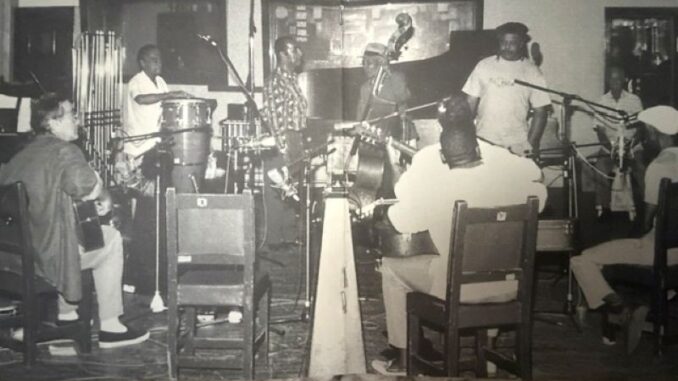
The musicians were gathered together at EGREM studios for what proved to be a very low-key and quickly produced (7 days) album of the various styles of Cuban music, most notably the son, a mixed music and dance style that originated in the eastern mountains of Cuba in the 19th century, based on Spanish-style guitar playing and Afro-Cuban percussive sounds. It migrated to Havana in the 20th century with the addition, typically, of bass and trumpet. In many ways, it can be said to be the foundation of modern Latin American music (mambo, cha-cha, and salsa, for example). And I mention the son first because there is one track that captured the imagination above all others on the album and became its most widely known and performed song, about which more later. Other styles on the album are danzón, bolero, guajira, criolla, and ballad, each with its subtle differences from the others.
Buena Vista Social Club was an almost instantaneous hit for a number of reasons; it played into the demand for honest folk music traditions, it reactivated the careers of veteran performers of great skill and told stories that piqued listeners’ interest, and it had the involvement of one of US popular music’s most in-demand artists, a guitarist of great skill and empathy who embellished the artistic skills of the Cuban maestros but never sought to outshine them. A documentary by the renowned Wim Wenders three years later about the making of the album only enhanced its reputation, and the album ended up selling more units than any other world music release by a factor of at least 10.
And now, in order to celebrate the 30th anniversary of its release and the 40th anniversary of the founding of World Circuit Records, we have a stunningly remastered version of the album on vinyl, with 5 additional tracks from the original sessions.
So the album kicks off with the iconic folk story of Chan Chan, written in 1984 by the great singer and armónico guitarist Compay Segundo (in his late 80s at the time), who neither played guitar nor sang lead on this track. It tells the story, in very simple terms, of a fictional folklore character who was in love with Juanita as they travelled across Cuba, played out to a captivating acoustic guitar riff across multiple percussion instruments and embellished around the middle of the song with Manuel Mirabal’s trumpet and Orlando Lopez’s bass lines. And not to mention Cooder’s swirling slide guitar floating across the background. It is hypnotic in the extreme, and singer Eliades Ochoa (a mere 50 years old) and his backing vocalists basically turned this song into the band’s signature track, thus cementing its popularity.
Cuba’s outstanding singer Ibrahim Ferrer takes centre stage on his composition De Camino a la Vereda with Segundo’s guitar and Mirabal’s trumpet to the fore. Marvellous harmony voices are in evidence (here and largely throughout) on a song with religious overtones about not straying from the path. It is the first of a number of songs that introduce real people and cross-reference other members of the ensemble.
El Cuarto de Tula is another of the album’s many highlights, an upbeat and sophisticated percussion ensemble driving the song for over 7 minutes, ending in a descarga (a kind of jam) with glorious shared verses from Ochoa, Segundo, and Manuel Licea, and the usual trumpet and bass underpinning the whole. This track, despite its upbeat rhythms, touches on a fire in the village where Ochoa lived. It should be pointed out that one of the percussionists throughout the album is Ry Cooder’s son, Joachim, who was 17 at the time. The main ‘guitar style’ lead is by Barbarito Torres, who plays the laoud, a kind of 12-string lute of Spanish origin, and the timbales on this track are played by 13-year-old superstar percussionist Yulien Oviedo Sanchez.
The other main instrumentalist in the ensemble is the remarkable 78-year-old pianist Ruben Gonzalez, whose Pueblo Nuevo is a very percussive danzón spanning just over 6 minutes with interludes from Mirabal on trumpet. A beautifully elegant tune. We are then introduced to the bolero on Dos Gardenias, a classic and famous song from the pen of Isolina Carillo in 1930s Havana, and recorded for Buena Vista Social Club as a tribute to the writer, who died at the beginning of 1996 at the age of 88. Ibrahim Ferrer’s vocals are very poignant. Another bolero follows, the lovely ¿Y Tú Qué Has Hecho? with its stunning guitar duet featuring Cooder and Segundo (who also sings the charming song in his deep baritone voice) on armonico, a 7-string metal-stringed guitar with the third double-strung, producing a quite unique sound.
And so the album proceeds with a mix of styles, each one beautifully conceived and recorded. Mention should be made of Omara Portuondo’s gorgeous lead vocals on the sad lost-love ballad Veinte Años, where Segundo’s armonico and Cooder’s guitar lines battle in the instrumental break with the lovely laoud of Torres. El Carretero, about the life of a cart driver, has the most amazing bass lines behind Ochoa’s vocals (trading lines with Ferrer) and lovely rolling guitar on a traditional country guajira. Candela stands out as an example of a typical tumbao, transforming a son into a more complicated syncopated rhythm pattern; this one has Cooder’s eerie electric slide behind the opening acoustic guitar and bass, while multiple percussion instruments hold things together as the vocals are traded back and forth towards the end, in response to Ferrer’s largely improvised vocals.
Cooder is prominent in the instrumental break on the lovely Amor de Luca Juventud, a treatise about youthful love, and on Orgullicida, where his guitar dominates proceedings on songs that were heavily influenced by American music of the 1930’s, the latter with its ragtime jazzy feel. Murmullo absorbs the style of Hollywood musicals and is a gorgeous ballad led by Ferrer and Gonzalez’s spectacular cascading piano. The title track Buena Vista Social Club is another danzón, an instrumental led by the extraordinary improvisational piano-playing of Gonzalez and with Cooder’s sonorous slide in the background and Lopez’s great bass lines. La Bayamesa is the only track without Cooder, a criola written in the 1860’s and sung by Licea (another septuagenarian), with Segundo and Ferrer harmonising behind him and throwing choruses back at him
The lively Vicenta is the first of five bonus tracks (each featuring Segundo and his usual backing band, Los Muchachas), a traditional son cubano which describes a fire in the village of La Maya, Ochoa’s home town, which nearly destroyed the entire village, and referenced, as mentioned earlier, on track 3. La Pluma features some of Segundo’s beautiful guitar playing. A Tus Pies is a twin-structured song (trova) that starts with a romance that moves up a notch, describing a friendly rivalry between the regions of Oriente and Havana. La Cleptomania is a humorous song where the narrator describes the thieving antics of Ana Maria, who ends up stealing the narrator’s heart. The album signs off with an alternate take of Orgullecida, which probably adds very little to the overall album, despite the swinging trumpet to end proceedings.
That being said, this is a magnificent vinyl re-release of an album that ought to be in everybody’s collection; one of the great world music albums, a multi- Grammy winner, with story songs brought beautifully up to date by an ageing group of virtuosic musical talents, and with the addition of Cooder’s empathetic guitar work and production skills, and to top it off, a magnificent remastering. As someone remarked in a blog about twenty years ago, “This is an album that makes you feel good about yourself for being a music fan”


