
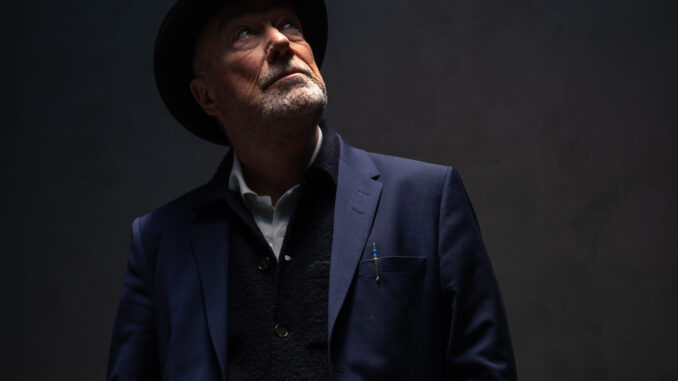
The songs of John Watts, whether in his band Fischer-Z, in his other bands or as a solo artist, aren’t technically Americana, but everything in their construction and recording has the feel of exactly what Americana is all about. Superb songwriting, the ability to tackle important subjects in songs in the most creative way, immaculate musicianship and an ethos about as determined as could be, coupled with a passion undimmed by fifty years of creativity.
Watts formed Fischer-Z after an initial career as a clinical psychologist, and this challenging experience was integral to his subsequent reputation for having a confrontational style of performing. The band also gained a reputation for being a white band that could really play reggae. The band’s debut album Word Salad was released in 1979, and with two further albums recorded in quick succession (Going Deaf For A Living and Red Skies Over Paradise), they found success in Europe and sold more than two million albums.
The band recorded with the likes of Peter Gabriel, Steve Cropper and Dexys Midnight Runners, played alongside James Brown in East Berlin and toured with The Police and Dire Straits. They also toured the US and Canada and were on a bill with Bob Marley on his last ever tour of Europe. Watts has released around 26 albums and played around 4,000 concerts.
As is often the case in the music industry, when the hits started coming (Red Skies Over Paradise shifted 30,000 copies a week in Germany in 1981), trouble was around the corner. After a punishing touring and recording period, Watts was forced to disband the group; he was completely burnt out. A period of solo recordings and forming another band, The Cry, gave him some positive creative outlet.
In 1987, Watts decided to re-establish Fischer-Z in a different form, and he’s been recording as this band ever since. His resilience and determination, combined with amazing creativity, have seen him not only recording continuously, but also branching out into art, video, theatre, poetry and writing. He’s just released his latest album, X Ray Serenade, and has recorded a fascinating range of new podcasts looking back over his monumental career.
His music encompasses indie sounds, atmospheric acoustic tunes, synth music and almost everything in between. He’s one of the most consistent and talented musicians we’ve ever had, and whilst his success is more noticeable in Europe than in the UK, he’s still touring and recording with a passionate and fervent following.
AUK caught up with John, mid-tour, at his Sussex home to talk about his astonishing career and included his passion for Mark Knopfler and an unfortunate incident with Peter Gabriel, New Order and Sinead O’Connor.
So, John, you’re celebrating you being the mainstay behind Fischer – Z and being a musician since 1976. Does music genuinely still excite you?
Yeah. But it’s art that does, really, because my art form is the strongest art form that I’m known for… It’s writing songs. But essentially, the world excites me. Any form of art, you know, as a personal expression. It’s your own view of the world at that moment. And, however you express it, you must express it genuinely and from a heartfelt way. The world is always changing, so there’s always something to say; it’s always exciting. And if you’re very lucky, it gains a universality and other people like it too. I’ve made around 24 albums, 24 studio albums, and yes, there’s different styles. I’ve worked with a lot of different people, which enables you to be flexible. I never should have been in a band. I should have been Fischer – Z, the solo bloke, and people would have understood me much better.
And you’ve said in the past that you’re actually more of an art person, a communicator, than a musician. Why aren’t you, “an artist,” creating paintings, as against being a musician?
Well, did you see the Punked record last year? (It was a collection of ten audio tracks, ten art pieces and a short film in ten chapters, and they all connected).
I did, I did.
That was an exhibition of drawings, and I only performed in art galleries. What was shocking about that was that it was taken seriously, and the critics and the journalists that came were not music business people. I expected it to be fans of the band, but it wasn’t at all. The publicity we had from that was great, and I work a lot in Germany. We’ve done 26,000 tickets for Germany this year, and because of that I got on the front page of the German equivalent of the Times Cultural Supplement, talking about art. But I don’t see myself as an artist.
In America, I don’t know if you saw the book that I did, the Grand National Lobotomy, but that was taken seriously in the reading parts of America. (The Grand National Lobotomy is a two-way book comprising an anthology of poetry and the script of Watts’ play The Last Picasso.) I enjoyed that. So, yes, you can almost say it’s taken me 50 years to get to where I should be. What’s pleasing is, I’ve never actually compromised any of the artistic stuff.
There’s a possibility of me working with a journalist in Holland on an autobiography, which is likely to be a ludicrous novel in the first person. Back in the months just before COVID, I was doing some press interviews and often when journalists chat with me, they can’t believe my biography. “Have you ever been shot at with a crossbow? Yes. Did you beat people up in Berlin? Yes. Did you play to 167,000 people with James Brown in Berlin? Yes. And did you do the last Bob Marley gigs? Yes.”
You have lived quite a life.
Recently someone put my details into AI, and it came back with “the best, the best British band, best British brand, an artist you’ve never heard of!”
But I have got more connections with Americana than you think. I’ve done hip-hop albums in New York and all sorts of stuff, but two years ago I was in Nashville. I’d never been to Nashville before, and I worked with some of the great session musicians there just to have a blast for fun, and they said you must make an album here. You must, with your type of songs, you must. I associate Americana with what I would call the best of country. I really adore great stories that are told in a very succinct manner. And when I think Americana, I think that.
Having done some research on the last fifty years of your musical career, there’s one recurring element to your character that your fellow musicians comment on. That you can be a bit of a pain!
I’m difficult.
But that element of your character is understood by these musicians because they also know how passionate, determined and single-minded you are to create the best possible music you can.
That’s what I get from Warhol, though. Oh, he’s my hero.
It’s also been fascinating looking back at some of your live concert footage to see how your music played live has progressed over the years. There was a gig where you opened with one of Fischer-Z’s most famous early songs, Pretty Paracetamol, and this rocker was started with just your female keyboardist playing in the most lush, romantic and beautiful way. It was also tear-inducing.
Well, you have to do that. I think you have to reinvent; I mean, songs don’t ever age, but arrangements do. Doing the reimagined tracks on the new album X Ray Serenade (Watts has recorded four reimagined versions of some of his most popular songs). When fans have listened to those new versions, many have said, “It’s not a different song; we like it just as much. In fact, I think we like it more.” So I think it’s a very good reimagined Paracetamol, and there’s a very good reimagined Perfect Day as well.
As your career has progressed, your fan base just keeps on growing, and you have an enormous European fan base, don’t you?
The average age of our fans is about 47; we worked that out. Coming back from these recent Portuguese shows we did on the weekend, it was mega. We haven’t been to Portugal for years. There were 2,000 in Lisbon. And Porto was sold out with about 1,700. The second biggest on our mailing list are Portuguese. And when I went there 40 years ago, they didn’t speak much English, but now they all do. It’s absolutely remarkable. So looking back over these 50-odd years, the two things that keep me going, my USPs, are my enthusiasm and drive. That’s it. And also, I find the world absolutely fascinating. However terrible it is, I can always find a funny side, which some people find disturbing.
Interestingly, you also said that the one thing you want from you recording all your songs is to try and get as many people as possible to listen to it. You’re not necessarily interested in the money; you just want as many people to listen to your songs as possible. How successful do you think you’ve been in achieving that goal?
I love Spotify. I think it’s phenomenal. Obviously, there’s much more of a listening public. I mean, whatever you think of the business model or anything about them, in the end, you want as many people to hear it. Then you get people to come and see you, and then that’s the only income. I’ve been very lucky. I’ve made an income from writing songs for 20 years and doing exactly what I believe in, and that’s hard. I’ve had 7 different major record deals, and I always fall out with them because it doesn’t match. They’re not quick enough.
Why is there a fallout? Is it that they’re not on the same wavelength as you?
It’s that I want to do things… It’s the Andy Warhol theory. If Andy would say, “It’s raining outside in Brighton today”, and he’d say, “Hey, let’s get a camera, try and find some dying people on the street and make a film about him”, and he’d do it!
And with me, I just want to do it. And you have to plan with the majors. First of all, the record business is one of the most conservative entities in the world. If you create a certain sound, they want to keep you doing it. And that’s very restrictive. Secondly, if you’re with the majors, they’re scheduling stuff, you know, eight months in advance. Like, no major record company would want you to make an album. I mean, I’m gonna make new music every year, because I can. And I want to do it while I still have the means and the enthusiasm to do it.
Why has it been that your profile in the UK isn’t as big as Europe? Your music’s relatively easily available here, and you had a good, strong following here in the 70s and 80s.
We had a very strong following with the first album, and what people didn’t realize was that, although it broke into Europe, we sold far more of the first album in England than anywhere else. Then the second album followed very quickly afterwards, with Going Deaf For A Living. We were getting really successful. We did 37 dates in the States. They absolutely loved us. But my manager at that time was a mate of mine, good businessman, didn’t know anything about music, and he was persuaded by the German record company: “Look, this is gonna be big, you’ve got to come back here and record the third album. ‘ The Americans wanted us to stay and do another 30 gigs. So we came back to do the Red Skies Over Paradise album. Two reasons to answer your question. We did about 270 gigs in that two years, I think. Something ridiculous. And only three of them were in Britain.
We did the university tour with Wilko and the Solid Senders. We then went in to record Red Skies at the end of 1980, and we then went straight out on tour. I was absolutely exhausted. We did 36 gigs in a row without a stop in Germany. They filled all the days off. I never wanted this… “you’re a rock star, you’re a”… I hated it. Absolutely hated that. That’s not what I do. That’s restrictive. So, we then did a number of guest things with Dire Straits, and I really liked that. Mark Knopfler, for me, is still the greatest guitar player of all time. I mean, I’ve never seen anybody play guitar like that with absolute consummate ease. Playing a dobro… playing Romeo and Juliet, and singing, oh my God! Great writer, underrated writer, lyricist, genius lyricist. And also, I love his voice, which most people don’t. So we were forced to do yet more gigs and festivals in Europe. In the end, I’d done three festivals within 24 hours. Anyway, I came off stage, and the crew mutinied. I mutinied. That was the last show I ever did as Fischer–Z in the 80s.
We were special guests of Dire Straits. It was 80,000 people in Inter Milan, the San Siro. The night before, I was on a swing outside the hotel, and I thought, “I’m not gonna do this anymore. I’m not gonna do this. I’ve got to get out of this; it’s driving me crazy.” So I decided I’d leave. Eventually, talking with the record company, we had a choice, and they just said, look, sack the rest of the band; we don’t care about that, do this, that, and the other. And they said, we’re gonna make you an offer you can’t refuse. That’s not what you do to me! So, obviously, I wasn’t going to take it. They offered us, what was it? It was 5 million pounds, with half of it up front to make seven albums. My manager was there, and he nearly fainted. I said, I don’t want to do that. I want 150 grand, and I want to make an album of my choice under a different name. So he dragged me out the room. We fell out after that. He shut my head in the piano! I didn’t like it; I mean, the rock business is so conservative, and so restrictive. I don’t believe that you should ever tell an artist what to do.
So you had a six-year break from Fischer-Z, recording a solo album as The Cry, but you were tempted back to resume the Fischer-Z role, albeit with new band members. With Reveal, the album kicks off with what I think is one of your strongest tracks ever: Perfect Day.
We recorded that in a London studio; I can’t remember where. We had Lee Scratch Perry one side. And Steven Street, I think, was doing the Smiths, the other side. Lee Scratch Perry used to wander in every night, and I couldn’t understand a word he said. So, for about a month, I think I was working hard, and Perfect Day wasn’t quite working the way I wanted it to. I’d just managed to get Scratch Perry out of the studio so I could continue working. Quite stressful! I had some complications in trying to sort out the guitar parts on the song, but I managed to sort it out and re-voiced my vocals, and it all worked out. It was top three in Australia.
It should have been a UK hit.
The record label was concentrating on the German market at that time, and they just didn’t push it. The joke is, I don’t think it dates. I think the remade version of it on the new album hasn’t even got the same riff, and what’s funny is, the meaning of the song’s different, because it’s much tenderer and it’s lower down. But, I mean, it’s a difficult thing to play live. I usually reserve it as an encore when you’re in the right mood. Just to get it right is difficult.
You’re touring extensively at the moment in celebration of this fiftieth anniversary – that’s a lot of material to potentially be performing live?
What I’m gonna do in Germany: I wanted to have a headset on for the first half of the show, because it’s big theatres we’re doing. There are 1,500-seat theatres in Germany, so you’ve got a gap in the middle. For the first half, I wanted to perform it in the crowd with a headset. I’ve been compiling my own electronic songbooks; it’s 290 songs or something. So I want them on an iPad, or on something to stick on the end of my guitar. So I can play any song from the catalogue, however obscure. I’ve started working on that now. I’ll be able to do it. I can’t teach the band all of it, but I wanted to do a whole section like that.
And do you still get a kick out of performing live?
Oh, of course, I wouldn’t do it otherwise. I think the thing for me is that’s the way of making money. If I couldn’t perform live, or I didn’t get a kick out of it, I’d go into a form of performance art after-dinner speaking. There’s very little money in writing. I mean, I live hand-to-mouth, inasmuch as if I don’t do the tours this year, I can’t pay anything.
I’m still amazed that you didn’t have more than one gig in the UK for this particular tour.
They won’t book them. We’re with a bigger promoter than we’ve done before. They’re doing just London, and if they’re impressed with it, we’ll do more British shows next year. We’ll have the full band with me for the London show in October.
Looking back over the 50 years, John, is there anything that you haven’t done that you wish you had?
I’d rather have done twice as many records. I’ve never spent an extended time in the States. I’d love to have done. I’d like to have stayed in New York in 84. Studio 54…Yeah. But I wasn’t confident enough to do it then. I’m not a networker. At parties, if people introduce me, I’m fine, but I’m not a person who can wander in and go up to people. Also, lots of people have said, “Why don’t you use your connections, people like Peter Gabriel, to do things to help you?” (Watts has recorded a number of his albums at Peter Gabriel’s Real World Studios near Bath, and the two musicians have become close friends.)
I don’t like going to artists that are much more successful than me, kind of grovelling up to them and trying to use that. One of the times we recorded with Peter Gabriel, he was going out with Sinead O’Connor. Well, she had that short haircut at the time. But before that, he was going out with Rosanna Arquette, and one night he said, “Look, her friend’s here. Will you have dinner with us? Making up the numbers.” So I said, okay, that face looks vaguely familiar to me. It was Isabella Rossellini. So she was my dinner date. With Peter. It was hilarious! After the dinner, they said, “I can’t believe we’ve never heard of you. Why have we never heard of you?” And Peter said, “He’s made a professional career of making sure people don’t know him!”
Going back to Sinead, anyway, we were staying in the producer’s cottage at Peter’s studio, and there were three bands in. He said, “Look, I know you’re in the producer’s cottage, but we need to bring somebody American to impress him for a couple of days. Do you mind moving out and moving into my house?” I said, no, that’s fine. It was a really nice house. Anyway, Peter and Sinead were making a record together. They were recording this beautiful stuff; you heard it floating out at nighttime. My kids were then 5, 7, and 9, and they were leaning out the window, listening to Sinead singing beautifully. Then I heard them play it back the next morning. Peter had overloaded the tape, so it was coming back, and then Sinead went ballistic. Anyway, they wanted a title for their album, and they left this load of Post-it notes around. Now, New Order were there; I love them. Lovely, funny people. Anyway, they suggested we leave anonymous titles for the album around the place. Sinead had never seen anybody’s handwriting, so we thought, alright. I think about 40 people contributed to this.
Until then Peter always had private dinners, but that night everybody in all the bands had dinner together, and Sinead was included. She was never very social. I’d met her previously when she was only 17 in Belgium with her first band. Amazing performer. Anyway, we had to write down what’s the title of the album? They suggested titles like Beautiful, Beautiful Gloucestershire Sky, or Water Under The Bridge, or Look At The Plants, Flowers, and Butterflies. But she actually worked it out. I thought she might think it was some of the guys from New Order, but they didn’t play the game. So, she worked out whose title was Shagging Sinead as a title of the album. It was me!
After that point, in the end, she never had dinner. I had to go to a separate dining room for a week. She wasn’t amused. I thought, being Irish, she’d find it quite funny. Peter said it was by far the best title, because we were still playing. Bless him, he’s such a natural. I thought, oh God, she was upset. It didn’t change his attitude to me at all.
So John, looking back at the 50 years. In your heart of hearts, what’s your proudest achievement of all the material that you’ve recorded?
I think I’d rather be remembered for the approach I’ve made to my music, to everything, rather than any specific song. Just being able to have a lifelong career from being an artist. The only time I didn’t like it was after the first era when I was forced to disband Fischer-Z. I was getting advances because of the past successes I’d had, but it didn’t match it. And because of a lawsuit, I never made any money at all from the Red Skies Over Paradise album. So it’s the fact that I have kept going with my sort of deemed capricious approach to music-making.

