
An entertaining homage to americana music reminds us of the breathtaking scope of the genre.
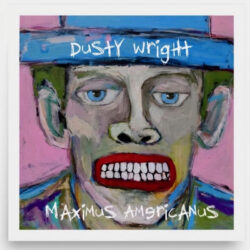 Self-described as an homage to americana music, Dusty Wright’s latest album offers a smorgasbord of nods to the genre. It would be easy to lose yourself in a spot-the-reference game, and whilst this may be fun, it is probably unfair to the material and ultimately reductive. From the Latin, Maximus Americanus roughly translates as ‘biggest’ or ‘greatest American’, and assuming the title is not a comment on his countrymen’s waistlines, it alludes to the wide musical scope and diversity that the americana genre offers, whilst also giving a clue to Wright’s rather tongue-in-cheek humour. On this album we are talking lots of americana, maybe the bigliest amount of americana and all of it squeezed onto a few multifarious tracks.
Wright hails from Akron, Ohio. He has led a number of musical projects as well as hosting his own video and podcast show, appropriately titled The Dusty Wright Show, on which he has interviewed many household names. This, his twelfth album, was cut live in the studio with his core band plus his former bandmate, keys player Erik Deutsch, on loan from The Black Crowes tour. The band are accomplished, albeit on this album mostly restrained, and they perform sterling work crossing the americana continent.
Of the ten tracks Wright has written eight; the other two by those up-and-coming names B. Dylan and L. Williams. The album stomps into action with New York Queen, apparently a tribute to those cool New York women who ‘control the scene’. Not sure if Wright has anyone in mind here yet; we’re incontinently parachuted into the Big Apple’s brash, confident, anything-goes scene. If you can get past this one, and you should, then some 1960’s Jim Morrison grunginess grinds our senses on That Was Then. The album lightens and starts to make more sense with the third track, Nowhere Good. Recalling a misspent youth in a town which didn’t offer much opportunity, this song shows Wright’s distinct voice and style. His creative and powerful word use showing rather than telling: “I busted out…you crawled south…we stole a gun…I stabbed a train”. Excellent verb use, driving the narrative forward, making the listener feel part of the action.
On Nowhere Good, Wright sounds like he feels at home, in his own groove, and not trying to be someone else. Similarly, with Right Side Of Love, a song which has a rather charming animated video and, as the PR says, a nod and a wink to Gorillaz. Although a little sweet and sentimental, it has an uplifting message, with the singer admitting he’s over being a total emotional dork. The last song, Hangman’s Rope, is another strong song, this time in the Johnny Cash tradition. As a bonus, there is some excellent accordion and ‘saw’ work from Ryder Cooley from the dark carnival outfit Dust Bowl Faeries. This has a gothic feel, and Wright’s voice really suits this style.
The other songs feel more tongue-in-cheek and do seem to be overreaching for americana references, maybe even clichés. We have some gospel with Wash Away (My Sins), and some very listenable Bill Kirchen-esque honky tonk with Honky Tonk Heart. One Way Town, not the most sophisticated of songs, effectively speaks to the small-town claustrophobia that prompted a sophisticate like Wright to move to the big city. It feels personal and heartfelt, even though why anyone would want to leave Akron while Devo were hanging out there is not clear.
So let’s come back to those covers. Wright’s treatment of the powerfully evocative Lucinda Williams song Essence is a credible effort and again suits Wright’s voice. You Ain’t Going Nowhere probably works, yet there are so many great versions of this song by some stellar artists it’s not clear that this version is necessary. It’s worth noting that Wright has form for doing covers, and to his credit he’s not at all afraid to take on some absolute classics. In one of his earlier incarnations, The Dusty Diamonds, he recorded a highly interpretative version of Zeppelin’s generally uncoverable Ramble On, and hats off, it’s pretty cool.
Being a little controversial, it may be that the album would be better without the Dylan and Lucinda songs. Just to be clear, these songs are absolutely top drawer, and Wright’s versions do have some merits. However, there is a danger that his own quirky compositions are overshadowed by these classics. This album is probably trying to cover too much ground to be cohesive, and it almost feels like a various artists compilation, except after a while you notice that the vocalists all sound pretty similar. Yet Wright has a distinctiveness, and he has written some original quality songs. This is a highly likeable record, and there is a sense that Wright and the other musicians had a lot of fun making it. If you’re looking for an antidote to some of the more serious material around, you could do a lot worse than checking this one out.

