
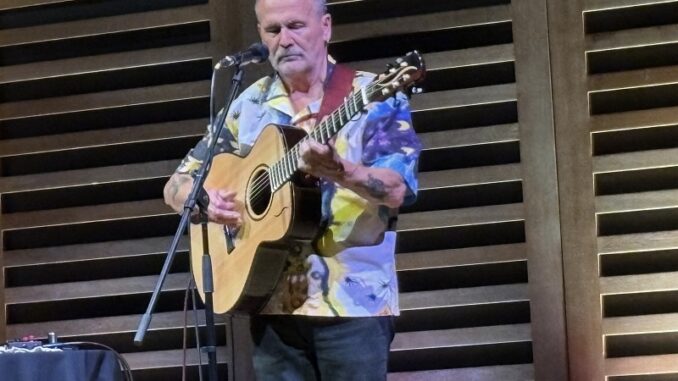
It’s getting into that busy, post-festival part of the year with an impossible number of gigs coming up through the Autumn. It could have been Grace Petrie at Union Chapel, or Cohen Braithwaite-Kilcoyne at the Ivy House – but it was Martin Simpson at the very convenient Kings Place for a gig supporting his latest release, Some Kind Of Jubilee. It’s an album that marks his fifty years in music, and this being also the release day, the gig was effectively the launch party. It was a gig without a formal support in the room, but there had been Anna McLuckie in the foyer beforehand. Sadly, thanks to the “reliability” of trains in the UK…and we all know how that sentence ends.
Martin Simpson strolled onto the Hall 1 stage at Kings Place pretty much at 8PM, and without a word of introduction, launched into a meticulous version of Motherless Child, playing effortless slide-guitar accompaniment. It was a song, he explained after, that has a double resonance for him; he had learnt it young from the singing of Paul Robeson, and it was a favourite of his older brother, who recently passed away, who gave Simpson his first guitar, something that, Simpson reflects, was judged in the family to be “a waste of time and money“.
Martin Simpson interspersed the songs that followed with anecdotes or explanations that, for Love Never Dies, were probably longer than the song. He has long been an interpreter, most significantly with the addition of complex and beautiful finger-picked guitar parts to songs either by others or associated with others. He learnt the traditional Mary Hamilton because he was obsessed with Baez and Dylan, which also explains Don’t Think Twice, It’s All Right. Mary Hamilton is one of the darkest traditional ballads – one of the Queen’s maids kills her baby and is hanged; the King tries to save her, but she scorns him since it was he who fathered the child.
There’s more reworking of others’ songs with a mournful Down Where The Drunkards Roll which imbues a slow song with additional layers of melancholy, but it takes a fine guitar player to bring a Richard Thompson song into their repertoire. It wasn’t an evening unleavened with humour – with Martin Simpson enquiring who has read Dylan’s Chronicles Volume 1 and being unimpressed by the show of hands saying “could be better.” The link, though, was to Mike Seeger, whose musical talent and vast store of songs convinced the young Dylan that he’d better write some songs of his own. Simpson was equally enthralled by Seeger’s recordings, in particular Handsome Molly, which Seeger sang to his own fiddle accompaniment and Martin Simpson, naturally enough, transposed for the guitar.
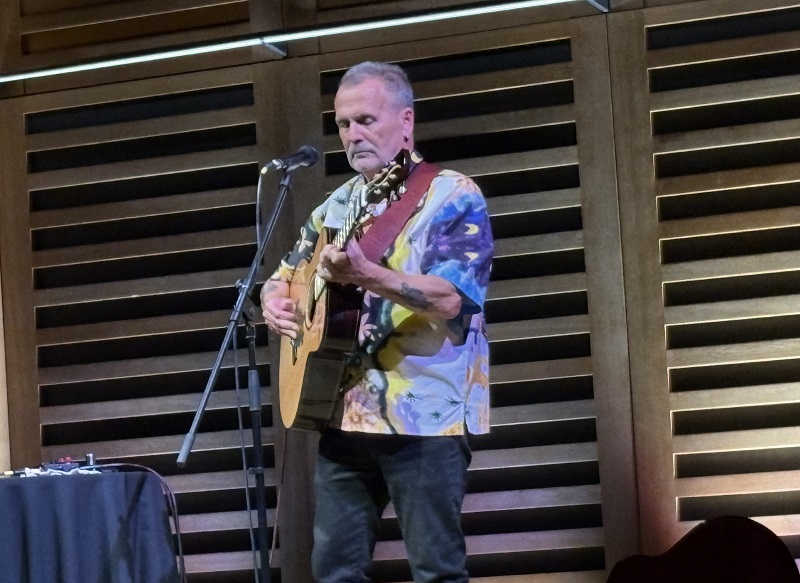
After the interval, the second set was promised as containing more songs inspired by or about nature, starting with Dark Swift And Bright Swallow where reflections on the folly of war at Slapton Sands (where the D-Day rehearsal Exercise Tiger went tragically wrong) are lifted by the sudden appearance of the first Swallow of the year; an endless migratory cycle that puts man’s cruelty into some sort of perspective. Skydancers benefited from a line gifted by Simpson’s neighbour, Richard Hawley, who, on one reflective evening, stated: “the bird completes the skyline“. That’s actually a heavy thought, as the song was commissioned by Chris Packham, and is about the Hen Harrier, a protected bird that should be thriving like the Red Kites that now often fill the skies but doesn’t because it has the misfortune to prefer grouse moors where, in the name of shooting “sport”, it is ruthlessly pushed out of its habitat. It is a gorgeous song that asks some not-so-hard questions; what’s more important, rare birds or gunplay? On Survivor, the attention turned to a favourite elm tree that’s clinging to life; it’s a song that twists and turns like the walk that inspired it, like the curved shoots of the elm that have seen off the industrialisation that once was a dominant feature of the stream it grows near. At least it did, once Martin Simpson had assayed three or so attempts to get the tune to respond to muscle memory, a baffling struggle finally resolved with the realisation “ah…it’s in the wrong key“, a demonstration that perfection doesn’t come as easily as he had made it look throughout the evening.
It wasn’t all bucolic revels and musings on the environment, though; Never Any Good is a wonderful recollection of a father, born in 1899, no less, who wasn’t adapted for a life of work, more suited to riding a motorbike and fishing. The Recruited Collier, we’re told, was originally a peat cutter; this information coming via Jon Boden, who had contradicted Martin Carthy’s assertion that Bert Lloyd had made the whole song up. Arguably, the floating and complex guitar work carrying Anne Lister’s Icarus is another nature song, although here it’s man’s nature in reaching too high, perhaps too attached to technology, definitely too in love with ambition. If Blues Runs The Game was a reconnection to a time when it was a song that every guitar player would have to hand, then Victor Jara is a condemnation of political oppression wrapped up in an almost hymnal package, Adrian Mitchell’s words set to music by Arlo Guthrie; someone, Simpson remarked, “not known for his great tunes“, but this one is. There’s another direct political commentary on the night’s closer, More Than Enough; a gently sung rebuke, although the words are hard enough, comparing society’s choices, which never seem to be to promote equality or a decent quality of life for all and instead ensure that “the well off they always take more, so there’s never enough for the poor.” Unsurprisingly it gets an enthusiastic reception; well, we’re all socialists down the folk club, now it’s just the rest of the world left to be persuaded.
It had been an evening that had touched on Martin Simpson’s musical history: his passion for certain performers, his love for the natural world and his disdain for political oppression. A rich mix, carried off with ease and a comradely demeanour. And an amazing aptitude for guitar playing; still one of the best players on the British, or any other, folk scene.

