
A welcome and wonderful return.
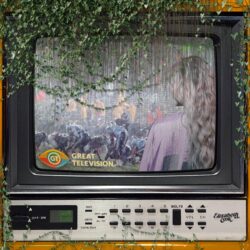 It’s hard to believe we have gone six years since Elizabeth Cook’s last album, Aftermath. Not that she’s been idle in the intervening years, with her television fishing show and a regular slot as a DJ on Sirius XM. Cook has also been collaborating on The Easy Kind, a narrative film about her life as an artist fundamentally resistant to Nashville music conformity. The film stars Cook alongside David Letterman (playing a version of himself), Karen Allen, Susie Essman, Melissa Jackson, and Charles Esten, all playing characters in the semi-fictional version of Cook’s life, and directed by Katy Chevigny in her narrative feature debut.
For Great Television, Cook took off with her touring band to Los Angeles to work with producer Shooter Jennings at Sunset Sound studio. For this record, Cook expanded on the narrative sensibilities of her past few albums while shaping her songs for immediate impact. “I wanted this album to take everyone on the ride of the American experience, both from a deeply personal perspective and from a place of reflecting on historical events and their ripple effects,” says Cook. “It felt important to make the songs very concise and digestible, but with a lot of layers to dig into if you want to really dive in. There’s a lot of code in these lyrics.”
The album opens with Sunset Promenade, in which Cook mulls the impact of celebrity as well as the way in which media perspectives shape news values. The song swells with strings in the chorus as Cook is joined in the vocal by Ashley Monroe and Trevor Bahnson. The strings over the outro create a gorgeous cinematic effect, conjuring images of the sun going down over the ocean.
Girls of Atomic City opens with some twangy guitar from Andrew Leahey as Cook sings of the contribution of the women of Oak Ridge to the US atomic programme in the 1940s. Motivation, commitment, sacrifice and opportunity intermesh as they reckon with what Cook calls the “quiet cost of a history-making mission”. History and wartime feature again in Thiokol Tripwire. The song is focused on the mainly black women who staffed a Thiokol factory in Georgia, feeding the military with tripwires during the Vietnam War. In early 1971, the plant exploded, killing and seriously wounding many. Cook’s tune is anthemic, rising throughout.
Okeechobee Mud is a slower-paced tune introduced with Cook’s vocal and acoustic guitar. As the song grows and the tale of love and roots develops, the piano beds down the melody while the outro features more swirling guitar licks from Leahey. Razorwire Wall was an early single and rocks out with a vengeance. Evan Felker adds the companion vocal while Cook sears and simmers.
Next up is The Easy Kind, a powerhouse ballad with a big beat and a bigger chorus. The song is a duet with Wynonna Judd and has an emotional kick that could wrench the hardest of hearts. It feels like a statement. It’s almost a relief when the heads-down country rock of Caldonia and the Love Convoy jumps the starting gate. The song’s an unapologetic road rocker which you can imagine setting the room moving in concert.
Emotion surges once more with In Your Veins, a non-judgmental take on addiction and choice, addressing the tendency to detachment while acknowledging the pull of love and family. Next up is a revisiting of the Stones’ 19th Nervous Breakdown, rewritten from the second person to the first person and rooted in Cook’s experiences. She completely reworks the final verse: “When I was a kid I mostly did anything I want/ Sometimes that works out for the best, but sometimes it don’t/ There’s many things at play in me, and this is just one part / I hope that on the other side you’ll help me make it art”. It’s brave but hits the spot.
Feverfew tears off at a fair rate as she rips through a tale of an unwise but irresistible relationship. Finally, we reach the album closer, Lightly, a slower song expressing the contrasting feelings within family but with love, albeit stretched, at its heart. After the final chorus, the piano fills lead into an uplifting guitar solo.
New music from Elizabeth Cook is always a cause for celebration, and Great Television is a superb listen from beginning to end.


Agreed. An excellent album from start to finish.
A terrific album deserving of this spot-on review. Cook in full flight is a joyous thing.