
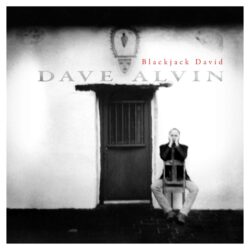
Dave Alvin’s Blackjack David, one of the great americana albums and now with added tracks, gets the Craft Recordings treatment.
Hightone Records and Craft Recordings, celebrating its 40th anniversary, are in the process of re-releasing iconic albums that were originally released during the lifetime of their existence. And they are now releasing an absolute classic, a remastered version (with two extra tracks) of Blackjack David by the esteemed singer-songwriter Dave Alvin. This now appears on 2 vinyl albums, CD and hi-res digital outlets to celebrate its 28th anniversary.
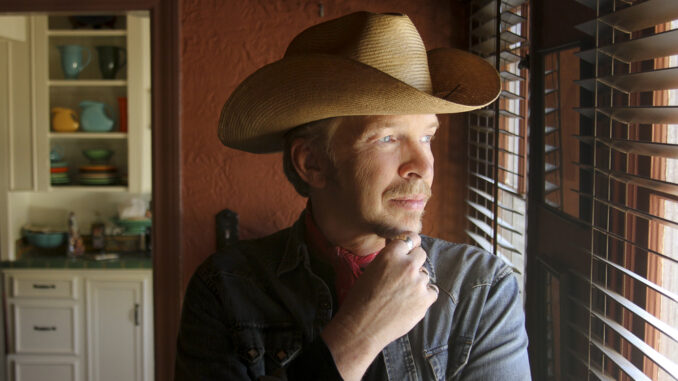
 Originally released in 1998, this was Alvin’s sixth solo album following his departure from The Blasters, an indie roots rock/punk outfit that featured Dave Alvin as writer and lead guitarist and his brother Phil on vocals. That band had been reasonably successful without troubling the scorers of commercial sales very much, but a tumultuous relationship between the brothers led to Dave leaving in 1985 after 6 years. His subsequent solo albums featured his interesting roots-type songs but were much less high-energy on record as he drifted into an area largely occupied by the likes of artists like John Hyatt.
His sixth album, Blackjack David, however, made listeners and critics look up, as it were, as it was, as you slowly begin to realise if you listen to it more than once, one of the great americana albums of the last 30 years, or since americana became a thing, a perfect song cycle about losers, lovers, migrants, veterans and various outsiders, some of whom are trying to run away and others who aren’t, vivid characters that inhabit some downtrodden existence and darker areas of society. The album dials down the electric guitar of The Blasters and his earlier albums, for a much more acoustically focused album, predominantly folk-inspired but with elements of blues,country and roots rock in which Alvin’s baritone lived-in voice matches the mood of each song.
It kicks off with a traditional folk song, the title track (previously known as Black Jack Davy or The Raggle Taggle Gypsy, with a lightly swinging acoustic guitar backing to a song about a woman who leaves her home for a stranger, and the tone for the album is set. Slick acoustic guitar playing, especially, as throughout, by Alvin and by producer Greg Leisz, who plays virtually every kind of stringed instrument on the album. Abilene follows with Dillon O’ Brian’s harmonium (and electric piano?) driving the upbeat rhythm on a downbeat story of a woman who is running away from abuse and other horrors, just looking to improve her life. Matching a very dark scenario with a rather jaunty tempo is quite clever and is applied more than once on the album. New Highway switches the sex of the protagonist to a man who chooses the highway as a friend and a means to get away, but finds it also highlights his isolation. It has a much more roots-based sound (and a 60s feel) with Alvin almost growling some of the lyrics.
California Snow is a quite brilliant ballad about the musings of a border patrol agent about the immigrant experience at the Mexico/California line. And no surprise that the song is so good, as it was co-written with friend Tom Russell. Evening Blues is rather more folksy than bluesy but the title evokes the loneliness of the character at the end of a relationship: “All the promises you whispered to me / I guess they’re meant for someone else / Cause all I hear is the soft evenin’ rain / And the blues that I sing to myself”.
And the masterful songs keep on coming: The Way You Say Goodbye is about the realisation of the end of a relationship, sung along to a jaunty, swampy beat, and includes a shortish fiery electric guitar solo, Mary Brown has much of the tone of the title track, a very noir song about Charlie Thomas who falls for Mary Brown but kills her husband due to his abuse, and then she abandons him when he is sentenced for the murder: “Now I haven’t seen Mary Brown since the trial’s end / And she never answers the letters that I send / And I heard that she married her husband’s best friend / Yeah but for the love of Mary Brown, man I’d do it all again“. Leisz’s haunting steel wails in the background.
Laurel Lynn has a bouncy tex-mex backing to a bluesy song, with Chris Gaffney’s accordion in evidence, and thereafter follows the album’s masterpiece, 1968, co-written with his friend Gaffney, the story of a Vietnam vet who is haunted by the death of his friend while they were both serving in the war. A brilliant title, as the song never mentions the war, this has a rolling Johnny Cash feel. From a Kitchen Table is almost as good, a stunning reflective ballad about a life un-lived, as a man reminisces about the woman who got away,with organ and a mournful clarinet drifting along in the background. The song is an emotional heavyweight with Alvin sometimes half-speaking the lyrics then soaring into a part describing his inability to leave the town after his father died. The eerie Tall Trees closed the original album, a very evocative number in which the narrator imagines a former lover returning to him, the sounds of nature a calling to him – tall trees swaying, full moon rising and night birds crying. “Most of the story songs I write don’t have endings. They leave room for different interpretations“, said Alvin in interview. And so it is with this track, a brilliant end to the original album.
There are two additions to the reissue; Dixie Highway Blues, a wonderfully sung and played (on acoustic guitar) blues, virtually retelling the highway as friend narrative and missed relationship opportunity ; this came from the original recording sessions and has already appeared on The best of the Hightone Years but Angel on Your Shoulder is a real find, a gorgeous gentle ballad, which was recorded back in the days of the original, but polished by additional instrumentation including lovely electric guitar and solo. The song itself is a diamond, the angel who looks after you who’s goin’ to make everything all right after: You turn the light on in your bedroom / Pick up a book you’ve never read / But the words just run together / So you reach for the phone instead / And try to remеmber / A number you once knеw / To tell someone about these good times / They’re missing not being with you”.
Aside from the great lyrics and fine tunes, credit goes to the session players, some of whom are with Alvin’s backing band. I’ve mentioned Leisz already and he is something of a superstar session player, but credit should also go to occasional guests, such as Brantley Kearns on fiddle (from Dwight Yoakam’s band), Bob Glaub on electric bass (one of 4 bass players to grace the album), Doug Wieselman on the aformentioned clarinet (and organ), and Dan McGough also on organ.
Twenty eight years on and this wonderful re-release is a timely reminder of what americana music is all about (though it had not been named at that time), and it ranks very highly as one of the best americana albums of all time. A very worthy addition to anyone’s record collection.
