
Stuart Anderson concludes our Americana Stories series with The Doubts That Make Us Strong. Stuart says:
I’m a retired network engineer who was shown three guitar chords by a good friend at school, and who hasn’t really progressed musically from there in the intervening years but still has the guitar sitting in the corner in case the muse descends. I tried a couple of times to be in a band, in the spirit of the “anyone can do it” attitude that surrounded me in my formative years. It turns out that, in fact, not everyone can do it; hence I’m a retired network engineer.
I suspect, like many of the Americana UK readership, I came to Americana via a long and winding musical road, and I do still revisit the twists and turns of that road from time to time.
The Doubts That Make Us Strong.
by Stuart Anderson
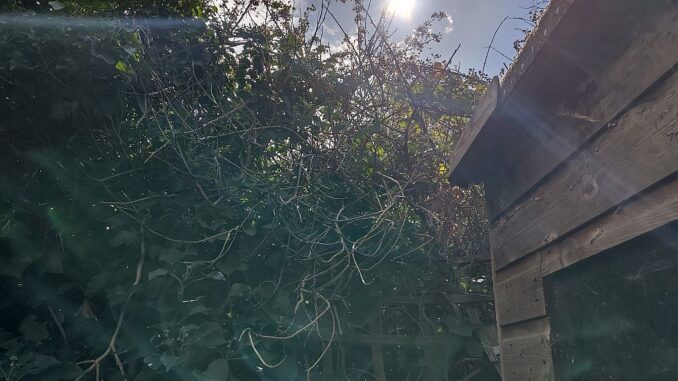
It was impossible to get through the fence. The ivy, despite having been cut back the previous year,
had wound its way round and through its rotting wooden remains, although this didn’t prevent the
foxes from entering the garden at will. I have often looked out of the upstairs window as a goods
train trundled by, speculating on where it was heading, where it had come from. Sometimes the
trains stopped, presumably a red light down the line delaying progress. That would be my
opportunity to board. Everything will be different when the train stops.
I heard the front door open then close as Zora returned. It caught me by surprise a little – she was
earlier than usual, but I could hear her half singing, half humming an old Patsy Cline tune as she
ascended, so I assumed there wasn’t anything wrong. She walked into the bedroom, then, after
loosening her hair, turned towards me.
“I want to talk.”
I stopped strumming as a sense of unease came over me.
“I forgot my sandwiches this morning, so I came back to get them. I heard you singing. I heard the
words. Can you remember them?”
“Well, er, it was a work in progress, I guess.”
“You once told me that you only ever write the truth. This morning I heard:
“If she should find out about these years of lies
and see through the habit of this disguise
I’m doomed”
Zora reached over and picked up my notebook. She looked at the open page, and then began
flicking backwards through it.
“I’m going to read for a while“, she said as she walked out of the room, notebook in hand and an
expression I found impossible to read on her face.
We had met at an open mic in the basement of The Death Knell. I’d been drinking there for a couple
of years, but that night was her first time in the scruffy but welcoming pub. We got talking whilst a
succession of past or future musicians sang morbid songs to the accompaniment of dolefully
strummed or maniacally thrashed acoustic guitars. That evening’s exception was a tall, handsome,
aged punk brandishing a ukulele with one less string than the accepted norm and with a fearsome
amount of anger towards supermarkets. I was initially captivated by his contribution, but it didn’t
hold my attention for long as I was drawn into the précis of a life that this slow-talking woman was
giving me, having lowered herself into the empty chair next to mine. She had an accent I couldn’t
pin down, and an aura I couldn’t ignore. In a gloomy basement largely peopled by drinkers who
weren’t quite as happy as they’d like to be, she seemed to know who she was. She didn’t fit in, and
I found that irresistible. I’d only had two pints at that point.
She told me she was born and had grown up in the US with her Yorkshire-born Mum and Dad, and
had come over to the UK accompanied by her Dad’s ashes, which she had scattered on the
Leeds-Liverpool canal earlier that year even though her Dad had never been able to swim.
She said he had claimed to have had many formative experiences by the canal: first alcoholic drink,
first black eye, first fumbles under the clothes of his contemporaries, first encounter with her Mum.
He didn’t want to stay in the US post-mortem having watched with increasing despair and
incredulity recent events in the country he had called home, and intermittently loved, for almost
thirty years. He and her Mum had tried their luck there when the canal and its surroundings were no
longer big enough to contain their dreams. It worked out for them, like it had worked out for so
many others in similar circumstances, but as he lay on the ground, blood and life slowly leaving his
body via the large wound above his right ear, he had said to his daughter the country was no place
for people like him any more, dead or alive.
Once she had tied a bow on her Dad’s death in Yorkshire, she started to explore the county and then
the country of her parents, and in part liked what she found. Tucking her US passport at the back of
both her suitcase and her mind, she felt she had found a place to call home. And so there she was, in
a pub basement on a Tuesday night, getting to know a stranger to the accompaniment of songs of
love, regret and shoplifting.
As I stood in the bedroom with the sound of her footsteps receding into silence, the memories of
that first evening pushed their way to the forefront of my mind. I felt strangely calm that she was
sitting down with my notebook in front of her – effectively my personal diaries – about to decipher
what I meant by truth. What I still mean by truth. I had never hidden the notebook. I just trusted that
if it wasn’t left open, she wouldn’t open it. Feeling something adjacent to guilt, but without its
dragging weight, I put my guitar back on its stand, reopened the window that I had closed earlier
despite the heat in order not to entertain the neighbours, and sat down. Suddenly the room had the
atmosphere of a dentist’s waiting room, with the added complication of history with the dentist.
At the end of that first evening we climbed the stairs from the basement side by side, not quite
touching. At the threshold of the pub she turned to me and offered her hand, very obviously for
shaking, not for holding. I responded as required, but my heart sank a little. The asthmatic sound of
an approaching bus was her cue to begin a gentle run towards the bus stop. I stood watching her,
full of words but tongue-tied. As she stepped onto the bus, she turned around, stared straight at me
and shouted much louder than necessary, “Same time next week, loser!” I wasn’t sure if it was a
statement or a question, and before I could respond- what could I say anyway?- the bus doors
closed, and as the bus pulled away she appeared on the top deck. She didn’t look down to where I
stood, confused but strangely happy.
“Loser doesn’t sound promising“, said ukulele punk, chuckling as he wandered into the off-licence
next to the pub, battered instrument under his arm. “I reckon I’ll see you next week though. I bet
you want to find out if she’s taking the piss; I know I do. I might even have a new song to play by
then; Same Time Next Week, Loser, is a cracking title“.
He wasn’t wrong. What’s a loser got to lose?
I must have been sitting on the bed for maybe an hour, floating happily on a current of nostalgia,
when I was reminded that I was nominally working by an incoming call. A bit late in the day, I
thought, but it seemed reasonable in the light of my previous daydreaming. I clicked on accept and
the smiling face of Elaine appeared.
“That tender; procurement being procurement, we’ve now got to get the evaluations in by the end
of tomorrow. Any chance?”
“I’ll give it a go, but no guarantees. What do Ash and Nina say?”
“Pretty much the same as you. Keep me posted on progress.” She ended the call before I could
introduce more doubt, and her face was replaced by the plain desktop I preferred. I listened for any
sound from downstairs. All was quiet.
The week after that night we first met passed in the traditional manner, with work, food, drink, and
a musical soundtrack. Part of the reason I had gone to the open mic was reconnaissance. I was
toying with the idea of putting my name down one week and actually unleashing a couple of the
songs, up to now heard by no one, on a very small part of the world. I wasn’t convinced it was a
good idea, but I thought if I could see a few people doing similar things in that basement I might get
a feel for how much of a risk I’d be taking, how much of a fool I might make of myself, just how
humiliating it could be. Thanks to Zora’s unscheduled appearance, I had in fact neglected my
research, finding myself captivated by her almost-monologue instead. But I hadn’t completely
shelved the idea. The performances I had heard hadn’t exactly made me feel that I was living in the
new Nashville. People could sing, people could play, there were words that rhymed, and notes that
from time to time added up to tunes. But there was a reason why these people were gathered in a
basement on the High Road on a Tuesday evening. Maybe I could give it a go? If things fell apart, I
need never go back; I could find a different place to drink, a different dream, a different haircut.
But perhaps this coming Tuesday wasn’t the best time to take the plunge. Having rerun the events of
the previous Tuesday evening too many times to count, I was now set on learning more about the
woman who had appeared from nowhere, before she disappeared back there. If she turned up. I was
painfully aware there were no promises to break.
I opened the spreadsheet I’d been sent, in which I was required to note my thoughts on various
competing proposals to supply The Organisation. But I found it hard to care.
I slowly sank into the work, distracted from anything else after a while and able to exclude from my
mind anything infinitely more important that might be happening downstairs. Time passed,
laughingly bold claims were disregarded, copy and paste errors were held against overworked
salespeople, as were spelling mistakes. Then I heard Zora’s gentle footsteps, and I looked up to see
her standing in the doorway. I guess she had been evaluating a proposal too in a way; I was keen to
see what she had noted in her spreadsheet. The look on her face didn’t give anything away; it was
neutral, blank, beautiful.
“Do you want a cup of tea?” she said.
“Good idea, yes, thanks“, I replied, although I didn’t really. A lie. I couldn’t stop my head briefly
dropping and a guilty smile passing across my face.
“Do you want to talk about truth?” she then said, perhaps with a slight chuckle. Given time,
everything becomes comical.
“Yes, in all honesty I do“, came my reply, before I’d even thought about what this might involve.
The Organisation can wait. Indefinitely if necessary.
Tuesday came. I left my guitar in its usual place on my bed and went to The Death Knell
unencumbered. Descending into the basement, I could hear that the evening’s entertainment had
already begun, the picked notes of a banjo – a banjo?! – getting briefly louder each time the door
below opened. When I entered, I could see the usual scattering of people, the music drifting out into
the half-filled room and enveloping them like fog. There was no sign of Zora, and my spirits sank. I
looked up at the low stage as a gentle voice joined the plucked accompaniment. and froze when I
saw her, dark fringe curtaining her eyes. I stared, didn’t move for perhaps a minute or more before
finally regaining control of my limbs and methodically, one step at a time, heading to the bar. I
ordered, sotto voce, my usual pint, and stood silently, drink in hand, fully focused on the stage.
Why hadn’t she told me last week about this aspect of her life? She shares details of her Dad’s
murder, but nothing at all about her music, not even the fact that it exists. I reminded myself that I
too had not talked about music, mine or anybody else’s, and had in fact not shared much at all last
Tuesday. There are no rules; that’s the beauty of strangers meeting. You can be whoever you want in
the initial excitement, but you can’t avoid becoming who you are in the fullness of time.
She had got to the chorus now:
“No-man’s land is for everyone, I will not disappear.
Why shouldn’t I be here? Why shouldn’t I be here?”
She repeated the last line again and again as the banjo accompaniment gradually diminished to a
single almost silent note. In a gentle parallel, the words became “Why shouldn’t I be?“, then “Why
shouldn’t I?“, then finally just “Why?“. Eventually there was silence. When those listening realised
it was actually over, applause rose from the void, building on itself then fading again. I was
mesmerised. Zora gave a smile, a quiet “thanks“, then looked directly at me for the first time that
evening as she stepped down from the stage and said, “pint of lager please“.
I turned back to the bar and ordered as requested. Zora appeared beside me as I paid and, smiling
again, said, “Glad you came“. Or possibly “Glad you came?” It was hard to tell, and I wasn’t going
to risk assuming one or the other, so just responded with a smile of my own.
“That was unexpected, and brilliant“, I said honestly, “you’re full of surprises“.
“Well, this is only the second time we’ve met, so I’d be disappointed if I wasn’t at this stage. Are
you going to play tonight too?”
“No. Hang on, what makes you think I play?”
“Nobody comes to an open mic without at least the possibility of playing in their mind. Unless
they’re a blood relative of a performer. Or in love with them.”
That escalated quickly, I thought. “Well, I’m not a blood relative of anyone here, so I guess you’ve
got me“. I congratulated myself on the genius ambiguity of my reply.
“That’s a bit of a smartarse reply“.
I hurtled towards the ground in flames, but laughed. As we continued chatting, things got less crapromantic-comedy-conversational-jousting, and more like real people talking. Like last week, the
time flew by, and I didn’t really register the subsequent performers, so my reconnaissance was
scuppered again. We just talked; it felt like we would never run out of things to say. It still feels like
that now, four years later, although we’re talking about different things. I knew, at the end of that
second evening, that this was it, she was it, she could save me from as-yet undefined perils. I hoped
that this was a reciprocal arrangement.
“This is a new song“, came a vaguely familiar voice from the stage, “it’s called Same Time Next
Week, Loser“. Zora snorted with laughter, showering me with lager. I laughed too, bracing myself
for what was to come.
Zora returned with two mugs, set one down beside me on the desk, and sat on the bed. We looked at
each other in silence for maybe a minute. “Do you want to start?” I asked.
“I’m not sure where to start. Things really aren’t as complicated as you like to imagine them, you
know? Not every action has an ulterior motive. Not every word is significant in the great scheme of
things.”
“But you wrote songs too. Every word is significant. Otherwise why bother with them? There’s a
limit for every song, so you have to choose them carefully. Otherwise…”
“I’m not talking about songs right now; we’ll come back to them. I’m talking about life. Nobody
can be 100% switched on to what they say and do 100% of the time. Sometimes we say and do
what gets us through the day, hopefully without doing any harm. But that hope can’t always be
fulfilled. Sometimes we do harm, and we have to live with that.”
“Yes.”
There was a long silence. It wasn’t clear to me who would be next to speak. I didn’t feel like I had
anything to add to my single-word reply. The sound of a train passing intruded. Eventually, even
though she didn’t appear to be as discomforted by the stalled conversation as I was, Zora spoke
again.
“I’ve been really happy since I met you. I can’t put my finger on why. You didn’t seem like the kind
of person that could make somebody happy when we talked that first night. I wasn’t sure I’d go
back the next week, but when I got home I realised that something in my life had shifted. And it
shifted further that second Tuesday. By the third week it felt like game over, in a good way. I like to
think you felt the same.”
“Almost the same, but without the same assessment of you. Or the doubt. Or waiting until the third
week for game over. So not really the same at all, but I arrived at the same destination. I think some
people call it love, but I struggle with the terminology.”
“Yeah, I’d noticed that.” Zora smiled a smile of such warmth that I felt like crying. “Do you think
we’ll die together?”
“Bloody hell, Zora, that was a bit of a leap. It’s a serious question?”
“Yes. I don’t mean like in a double murder or a bus crash or a suicide pact. I mean, will we be
together when one of us dies?”
“That’s what I want.”
“But do you think it’s what will happen?”
“If it’s what you want too, then yes. And ideally I’ll go first, so I skip the grief and the death
admin.”
“It’s what I want too. For you to die first, I mean. I’m better at admin.”
We smiled simultaneously. I felt like I was floating, warm, at peace. Nothing more was said for a
couple of minutes, but it didn’t feel like silence. Then I remembered how we’d got here. “So, did
you enjoy your reading earlier? Probably made a change from your usual at least.”
“It’s all fiction, isn’t it? But full of truth. I was angry about your lines about lies and disguise; I don’t
want to be in that kind of relationship. It’s such an obvious rhyme; it’s lazy, and we deserve better.
I’ve had time to think about it now, and I realise it’s not the big deal I thought it was when it felt like
I’d stumbled upon a secret you were keeping. Secrets are just things you haven’t told me yet, and
it’s good that you still have things to tell me. That should keep us entertained until you die first. I
think you should rewrite it, maybe try memorialise? Or tranquillise? Actually no, they’re crap; it
would be rhyming lies and lise, which isn’t a rhyme at all. Pies, that would work. How about:
If she should find out about these years of lies
and find out who ate all the pies”
“I could be wrong, but I think you’re taking the piss now. God, I hope you haven’t found out about
the pies though.” Love was coursing through me, combined with relief. But now that Zora had
opened my notebook, I wanted to annotate it for her. “I do only write the truth, though. I do want you
to understand that. Things can be true for just a moment, like a particle with a fleeting existence. If I
document that particle, it doesn’t make it live longer, but it might make it easier to understand. I’m
trying to understand things, that’s all. There isn’t meant to be collateral damage. I don’t want us to
be collateral damage.”
“I know. The truth of my anger was transient too. Your notebook made for an interesting read. I
couldn’t decode most of it, but some parts were enlightening. A couple of lines near the end helped
my anger fade.” Zora opened my notebook at a page I saw she had marked, and read:
“Written in these songs are the doubts that make us strong
And the cracks that make sure we don’t fall apart”
“Shit, did you read the first bit of that one too?”
“I read everything. The first bit’s about someone else, isn’t it? So you don’t need to freak out. I
know you better now, but I don’t think any worse of you. Isn’t that a happy ending?”
“Ending?”
“It’s a figure of speech. Try letting some words drift by you; you don’t have to grab them all to
analyse them. I said earlier, not every word is significant in the great scheme of things.”
I stood up and walked towards Zora, who was still sitting on the bed. She stood up too, and we held
each other. Eventually we each lowered our arms and took a step back. There was nothing left to be
said, so we said nothing. My tea was undrunk and cold. I picked up my mug and started downstairs
to the kitchen. Zora followed. I flicked the kettle on, and turned to her. “I can’t do tenders and all
that any more. I don’t care about them. Nina and Ash do, fair play to them, but I don’t. I want to
jump on the train and see where it ends up,” I said. “The goods train beyond the garden. I need to go
somewhere I haven’t been before, experience something I haven’t experienced before. I’ll come
back; how could I not? But I feel like life changes from today, in a positive way.”
“Another terrible rhyme“.
“Fair. How about “Life changes from today, but I won’t be led astray”?” Zora rolled her eyes. “I
won’t. I want to die with you. But I need to go to come back. Do you understand? Will you still be
here?”
“Sort of, and yes. I don’t want to be anywhere else. This is our home. Jump the train, take a new
notebook – I’m holding the current one hostage – but make sure you come back.”
Having given up on getting through the ivy onto the railway embankment, I climbed up onto the
roof of the shed. It creaked as I shuffled along the length of the roof to the edge nearest the line. I
looked down to see that the drop was significant. The foxes were always sunbathing up on this roof; if they can get up and down, surely so could I? I scanned again for a suitable landing spot, and
settled on a benign-looking bush in an ocean of blackberries. To reach it I would have to stand up
on the roof so that I could jump, as dropping off from my current sitting position would leave me
short of my target and waist-deep in brambles. Slowly I pushed myself up, then listened for the
train. It was just after 3am. Almost every night around this time a train approached noisily, stopped,
then set off again, rattling the windows of the houses. If I was going to do this, now was the time.
I looked back at our bedroom window. There was no light, but the curtain was pulled slightly to one
side. I could only see darkness beyond it. I faced forward again and jumped. The relative silence
was pierced by a loud crack followed by an anguished scream.
At this point an observer would have seen a body fold dramatically, an ankle disfigured, then a head
impacting on a tree stump, then perfect stillness. Minutes later, such an observer would see a goods
train approach and come to a gentle halt, then move off again effortfully. Windows would rattle, but
nothing would stir on the embankment. The train would disappear into the darkness, then a fox
would emerge and sniff around a still body, then issue a cry of neither joy nor anguish. One by one
further foxes would join, and soon the still body would be encircled, and the noose formed by the
foxes would tighten. At this point, an observer would look away, there being nothing more to see.


