
An immersive collection of pastoral folk songs to lose yourself in, full of beautiful harmonies, flowing guitars and quiet reflections on love, loss and the natural world.
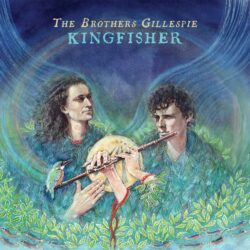 There are albums that demand your attention and others that seem to invite you to fall into them. Kingfisher, the new album from Northumbrian folk duo The Brothers Gillespie, belongs firmly in the latter category. Brothers James and Sam Gillespie have created a collection of songs built around acoustic instruments, close harmonies and recurring images of rivers, woods, birds and changing seasons. The result is music that often feels almost meditative: less a collection of individual songs than a place to spend some time.
That atmosphere is established immediately on The Worlds Unfold. Rolling, plucked guitar sits beneath slightly ethereal harmonies before fiddle and the soft crash of a cymbal gradually add texture. Lyrically, the song introduces ideas that recur throughout the album: light, water, dreams and the possibility of something beyond what can immediately be seen. “As the worlds unfold / They’re all aglow / And I’m falling home” could almost act as a statement of intent for what follows.
Snowdrop Song continues the gently hypnotic quality, its fingerpicked guitar moving at a slightly quicker pace as the brothers’ voices come together. There is a longing here for somewhere quieter and wilder, “Where there’s room for wildness” and “time to talk slow”. It would be easy for this immersion in nature to become overly romantic, but the musical restraint helps. Fiddle, percussion and other acoustic touches appear and disappear rather than competing for attention, giving the album a richness that is not immediately obvious.
Nature on Kingfisher is more than picturesque scenery. Rivers, in particular, become associated with memory, time, and the movement between life and death. Tweed One begins with childhood recollections of fishing with an uncle before widening into something more reflective. “Everywhere I hear the echo of the vanished years” captures much of the album’s emotional territory. The river continues to flow while people, memories and generations pass through the landscape.
That connection between the personal and something larger is also beautifully explored on Oisín’s Song. Banjo and voices initially dominate before plaintive fiddle enters and the song eventually gathers pace. Written as a welcome to a child, its hopes are expressed through the natural world: oak, beech, yew, hazel, open fells, and the waters of the Tyne. “Long may you fly in the bright morning sun / We welcome you home our darling young one” is simple, but the warmth of the harmonies gives it considerable emotional weight.
Perhaps the album’s most immersive moment is Anam Cara. A voice emerges over a sustained drone before a wooden flute begins to follow and almost answer the vocal. At over several minutes, the song is allowed to unfold at its own pace, becoming closer to a meditation than a conventional folk song. Its story of kindness offered during a period of difficulty gradually returns to one of the album’s central images: being carried by the current towards the sea.
That sense of refuge reaches its clearest expression on House of Shelter. Beginning quietly with banjo and voice, the arrangement grows as fiddle and percussion join, making it one of the album’s more expansive moments. Its repeated invitation, “Come and lay your burden down”, could equally describe Kingfisher itself. For all the grief and longing within these songs, this is ultimately music concerned with consolation.
Even the explicitly political Till Palestine is Free remains within that musical and lyrical world. Rather than suddenly changing tone, the song places its plea alongside the familiar imagery of burns, larks, rowan trees and the Tweed. The message is direct, but the arrangement retains the same pastoral gentleness as the rest of the album.
There are moments when Kingfisher’s consistency of mood means that individual songs merge into one another. Yet this also seems fundamental to its appeal. The album works through accumulation: flowing guitar, intertwined voices, fiddle, banjo and subtle percussion creating a space in which the listener can simply settle. The instrumental Golden Hilltop provides another opportunity for the guitars to weave around one another, while Tweed Two returns to the river, memory, and those who have gone before.
By the time The Humming Song closes the album, words are no longer really necessary. Voices hum gently over another quiet, meditative arrangement, leaving the listener with their own thoughts. It is an appropriate ending to an album that rarely pushes itself forward.
Kingfisher is beautiful without being showy, spiritual without needing to provide answers. Its recurring imagery and dreamlike atmosphere will not appeal to anyone looking for sharp changes of pace, but that rather misses the point. This is music about surrendering to the flow: to rivers, memory, grief, love, and the passing of time. Sometimes the best thing to do is simply lay your burden down and listen.

