
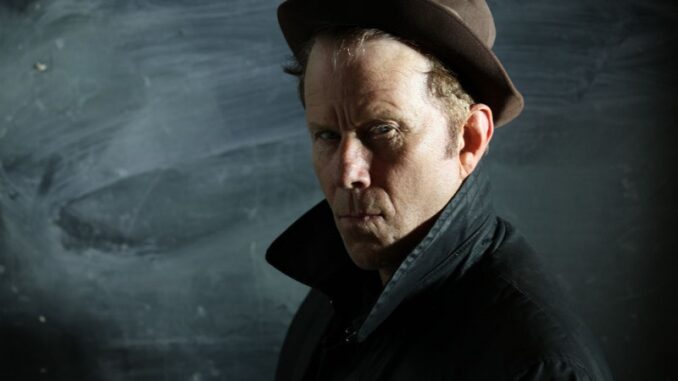
The musical influence of Tom Waits over the last seven decades has spanned far beyond what one might define as americana. His deep, gravely voice, has been described as having been soaked in a vat of bourbon, left hanging in the smokehouse for a few months, and then taken outside and run over with a car, while his genre-diverse accompaniment has gatecrashed its way from folk to rock, jazz, delta blues, opera, vaudeville, cabaret, funk, to even flirting with experimental techniques that verge on industrial music. So, with that in mind, does he really qualify for a major article within these hallowed pages? Well, of course he does, because you just need to look at the calibre of artists that have recorded his songs throughout those seven decades, and in particular, to those contributing to such tribute albums as Step Right Up, New Coat Of Paint, Come On Up To The House; Women Sing Waits, and most recently Where The Willow and the Dogwood Grow. Household names such as Bruce Springsteen, Johnny Cash, Willie Nelson, Joan Baez, Robert Plant and Alison Krauss, along with americana icons like Lucinda Williams, Los Lobos, Patty Griffin, Rosanne Cash and Iris Dement have all sung both his praise as well as his songs. Yes, Tom Waits’ musical influence may be wide and varied, but strip it all back and what lies at the heart of his recorded output is a songwriter of the highest craft.
Now, as always, these articles come with a caveat, and in this case it’s simply a contradiction to the feature’s title. Of course, I can live with all of Waits’ back catalogue, as even his slightly less impressive work still knocks spots off most of what his contemporaries have been able to produce. And yet, as you would expect from an artist who has continued to push boundaries and explore new musical soundscapes, some creations have succeeded better than others. Interestingly, though, the album I have chosen as my least favourite is one where I felt he played too safe, rehashed old ground, thus appearing to write himself into a cul-de-sac, rather than where he has pushed the envelope slightly too far, as in the case with his soundtrack contribution for both cinema and theatre.
Can’t Live With It: Foreign Affairs (1977)
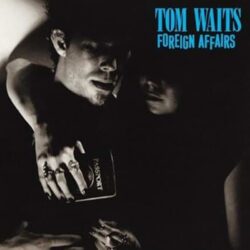 Foreign Affairs saw the light of day on the 13th of September 1977 and was Waits’ fifth studio album release. The album was recorded at Wally Heider’s Studio 3 in Hollywood and was produced, as were all but his debut release, by Bones Howe. Foreign Affairs followed hot on the heels of the previous year’s album, Small Change; in fact, only ten months separated their releases, an album that would in later years be seen as the crowning moment for Waits’ beatnik-glory-meets-Hollywood-noir period. During those preceding years, Waits, inspired by the work of Bob Dylan and the Beat Generation, particularly Jack Kerouac and Charles Bowkowski, had skilfully created a complete persona, where hipsters and wino’s flirted with all-night waitresses who would turn tricks when times got tough. From the release of his sophomore album The Heart Of Saturday Night (1974), Waits had been gradually mastering his craft as a storyteller, drawing on the influence of crime-noir writers such as Dashiell Hammett, and incorporating it with his down-at-the-heel characters, from ambulance drivers to street sweepers, who spent their nights frequenting the seedy hotels and bars of Los Angeles.
The problem for Foreign Affairs was how to follow the relative success, both in sales and critical acclaim, of its predecessor. In a previous interview, producer Howe recalled how the original concept for the album was to create the audio equivalent of a black-and-white movie, which is where the cover art for the album came from with its film noir ambience, in particular the back cover that casts Waits as a slicked-back hoodlum; half matinee idol, half hair-trigger psychopath. The issue here, however, was that over the past three years, Waits had mined his characters to such a degree that there was very little left to tell; his flawed heroes now felt one-dimensional, his own vocals, which by now betrayed the distinct influence of Louis Armstrong, peppered with a hint of Dr John and Howlin’ Wolf, felt tired, whilst his razor-sharp narratives now appeared blunt, lacking direction as if he, himself, had become acutely aware that he’d written himself into a corner.
That’s not to say that the album is without merit, though the warning signals appear immediately with the heavily orchestrated instrumental opener Cinny’s Waltz, which is simply bland, neither setting the scene nor mood for what’s to come, while the following number, Muriel, continues to evoke that same sense of foreboding, feeling a pale pastiche of previous successes. However, things improve considerably with I Never Talk To Strangers, a duet with Bette Midler that harks back to the sort of piano ballad that had become a trademark of Waits’ early recordings. The connection between Midler’s sassy delivery and Waits’ raspy vocals is both complementary and sincere, the two sharing an intermittent relationship at the time of recording. The combination of Waits’ half spoken/half sung poetry with a smoky jazz groove underpinned by some delightful tenor saxophone from Frank Vicari continues to lift the mood on the cover medley Jack & Neal, California, Here I Come, as well as expectations, which stalls somewhat on A Sight For Sore Eyes if only because it retreads some of his better work a little too closely. That disappointment continues to what would originally have been the opening track for side two of the album, Potters Field, which, despite its theatrical demeanour, lacks any cohesion with Waits’ vocal delivery starting to waver from its usual swagger to one that hints at desperation and an awareness that he’s beginning to bore himself.
However, as is the case with genius, just when you think they’re down and out, they hit you with a sucker punch. In this case, that punch comes in the shape of Burma Shave, a song that, to this day, still stands as a Waits classic. The lilting sweetness of the melancholic melody, the heartfelt sincerity of the vocal performance, notes gently caressed and moulded to add credence to the narrative. This is one of Tom Waits’ best songs from his 1970s Beat influence period. This upturn in quality is, to some extent, maintained through the closing two tracks, initially with the mumbled monologue of Barber Shop, before the title track, another piano ballad, but here with a touch more variety in the arrangement that offers greater support to the narrative still trying to fight its corner.
Foreign Affairs is not a bad album, but at this stage in his career, Waits’ narratives were beginning to sound repetitive, and with Howe choosing a monochromatic arrangement, it offered Waits little help in adding any lyrical depth or colour to his by-now all-too-familiar characters. In hindsight, it was clear Waits’ overall sound and persona needed a major makeover, and though his following two albums, Blue Valentine and Heartattack and Vine, both again produced by Howe, hinted at a new direction, it would eventually require a relocation to New York and, most importantly, the introduction to the woman who would soon become his wife and writing partner, Kathleen Brennan, to see Waits evolve into the second phase of his career.
Can’t Live Without It: Rain Dogs (1985)
 It would be irresponsible to wax lyrical about Waits’ ninth studio album immediately, without at first recognising the merits of the album that preceded it, Swordfishtrombones (1983), and the impact Brennan had on Waits’ musical direction. The couple first met in 1978 while Waits was co-starring in the Sylvester Stallone-directed film Paradise Alley, with Waits later describing the encounter as love at first sight, and they were engaged to marry within the week. The two would also work on the soundtrack to Francis Ford Coppola’s film One From The Heart, Brennan as an assistant storyteller, on a project for which Waits was asked to write songs more akin to his early work, a genre he was trying to leave behind, and thus characterised the request as an artistic step backwards. Ironically, the finished work would go on to be nominated for an Academy Award for Original Music Score.
Waits may have had misgivings about the soundtrack album, but the nomination, along with working with Coppola, was vastly important to his career as they led directly to him moving from cult artiste to centre-stage, and with the newly weds now settled in New York, his Elektra-Asylum record contract completed, the artistic reinvention could begin. With Brennan’s help, he said goodbye to his old producer Howe, fired his manager Herb Cohen, and began listening to different music, in particular Captain Beefheart and Harry Partch, which would result in an altogether different approach to his own writing, using images rather than moods or characters as the basis for his songs.
The first public viewing of this new musical style would appear in the form of the album Swordfishtrombones, recorded at Sunset Sound Studios and produced by Waits himself. Here he abandoned the jazz sound characteristic of his earlier work; it was his first album not to feature a saxophone and the first to feature the marimba. The album proved to be a breakthrough, where the music now matched the evocativeness of the narrative, with Waits’ gravely voice resonating against a myriad of horns and percussion. It was as if he had shifted from monologues to screenplays, not just radically reinventing himself but reshaping the musical landscape. And yet in some ways this was only a template for what was to follow some two years later.
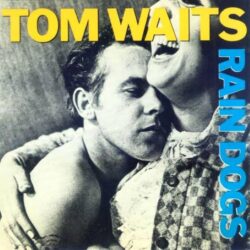
Raindogs was recorded at RCA Studios during the summer of 1985 and released at the end of September that year on the Island Records label, which had stepped in to release Swordfishtrombones after Asylum declined. A loose concept album about the “urban dispossessed” of New York City, Raindogs is generally considered the middle album of a trilogy that concluded with Frank’s Wild Years. Waits wrote the bulk of the material in a two-month stint during the fall of 1984, in a basement room in Manhattan, which, according to Waits, was “kind of a rough area, Lower Manhattan between Canal and 14th Street, just a block from the river…It was a good place for me to work”. Again, taking on the responsibilities of producer, he employed a wide range of instruments to achieve the album’s sound, including marimba, accordion, trombone, banjo and double bass, but what was probably most fundamental to the albums eventual organic sound was Waits total mistrust of what was then the fashionable studio techniques, prepared instead to go as far as using a “chest of drawers in the bathroom and bang it real hard with a two-by-four” until eventually “the sound becomes your own”.
Another key component of the album’s broad spectrum of musical styles and genres was the addition of guitarist Marc Ribot, for whom Raindogs was his first session work, forming a working relationship that would endure for the remainder of Waits’ recording output to date. The album also marked the first time Waits would work with Rolling Stones guitarist Keith Richards, who played on three of the tracks, with Waits reciprocating by contributing vocals and piano to the Rolling Stones album Dirty Work that was released the following year.
Waits would later describe the album’s musicality as “kind of an interaction between Appalachia and Nigeria”, though closer inspection of the soundscape reveals everything from dirty blues to New Orleans funeral brass that perfectly demonstrates Waits’ new persona, liberated from compromise and convention, where nothing is off the table. This newfound freedom also applies to the narrative, and though Waits has made no sacrifices to his storytelling in the pursuit of reinvention, the Beat poetry and piano ballads have all but gone, as are the usual suspects that had littered the margins of his earlier work, lowlife characters scratching out a living on the fringes of society. In their place, Waits has raided the local ‘Freak Circus’, introducing us to Chinese barflies, a blind fireman, one-armed dwarves, and a Puerto Rican mistress with a wooden leg, of which a society this unbalanced is unlikely ever to exist, and yet in the hands of this master wordsmith, they most certainly do.
From the opening track Singapore, with its jagged rhythms delivering an impossible dance beat against Waits’ sinister vocal delivery, to the funereal hymn arrangement of the closing song Anywhere I Lay My Hat, where Waits howls his lament to the moon, this album, with no less than nineteen songs, takes the listener on one of the most surreal fairground rides imaginable. In between, you have the hypnotic percussive beat of Clap Hands, before the following song, Cemetery Polka, introduces the listener to Uncle Vernon, who just happens to be a slaughterhouse boss. One of the album’s many highlights comes in the shape of the much-covered Jockey Full Of Bourbon, where the salsa beat competes with sporadic metallic crashes from the rhythm section. Big Black Mariah swings and stumbles in equal measure while Richards offers up his best trademark licks on guitar as if already aware that he’s playing on the greatest album he’ll ever be associated with.
Elsewhere, the dementia of the lyrics on Diamonds & Gold is equalled by the arrangement, whereas Hang Down Your Head features a slightly more conventional melodic structure that leans closest to his earlier work, and would later be covered by Lucinda Williams. The following song, Time, also gives a nod to Waits’ past; his half-spoken, half-sung, heartfelt delivery takes centre stage against the melancholic melody. In June of this year, CBS News included the song in its list of the 250 essential songs of the past 250 years.
The myriad of sounds continues to challenge the senses. From the rhumba beat of the title track, the twisted talking blues of 9th & Hennepin, the sleazy swagger of Gun Street Girl, to Blind Love, where Waits flirts closer to country music than he’s ever done. Union Square and Walking Spanish have an infectious rock vibe, before the much-covered Downtown Train leads the album triumphantly towards its conclusion.
There is no doubting Raindogs is an astonishing listen, and even forty years after its release it never fails to deliver, still sounding like nothing else. Okay, so it lacked the surprise element of its predecessor, but if Swordfishtrombones was Waits testing the water of his new swimming pool, with Raindogs he’s jumped in, fully submerged, and not yet come up for air. Needless to say, the album has gone on to be Waits’ biggest-selling album and become a staple in the music-press surveys listing the best albums of all time. Raindogs may not strictly be an americana album, but there again neither does it fit comfortably into any other recognised musical genre, but its influence on the americana community, its singers, songwriters and musicians is immeasurable, and to this humble scribe in particular it would prove to be a pivotal moment in my own musical journey.



OK, Graeme – just one observation … the obvious one. “As a songwriter he is right up there; on the top table with the legends. But, vocally to say he’s “an acquired taste” is somewhat understating it.”
….. and yet …. for me I agree that Rain Dogs is outstanding. (but I still prefer the covers!)
Lol. Sorry, Alan, I knew as soon as I’d chosen to cover Tom Waits for this feature you’d be a little perturbed. We will have to disagree about the vocals, though I agree it may be an acquired taste, but at least we can agree on the quality of his songwriting and the choice of “Rain Dogs”. As for the covers, my two favourites are the album John Hammond Jnr did entitled “Wicked Grin” and my old friend Southside Johnny with his album “Grapefruit Moon”. Both worth checking out.