
An atypical blend of influences results in an album of great appeal.
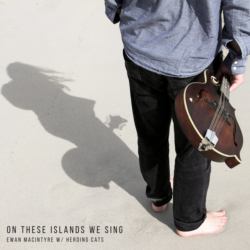 There has never been a time like the present for the merging of traditions. Long before the advent of generative AI (which has certainly produced a great number of stylistic reimaginings of classic material), modern trends showed a clear interest in the interplay between different musical genres and influences. With his latest release, Scottish songwriter Ewan Macintyre follows this tendency with a record that features songs in both English and Scottish Gaelic, styles ranging from Celtic music to soul (with a variety of Americana peppered throughout), an instrumental track, and a reimagining of a First World War poem revamped with what is described as “Appalachian/Brazilian style arrangements”.
Macintyre’s fifth album, On These Islands We Sing, was recorded on the Isle of Skye and developed with his new band Herding Cats (consisting of Bado Réti on double bass, Tam Whiltshire on drums and pandero, and Dirk Ronnenburg on fiddle). Additionally, the album benefits from the contribution of backing vocalists Lucie Yavruturk, Sally Jaquet, and Emily Domhnallach, resulting in a richly layered polyphonic work. Certainly, there are many different elements at play, yet the album manages to remain accessible through its use of familiar patterns and progressions, inventive yet heedful of tradition. Right from the start, there are passages that resonate like classics, so that as soon as the first song, An Saighdear Nach Till, breaks into its chorus, you might find yourself attempting to sing along regardless of whether you know or even understand the words.
This is not to say the lyrical work isn’t important, because there is certainly a sense of purpose in every song. The first track, An Saighdear Nach Till, is a reinterpretation of an anti-war poem by Dòmhnall MacAoidh, worth revisiting to note that not much has changed in the last hundred years, an idea Macintyre explores through his later use of similar bellic themes in Gabh do Thàmh. Old lessons are used as a springboard to draw observations on modern society’s shortcomings.
Refreshingly, On These Island We Sing is an album on which no concessions seem to be made for the sake of a wider appeal. However, it’s precisely Macintyre’s uncompromising vision that results in an album that, through eclectic associations, revitalises classic sounds in ways that will surely resonate with different types of listeners, each finding something to enjoy.


