
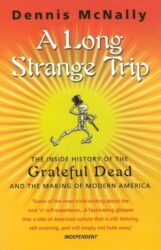
 When Dennis McNally published A Long Strange Trip: The Inside History of the Grateful Dead in 2002, he had an almost impossible task. It needed to document a band whose history was already wrapped in layers of myth, while satisfying both obsessive Deadheads who knew every set list by heart and general readers who saw the band as a chaotic relic of the 1960s. McNally, who served as the Grateful Dead’s official publicist from 1984 and appears in the book calling himself “Scrib”, managed to achieve something well ahead of the standard chronological rock biography. He produced a piece of cultural history which treats the band not just as a musical group but as an essential lens through which to understand post-war America.
What makes the book unique in the world of Dead literature is McNally’s background. He holds a PhD in American history from the University of Massachusetts Amherst, and before he worked for the Grateful Dead, he wrote an acclaimed biography of Jack Kerouac, which we should cover here sometime. McNally does not look at the band in isolation; he traces their roots directly back to the Beat Generation, the bohemian arts scene of San Francisco, and the unique cultural currents of Northern California in the 1960s. Where other books, by those in the band, Phil Lesh and Bill Kreutzmann, or even closer than McNally, roadies Rock Scully and Steve Parish, tend to have the rose-tinted spec of the true insider, A Long Strange Trip can step back far enough to see the negatives of life with The Grateful Dead. McNally travelled on the buses, stood at the side of the stage, and dealt with the PR crises of the band’s chaotic daily life.
He uses an inventive structural device to capture the overwhelming experience of touring with the Grateful Dead by alternating his chapters between a chronological history of the band from Jerry Garcia’s childhood through to the aftermath of his death in 1995, and “show” chapters interspersed throughout the history. These are impressionistic, present-tense snapshots of a typical night on tour in the late 1980s or early 1990s.
These tour chapters capture the sheer scale of the operation. They follow the crew setting up the massive sound system at dawn, the office staff managing ticket distributions, the chaos of the car park scene, and the intense energy of the performance itself. By placing these vignettes alongside the history, McNally reminds us that the band’s past was always alive in its chaotic present.
McNally writes exceptionally well about music that was notoriously difficult to capture in words. He describes how the band combined different styles, showing how Garcia’s bluegrass roots, Phil Lesh’s classical training, and Bob Weir’s distinctive rhythm guitar work created a completely new sound. The book details the band’s artistic peaks, such as the creation of Workingman’s Dead and American Beauty, while remaining honest about their self-indulgence and the uneven nature of their live performances.
He doesn’t shy away from the darker side of the story. McNally details the financial crises that constantly threatened to ruin the band, the tragic toll of drug addiction, the fractures within their community, and the exhaustion that came with their late-period commercial success after the 1987 hit single Touch of Grey. Jerry Garcia is portrayed with deep affection but total honesty, showing him as a brilliant, reluctant leader who was eventually crushed by the weight of expectation from the counter-cultural community he helped build.
A Long Strange Trip succeeds because it treats the Grateful Dead with the intellectual seriousness they deserve. McNally views them not as a marketing phenomenon or a simple nostalgia act, but as an ongoing social experiment in bohemian community and artistic freedom. For anyone wanting to understand the American counterculture, its triumphs, and tragedies, this is an essential, beautifully written account of a band and a time which, with Bob Weir’s passing this year, is lost forever.
Widely regarded as their live high point and featured by McNally in detail, was the Spring 1990 tour…
Americana UK has ongoing running costs. If you have enjoyed reading this post, please consider supporting us for £2.99 a month.

