
Posthumous studio album from literate Californian singer-songwriter turns dreams into songs, providing a fitting epitaph for one of life’s truly great maverick artists.
 The sub-zero temperatures that covered the bulk of the UK during the first month of 2026 felt a whole lot colder with the devastating news that Tucker Zimmerman and Marie-Claire, his wife of almost sixty years, had died in a house fire at their home near Leigh, Belgium, on the 17th of January. An octogenarian, Zimmerman had enjoyed a late-career spurt, having originally walked away from a recording career in the early 1980s, one that had started with his debut album in 1969, instead choosing to divide his time between writing novels, short stories, and poems and composing film music and symphonic works. Enticed back to the recording studio by the generous advocacy and production of Big Thief, and in particular Adrianne Lenker, Zimmerman released the critically acclaimed album Dance Of Love in 2024, and in collaboration with Nick Holton and the team at Big Potato Records was all set to announce the news of a follow-up album when tragedy struck.
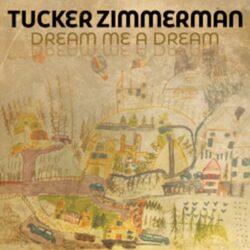
Six months on, and the heartaches have eased enough for Dream Me A Dream to be released, and though most of the songs were written whilst recording during two sessions in 2024 and 2025, a few here do date back to the sixties. What is immediately apparent with this album is the change in musical landscape compared to the rustic folk vibe of its predecessors, with orchestral Moog, analogue synths, and processed piano providing as much instrumental support as the banjo and violin, creating a distinct departure from anything in his previous seven decades of recording. What hasn’t changed is Zimmerman’s unique poetry, a use of vocabulary that refuses to follow the rules, and yet the intuitive ability to connect emotionally, offering joy and sorrow within the same heartbeat.
The album opens with the sparse fragility of Sun in Scorpio; Zimmerman’s vocal, despite being scarred with the frailty of time, still delivers with an emotive quality, stripped of all unnecessary decoration, that draws the listener in close, hanging on his every word. His every breath. Thematically, the lyrics explore the strangeness of being in someone else’s dream, which leads seamlessly into the title track, a song based on a poem from his first book When In Flows The Sea, which itself was influenced by the novella The Little Prince written by French writer, poet, journalist and aviator Antoine de Saint-Exupéry. The arrangement here leans a little closer to that on his previous album, with slightly more americana influence, a plucked banjo, gentle violin and gorgeous backing vocals, both supplied by Jackie Oats, help to create an intimate folk vibe. A similar tone is repeated later in the album with Rose of Sharon, a song whose origins date back through the decades, reflecting the dark side of the hippie movement, though here the inclusion of synths rather than banjo accompanies Oats’ violin and backing vocals, resulting in a somewhat more psychedelic sound.
Elsewhere, Don’t Feel Like Doing Nothing Today finds Zimmerman in a more cantankerous mood, name-checking everyone from Dire Straits, Tom Waits, and Howlin’ Wolf to the Beach Boys and Neil Young, while Riding Around My Dream sees Marie-Claire on vocals, offering up the perfect roadmap for a dream landscape. Another musical shift takes place on Rooftops Of San Francisco, where a hypnotic harmonium pulse creates an almost Krautrock soundscape that acts as a conduit to Zimmerman’s spoken word narrative based around a poem he wrote as a youthful visionary nineteen years old, delivered now with a reference and sagacity only time can truly shape, drawing comparison to Gil Scott-Heron’s final album I’m New Here. It is, however, with Lovers Of Beggar St that the album delivers what is possibly its crowning jewel, a bittersweet melody with an aching refrain and delightful backing vocals again from Oats that finds Zimmerman reawakening to his musical calling, though the album’s penultimate track, a cover version of Lenker’s beautiful song Stay (Wanted You To Stay), is another delightful offering, and the only cover version Zimmerman has ever recorded.
With the desperately sad circumstances that preceded the release of Dream Me A Dream, it would be easy to get caught up in the poignancy surrounding the album, allowing the heartstrings to determine the quality of the art. And as understandable as that might be, it would do this body of work an injustice. For it is the calibre of the songs, and their unique interpretation of cosmic soul, the bravery and integrity within both the performance and the musical arrangement, along with the surreal nature of the poetry, that, whether by pathos, humour or subtle perception, never fails to connect, which collectively defines this album as possibly Zimmerman’s finest recording, and a fitting epitaph to one of life’s truly unique maverick artists.


