
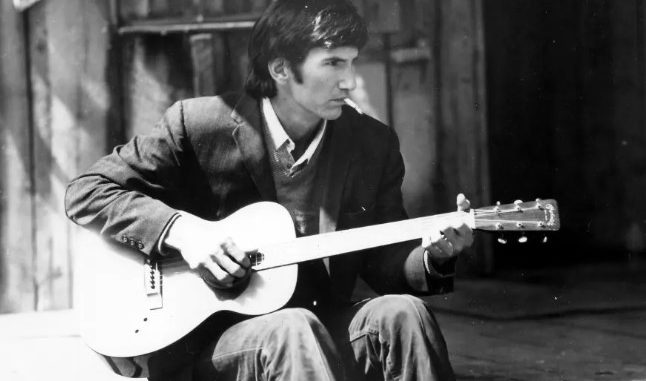
You only have to look at the list of people who have covered this song to get an idea of just how important it is to the progress, legacy and development of country music. Originally written by the incomparable Townes Van Zandt in 1972, ‘Poncho & Lefty’ – typically renamed ‘Pancho and Lefty’ – is a classic Western tale, one that rides along to a genius simple melody and sinks into the heart no matter who’s singing it.
Two characters. One big betrayal. Pancho: the young outlaw who leaves home in search of fortune south of the border, as the song progresses, we see his journey to the ‘deserts down in Mexico’ and the betrayal that comes at the hands of his companion. Our other character, Lefty, after turning Pancho over to the ‘federales’, spends his years in Ohio, existing in a state of regret – it’s a heartbreaking story.
“So the story ends, we’re told / Pancho needs your prayers, it’s true / Save a few for Lefty too / He just did what he had to do / And now he’s growing old”
As with much of Van Zandt’s early career contributions, ‘Pancho and Lefty’ was an underrated gem nestled into the now legendary album “The Late Great Townes Van Zandt”. Upon its release, it received very little attention, and although now being one of the Texans’ most popular songs, it was the covers of the track that made it into the country music staple it now is. Emmylou Harris was the first to shape the song in her own way, releasing her version in 1977 on the album “Luxury Liner“- ‘Pancho and Lefty’ became a hit for the California country queen.
After Harris’s success, along came a couple of outlaws in their own right. Willie Nelson and Merle Haggard recorded ‘Pancho and Lefty’ for their joint album of the same name, and suddenly the song developed another narrative – one that gave us a vision for the characters, they looked awfully like the country legends that were singing it. As with all the best stories, the recording of the duo’s version of ‘Pancho and Lefty’ has its own lore; the story goes that after completing the recording of the album, Nelson felt like something was missing. At the guidance and recommendation of his daughter, Nelson immediately fell in love with the Harris version of Van Zandt’s song, and I mean immediately. He desperately recorded his vocals in the middle of the night, and to Haggard’s dismay, forced his partner to record his too – when the sun rose, Nelson was adamant that the midnight vocals were fine, and so they made the cut. He was right, though, because the album soared to number one, and it might now be the Nelson/Haggard recording that has the most scratched, worn-down, and well-loved records.
Since its original release in 1972, the song still remains as a heavily covered and well-loved track. Jason Isbell and Elizabeth Cook delivered a moving acoustic rendition of the song in 2013, one that feels so natural it could be one penned by Isbell himself. Hoyt Axton took his turn in 1977, Steve Earle opened his 2009 album “Townes” with the song, and Shane Smith and the Saints gave it a go in 2021, and that’s just to name a few. Its longevity is proven not just by the number of times it’s been covered, but by the outward love that is so often expressed for the track, especially from other songwriters.
In a 2007 interview, Steve Earle stated that “you won’t find a song that’s better written, that says more or impresses songwriters more.” As an artist so frequently hailed as one of the greats, it’s hard to argue with Earle. American singer-songwriter Mickey Newbury ever so eloquently and accurately said that “anybody who can’t recognize the genius of Townes Van Zandt, I don’t want to spend more than five minutes talking to them.” Honestly, agreed.
“A few great federales say / They could have had him any day / They only let him go so long / Out of kindness, I suppose”
A bittersweet sadness lingers when the story ends. Through it all, there’s one of Van Zandt’s simple lines that strikes a chord with its deceptively heavy emotional weight, setting out on the road, following dreams and wide open spaces, people are just watching Pancho’s life play out: “She began to cry when you said goodbye / And sank into your dreams.”
There’s no way of really knowing what’s on the road ahead of us, outlaw or not, life is unexpected. One thing that we can do, though, is chase and embrace dreams, settling and sinking into them, for better or worse. Van Zandt’s life wasn’t easy; he had more than his fair share of struggles, but he chased words as far as they could take him and left them in his poetic path – after all, it was the poets who told how Pancho fell.


