
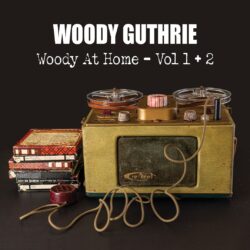
Yes, you read that headline correctly. Seventy-five years late, twenty-two previously unreleased tracks from 1951-1952 home tapes, including 13 songs never recorded elsewhere, and rare ‘This Land is Your Land’ verses have been rediscovered and are to be released. Raw, intimate recordings made at his Brooklyn apartment before Huntington’s disease silenced the legend forever. The album “Woody At Home Volume 1 & 2” will be available on the 14th August 2025 via Shamus Records, and the powerful and deeply relevant single ‘Deportee‘ is available now which you can aurally peruse below.
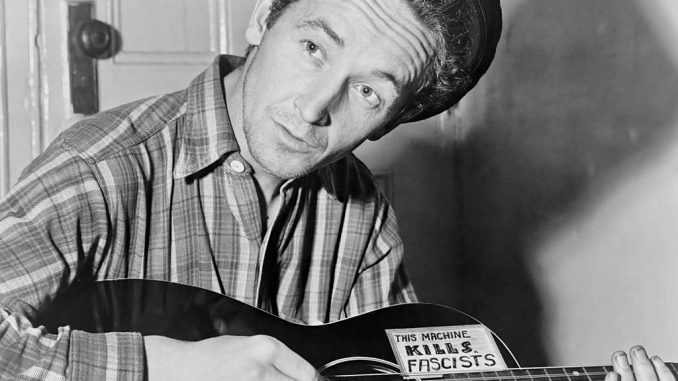
Woody Guthrie, extraordinarily, became a Rock & Roll Hall of Famer, Songwriters Hall of Famer, International Folk Music Award Lifetime Achievement honoree, and GRAMMY Lifetime Achievement Award winner, and the lead track off the collection is Woody’s only known recording of his iconic song ‘Plane Wreck at Los Gatos (Deportee)‘. Guthrie wrote the track in 1948 in response to a New York Times article about a plane crash in Los Gatos Canyon, California, that killed 32 people, including 28 migrant farm workers.
Of ‘Deportee,‘ historian and author Tim Z. Hernandez, who has written two books on the incident, adds, “On January 28, 1948, a plane deporting 28 Mexican workers crashed down in the agricultural hub of California’s San Joaquin Valley, in a place called Los Gatos Canyon. Not a single soul survived. News reports named the four American crew members but referred to the Mexicans simply as ‘deportees,’ after which they were buried anonymously in “the largest mass grave in California’s history,” while the remains of the American crew members were sent home to their families. Guthrie understood that to be nameless in death was an injustice of the highest order, and within days of the crash, he sat down to pen what would become one of the major protest songs of the last century, perhaps even more relevant today than it was nearly eighty years ago.
The song, as set to music in the late 1950s by Martin Hoffman, has travelled the world over, thanks to musicians who keep it in our consciousness. Musicians like Pete Seeger, Arlo Guthrie, Joan Baez, Judy Collins, Bruce Springsteen, Bob Dylan, Dolly Parton, and so many others have kept this conversation in motion. The song is as relevant today as the day Woody first penned it. Tim Z. Hernandez finally answered Woody’s question, “Who are all these people, scattered like dry leaves?” Tim found the names of all 28 Mexican victims, giving closure to all those who never knew what happened to their loved ones. We recognize all of the victims of this tragic plane crash; Miguel Álvarez Negrete, Francisco Durán Llamas, Santiago Elizondo García, Rosalío Estrada Padilla, Bernabé García López, Tomás Gracia de Aviña, Salvador Hernández Sandoval, Severo Lara Medina, José Macías Rodríguez, Elías Macías Trujillo, Tomás Márquez Padilla, Luis Medina López, Manuel Merino Calderón, Luis Miranda Cuevas, Ignacio Navarro Pérez, Martín Navarro Razo, Ramón Ochoa Ochoa, Ramón Paredes González, Apolonio Placencia Ramírez, Guadalupe Ramírez Lara, Alberto Carlos Raygoza, Guadalupe Rodríguez Hernández, Maria Rodríguez Santana, Wenceslao Ruiz Flores, Juan Ruiz Valenzuela, José Sánchez Valdivia, Jesús Santos Meza, Baldomero Marcos Torres, Frank Atkinson, Mrs. Bobbie Atkinson, Marion Ewing, and Frank E. Chaffin.
Nearly 75 years after they were made, the recordings on the album have been newly transferred and produced by GRAMMY-winner Steve Rosenthal (The Rolling Stones, Blondie, Lou Reed, Natalie Merchant, Laura Nyro) and restored and mastered by GRAMMY nominee Jessica Thompson (Kurt Vile, Erroll Garner, Mickey Newbury, Ralph Stanley, Lou Reed, Janis Ian), using both pioneering software and antique tape machines to de-mix and mix the voice and guitar, while staying true to the homemade, analogue spirit of the original recordings.
These raw and intimate home tapes were recorded in the early months of 1951 and 1952 at the family’s apartment in Beach Haven, Brooklyn. Woody made them as his musical introduction to his music publisher. Woody got his first publishing deal in 1950 with a new startup, TRO Essex Music Group, founded by music publisher Howie Richmond. By 1950, two-channel tape recorders allowing recordings in stereo appeared in the United States for the first time. Able to get his hands on one of the new machines, Howie sent the recorder to Woody in Brooklyn. Woody spoke, rambled, sang, and gave new context and intimate reflections into his songs using the single-mic reel-to-reel machine. Woody sings about historic events, stories of the disenfranchised and ignored, love, and, of course, the fight against fascism.
You can pre-order the album here.



Revolution alive and in safe hands with my hero Woddy.
Looking forward to the recording release.
A major work from the voice of all generations.