

Over the years, Rod Picott has built up a dedicated following through regular album releases and frequent touring. The singer/songwriter from Maine is definitely a friend of the AUK show. So, his announcement earlier this year that his forthcoming European tour will be his last will have come as a surprise and a sadness to many readers. Singer-songwriter does Picott insufficient justice as he writes poetry and fiction, too. But to most, it is his 14 albums and countless tours that resonate most. Whether drawing from his years as a construction worker or as a full-time artist, Picott’s acute observations of people and places, particularly those battling all manner of struggles, characterise his songwriting. AUK was privileged to spend some time chatting with Picott about his change of direction and what lies ahead.
For most artists, particularly those in the americana genre, touring is their lifeblood. Picott is no exception, as the stories from the road he tells during performances only intensify their richness. To this interviewer, Rod Picott fits more into the ‘Never Ending Tour’ camp, so what has brought about the ‘Last Dance’? Picott shrugged and smiled as if he was about to reveal a big secret. If not a confidence, he had clearly thought long and hard about his decision. “I’ve been thinking about this in earnest for two or three years. It felt like there was a sell-by date coming up, just in my bones”. Digging deeper, Picott divulged how he was, “trying to get real with myself about how I was feeling about touring into my 60s”, admitting, “I wasn’t feeling good about it. You see, all those old blues guys played ‘til they dropped. David Olney died on stage, and there is a kind of romance about that, but there are other things that I want to do. Things that I really want to chase”. Such as? “Well, I was looking back at my records, maybe not the last few, but a couple of records.” Any in particular? “Maybe ‘Out Past The Wires’ and ‘Fortune’. Not that I’m unhappy with those records, but I sort of felt like, jeez, I’m starting to repeat myself. I’m writing a version of the same song over again. And I started to feel like what I wanted to write about in the way that I wanted to write couldn’t be contained in songs anymore”. That’s quite an admission for a songwriter, particularly one as prolific as Rod Picott, so does that mean the muse has dried up? “No, it’s not that I’m not writing songs. I have enough for another album already, but I wasn’t getting the satisfaction out of it that I used to. Songwriting used to be an enormous thrill. It’s still thrilling. It’s still pleasing, but not in quite the way that the fiction is and these longer forms. What I wanted to write couldn’t be contained in song anymore. It couldn’t be contained in 12 lines and a chorus”.
Swiftly and typically lucidly, Picott made it very clear he was not suffering from a case of writer’s block. Here is an artist seeking new forms for his art, but first, on behalf of his listeners (not fans, this is Rod Picott), it was reassuring to know that songwriting was not being dropped altogether, but would drop a notch or two down in Picott’s writing priorities. “It’s a matter of something taking on more importance. I’ll always write songs. I sort of can’t help it. I’ve been writing songs since I was 16 years old, and now I’m 60! They just kind of come out and, you know, I hear melodies in my head and chase them down on the tape recorder, and I hear chord progressions. So, I’ll always do that. But the thing that I’m really genuinely pulled towards is fiction right now”.
Fiction is not entirely a departure for Picott. Having had three books published, he has actually written seven. Interestingly, he approaches writing in the same methodical way he would book his tours. “I would sit down at the computer for eight hours. After four hours, I’d get up, eat a sandwich and sit down again and work for another four hours. Over the course of a couple of months, I’d book up the entire year. I just considered that was my job. And that’s what I’ll do with these books. I’ll go looking for a publishing deal, a literary agent, and I’m just going to make that my job”. Picott’s literary production line already hums with activity, “ I’ve got to finish a novella and another book of short stories. I had a memoir-ish kind of piece. That’s very long and in a rough state, but having that little body of work will allow me to push the writing forward”.
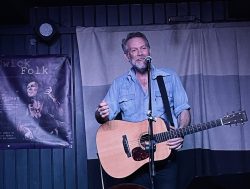
In a previous conversation, Picott talked about his longer-form writing, in particular subjects and characters, so this seemed like a good moment to revisit the theme. “The writing is a lot like the songs where I’m drawn to these kind of everyday characters, and I’m drawn to the idea of nobility in everyday characters and in the common man. I find that a very rich theme that can be written about in a lot of different ways, and the cast of characters is endless. That’s my ethos as a writer. I don’t think I can ever get away from that. I’ve always been moved by that concept, that the ordinary man could do something extraordinary and that there’s something beautiful in an ordinary life. Those are the people that I grew up around. That’s just in my blood. I don’t see myself being able to write a vast adventure piece, you know, heroes leaping over stone walls!”
Warming to his theme, Picott agreed that his life as a construction worker had informed his songwriting. These characters live exceptionally hard, hand-to-mouth lives. I wondered how they might compare to the more romantic images portrayed in some mainstream country songs. Picott’s contrast was typically vivid. “Country tends very often to try and glamourise some kind of working life that all ends up very conveniently drinking beers on the back of a pickup truck. But it’s not really like that when you’ve just scalded yourself with your welding kit”. We get the picture, but it was worth pursuing whether Picott the construction worker would inspire Picott the novelist as it had Picott the songwriter. “It absolutely does. There was a distance in my mind between the job that I worked and who I was inside my head. There are plenty of people out there who have that kind of distance, that discord. It’s just where life leads you sometimes, depending on how and where you grow up, your opportunities and the people that you meet. So that discord is a really powerful theme to me”. Have you a particular example? “I remember when I was hanging sheetrock. You know, sheetrock is a filthy job. You’re just covered with this white chip and dust, and I remember going into the bank with my paycheque, decent paycheque, but covered in that sheetrock”. By this time, we could have been in the pub, Picott laughing gently while reminiscing. “My face just covered with dust, I looked like a raccoon in reverse. You see my eyes, that’s it, the rest of me, it was just white.” But he conveyed a serious point: “I remember the way that people looked at me. I knew I had a lot more inside my head, but I remember the way that people would treat me. I felt every bit of that distance, who I was inside my head. It was painful. And I remember turning around to walk out and seeing my white footprints I had come in, just feeling horribly embarrassed. But it’s complicated. After years doing construction, you really see both ends”. Picott sums up: “If you’re an interested, engaged person like I was, and you’re interested in a conversation, you will find people who are really brilliant and have amazing minds in that world. And you’ll also find the exact opposite. You will find the guy that is exactly who he looks like, so yeah, it definitely plays a role”.
Since we had been looking back, I wondered how Picott would remember his touring life. Does he have any regrets at giving it up? “I’m done touring, I’m done with the roadwork. I’m not saying I’ll never play again. I might play the odd show here and there. But I’m not going to tour. My girlfriend, Ashley, and I were talking about it this morning. It’s complicated, but I got a real genuine pang of, not regret, and not sentimentality, but just a real sort of tug of emotion of like, jeez, I’m walking away from something that I worked so very hard to get to. And a sense of identity, too. And so I’m sure there’s going to be some struggle with that”. Still no regrets? “I still feel like it’s the right time”. What will you miss the most? “I think the interaction, there’s something so beautiful about being on stage in front of people, and playing, singing something that you wrote and seeing people have an actual, legitimate, emotional response to that”.
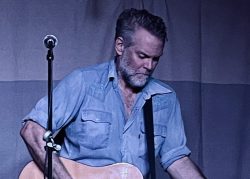
Another reason for his decision is that for Picott, being on the road is a solitary activity. “I’ve had a band and a few side people but for the most part it’s been just me. But the hotels and the driving and all the noise being on the road didn’t weigh as much as the show. The shows weighed so much, and they are weighing more. I’m older; I have a terrible back. I have arthritis. I’ve started to have a little bit of trouble with my hands, and I can just see that my body is not able to do it. It’s physically hard work, but it’s a funny job. You don’t ever work particularly hard when you’re on the road. You’re not really ever doing anything. The hardest work you do is standing on stage and playing guitar. But you’re never not working. That’s the thing. Even when you’re sleeping, you’re working because you’re not at home. You’re in hotels, or you’re staying with friends, or you’re just always on. There’s always the next thing to take care of. So it’s a kind of exhaustion that’s hard to describe. It’s not a typical exhaustion”.
From that very personal insight, Picott admits that touring itself is harder today than 10 or 20 years ago, especially the expense. “The economics have not been favourable. CDs cost exactly the same as they did 20 years ago. You can charge more if you want, but the other costs are all going up – the flights, the rental cars, everything costs more, and we don’t make any more. I don’t think things have come back since COVID. Not all the clubs have come back, and we lost a certain amount of the audience. They sort of age out and they’re not going out as much”. Turning more specifically to ‘The Last Dance,’ where are you going and what have you got in store? “It is shows in the Netherlands, England and one in Scotland. I want to hit all the different parts of the catalogue, but I really love the last two records. Those are two of the best records. Maybe not as fresh as “Stray Dogs” and “Welding Burns”, but on balance, the writing is strong and I’m really proud of them. So, I want to hit the newer stuff, and I want to hit some of the old favourites. I just want to connect with people one more time. I want to feel that connection”.
Mention of his most recent album, “Starlight Tour”, prompted a thought. Might the final track on the album, ‘Time To Let Go Of Your Dreams,’ have been a clue to the decision to stop touring? “I wasn’t thinking that when I wrote it, but sometimes you’re writing about something you didn’t know you were writing about. And I think that’s true in the case of this song. I remember finishing it and going, Oh shit, this isn’t what I thought it was. I think this is actually about me. I could see the end was coming, that I was wanting to do other things and that it felt a little bit like I’m starting to repeat myself. I don’t want to do that, really don’t. I’ve seen an awful lot of people do that, you know. And I won’t name any names, but it’s inevitable as an artist. You know, you have a voice; you use up these great ideas, ‘Tiger‘, ‘Tom Dixon’s Blues’, ‘Stray Dogs’, I can never write ‘Stray Dogs’ or ‘Angels and Acrobats’ again. So, you use these ideas up, these themes and words that are delicious to you, but you can’t write “stray cats” or “stray goats”. You use things up, and I feel I’m coming to the end of my language for doing this. And so I’m ready to move on to being able to use language in a different way, in a deeper way. Without the handcuffs, too. Songwriting is difficult to do well, but it’s also really simple. Like, once you say the song goes in this rhyme scheme, you’ve mapped out the rest of the song. That’s not true with longer forms of writing. Every sentence is its own little world that you’re creating. So you’re just constantly challenged. And I’m ready for that challenge”.
For most artists, that would be enough of a change, but given Picott’s prolific output, it was worth asking if he had any other plans in this new life off the road. “I spent so much time on the road the last 25 years that it’s really novel for me to sit here at this desk and to have coffee in my own bed in the morning. I’m with Ashley, a wonderful woman. We have a lovely life; we cook together at night and I’m just liking the way that this feels”. Returning to writing, never far away in the Picott world, he outlined an idea for a memoir during which he gave a heart-warming insight into his own family, particularly his father because, “the centre of the book is my life with my father since my mother’s passing. It’s all those pieces of writing done about my father, writing in his voice and writing about him. It’s all through the lens of my relationship with my father, which is a complicated and difficult relationship. We’re very different people, and he’s from a very different time. I always say this, and it’s absolutely true. Paul McCartney and Mick Jagger could knock on his door, and he would not know who they were. He wouldn’t. He’s really inside his own head. He’s an interesting guy. It’s hard to describe, actually. We have a lot of conversations about it. He was a tough young guy. He’s become this very sweet old man”.
If not in the sights of Picott’s own memoir but on a similar theme, drawing from the world he has inhabited for the past 20 years, is there any advice he’d give the young Rod Picott setting out two decades ago? “I have two things: first, if somebody’s gonna do this thing, there is nothing to stop them. There’s nothing that you can say to help them, and there’s nothing you can say to stop them from doing it. They are hell bent on doing it. And that was me. You could not tell me that I couldn’t do it. I just didn’t care what anybody thought. I knew that I had something. I knew that I could hammer it into something. But the other thing, and what helped me the most, is that I was willing to do the things that I didn’t want to do to be able to do the things that I did want to do. There are so many talented people out there and so many talented musicians, young, old, middle-aged, who just lack the drive to do the stuff they don’t want to do. I don’t know if it was my stubborn streak or if it was I wanted it bad enough; whatever that was, I could make myself do the stuff that I hated. I wouldn’t take no for an answer, not in the sense that I was bothering people, but in the sense of, I’m going to find my way. There’s a way that this works. I’m going to find my way to open for somebody at that club. I’m going to make it easy. You don’t have to pay me. I’ll play for 20 minutes. I’ll do four songs. I was going to find a way to do it”.
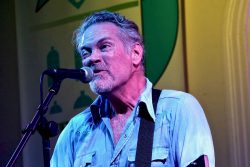
From his comments about the changes in the music business, Picott now would have to multiply that determination several times. People do not buy CDs; they do not listen to albums, preferring instead streams of individual songs, and, God forbid, songs created entirely using AI. His example was chilling.
After such a wide-ranging discussion, it felt only right to pose the usual AUK interview question about current listening. Unsurprisingly, Picott’s response was not typical. “I’m listening to the same. I’m listening to Lucinda and Springsteen’s “Nebraska”. I’m listening to the same stuff that I’ve always loved. The last album that I really fell into 100% was Isbell’s “Southeastern“. I just think that’s a brilliant album. That’s quite a long time ago, at least ten years. I love John Moreland’s “In the Throes”. A chat with Picott would not be complete without a similar enquiry about his current reading list. Authors he mentioned in response to what have you been reading recently were: Russell Banks, Willy Vlautin, Denis Johnson, Harry Crews, and Chris Whittaker.
To bring together the various strands of this fascinating conversation, I took a deep breath and offered my impression that Picott is essentially a writer. That’s what runs through his life. We have known him mainly for his songs, but now it is the books. There may be more songs; you can’t kick the habit of a lifetime, but they will become almost incidental rather than something that he consciously intends to keep going. What does keep going, though, is his creative appetite, his characters and the products of his shrewd observations. Previous inhabitants of his songs will take up new residence in his fiction. I added that speaking on behalf of his listeners, we shall miss you, but we salute your brave move. You have reached a decision and you’re going to go in another direction. That’s it. Picott responded, “You hit it on something that’s kind of insightful in there. One of the things that I’ve discovered over the last seven years or so is that I’m not sure I ever was really a musician. I’m quite sure that I was a writer. And this was the form. This was the form that I loved, that moved me when I was a kid. So this is what I gravitated towards. But it was the writing that did it for me. And I think anybody who likes what I do knows that. Am I a good singer? It’s an ok sounding voice, sometimes kind of interesting. Am I a great musician? Absolutely not. I’m playing everything at first position. There’s nothing particularly interesting going on. A couple of melodies. But what I am good at is I can write. That’s what I can do. And I’ve always known that. I’ve always been very comfortable with that. And it’s been revealed to me over the last six or seven years that I can do this in a lot of different forms”.
With that perfect sign-off, we agreed it may be farewell to Rod Picott on a stage, but it’s not goodbye Rod Picott as a writer. And there’s a lot more to come. We just have to consume it in a book. Above all, what runs throughout all his writing is how he draws in the listener or reader to use their imagination and pay attention. And don’t we need to do both these days! “That’s a lovely thing to hear. Thank you”.
Rod Picott’s tour dates and details can be found here.



Great interview Lyndon. I first came across Rod’s music back in 2002 and have been a big follower ever since. I’ve seen him 3 times live and he always delivered thoroughly honest and passionate performances. I hope to catch him at Barkestone next month. Thanks for the memories Rod.