
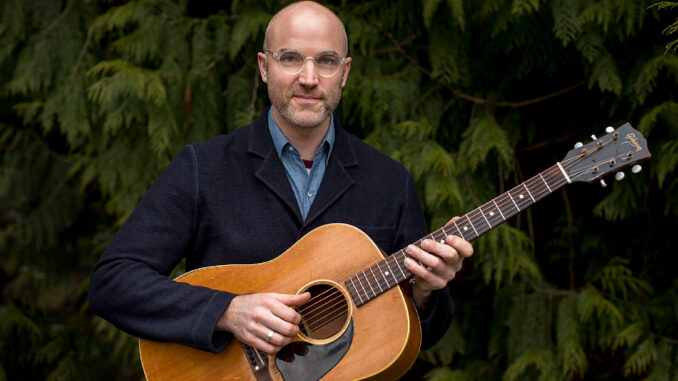
With his “The Shape of a Sway” album (Tender and Mild Records, 2025) released, AUK asked Eli West ten questions on a variety of topics.
“Making music the world needs” is a defining statement about multi-instrumentalist americana roots artist Eli West, courtesy of the extraordinary master musician and songwriter Tim O’Brien. West first gained recognition as one half of the duo Cahalen Morrison & Eli West, producing three albums before West established a solo career with “The Both” and “Tapered Point of Stone.” His third album blends conventional bluegrass structures with experimental folk, reflecting on profound life changes— including marriage, fatherhood, and loss—to create a deeply personal and cohesive collection that showcases his chops on guitar, banjo, mandolin, and pedal steel.
Coming from Olympia, Washington, West has a background as a designer, which helped to inform his command of sonic spaces. Evergreen timbres weave among pitches, rhythms and lyrics to become comfortable rooms into which listeners are invited. What is most impressive is the subtlety of his timing, using command, not flash, to match melodies to thoughtful lyricism. The front porch picking of his bluegrass background is still evident, but jazz-inflected stylings are now stirred into the kettle.
You may be absorbed in the striking beauty of the waltz-time ‘Rocks & Trees,’ an introspective song about becoming a new parent. The first line of this song is a heavy rock that’s lightly held. “I have a nine-month-old daughter, and that is speaking to that reality of who she is in my life,” West informed about the song, which contains the phrase that became the album’s title. His upbeat tunes like ‘Everlovin’ Need to Know’ display that West can pick up the pace when required by the song. He disports his flatpicking skills on one of the two instrumentals. ‘Gentlemen’s Bulldog’ has a palpable energy with stirring fiddle work by Patrick M’Gonigle. West’s other bandmate on this adventure is bassist Forest Marowitz.
“The Shape of a Sway” covers old-time, bluegrass, and singer-songwriter terrain with six originals and four covers, including Jean Ritchie’s ‘Cool of the Day’ and a luminous take on Paul Simon’s ‘Hearts and Bones.’ The former has somewhat of a chilling arrangement, and the latter rolls the bones and comes up with a number that requires hitting the point on the next listen before you can get Simon’s take out of your head, but his intention is not lost. One and one-half wandering Jews / Returned to their natural coasts / To resume old acquaintances and step out occasionally / And speculate who had been damaged the most.
Mid-tempo seems to be West’s sweet spot, and the conflict baked into ‘Spite & Love’ makes this one of the two best tracks on the album. A crow and a dove sit on either shoulder of a man who lays in bed, paralyzed by both spite and love. West may be in the laboratory stage, given the differences in his three solo albums. His first effort (“Both”, self-released 2016) engaged the staggering talents of perhaps the world’s most inventive guitarist, Bill Frisell, to make a record with drones and loops and other weird stuff that somehow works if your expectations are open-ended. His second is an intimate collection recorded not long after West’s father passed, the architect inside constructing the album stone by stone, until you gaze at the finished drawing of a pyramid on its cover artwork. In which direction West will travel after “The Shape of a Sway” is anyone’s guess, but let us hope he sticks to the back roads rather than one of America’s replicable Interstate highways.
Being the thorough type, Eli West responded to all of the 17 questions we asked of him. We had to do a little fancy picking as the title of this feature is “Ten to One.”
The title of the album, “The Shape of a Sway,” is curious. Can you tell us why you chose it?
It is a reference to knowing something without directly understanding it. In this case, my baby daughter, knowing who she is, by watching her move.
Tell us about an object that’s within 10 feet of where you are now. What is it, and why is it important to you?
A very large palm plant. It isn’t digital; it lives and breathes, and helps calm the space.
As a songwriter, what factors might lead you to choose waltz (3/4) time over common (4/4) time, and vice versa?
It is a strong feeling that I love to explore. The cadence of syllables, the content, the general feel all inform that choice. ‘Rocks and Trees’ is in 3/4, but I tried to make it feel like 4/4.
If you could study music at the feet of a pre-20th-century personage, who would that be, and why?
Probably Chopin, his sense of time and layering.
Your lyrics are more poetic than narrative. For example, ‘Rocks and Trees’ starts out, It’s a heavy rock / and it’s lightly held. How do lyrics come to you, and do you see them as having emotional weight equal to the music?
Metaphors on their own can be patronising or too on the nose. Context for a metaphor is just as important. I’m visually oriented and tend to want to talk about the landscape around an object as much as the object itself.
When you’re performing, are you more concerned with what you want to express or with how the audience will receive it?
If I feel like I’m not connected to an audience, I’ll think of the stories in the life of one person in the audience and how they would relate to what I’m presenting. Trying to let empathy pull the performance off the stage. So, that might be more oriented to the audience… but that is what helps me express what I want. Chicken/egg.
What song do you wish you had written, and what about it speaks to you on a deeper level?
Probably Anais Mitchell’s song ‘Shepherd.’ It digests tragedy as it coexists with our daily life. I can’t not be moved when listening to that song.
You own a church? How’d that happen, and what do you do in there?
I’m either starting a cult or going into the wedding/venue business. We bought 11 acres on Orcas Island (Washington) to build a timber-frame cabin, and it happens to have a historic chapel on it. I’m presenting a music series and hosting weddings – Victorianvalleychapel.com.
Tell us about one sacred relic in your life.
My dad’s cider press.
What’s been your greatest moment of joy in making “The Shape of a Sway”?
Watching my son sing his version of my songs.

