
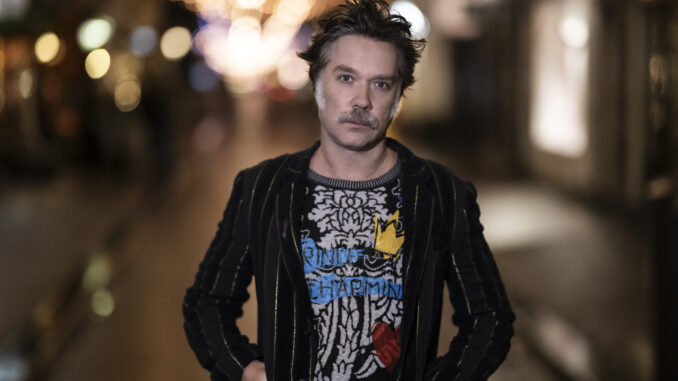
Rufus Wainwright’s fascination with Kurt Weill began early.
“I first came in contact with Kurt when I was about 12 or 13,” he recalled. “I was at a record store and I saw an album with Lotte Lenya on the cover. It was really the photograph that got me first. I had to buy the record, went home and put it on. It was Kurt, of course, singing both the Berlin songs and also the American songs. What really got me was the variety in the types of music I discovered—cabaret, big band—it was such a rich landscape to investigate as a young, curious musician.”
That early encounter sparked a lifelong relationship with Weill’s music, and decades later, Wainwright channels that enduring fascination into his new album, “I’m a Stranger Here Myself – Wainwright Does Weill.” Released via Center Stage Records, the album unites the three-time GRAMMY®-nominated singer-songwriter with Los Angeles’ premier 40-piece orchestral jazz ensemble under the baton of Chris Walden.
“The songs of Kurt Weill have long haunted my imagination and remain solidly mysterious,” Wainwright said. “Be it the opening trap of ‘Mack the Knife’ or the closing explosion of ‘Lost in the Stars,’ this wondrous musical journey began, continues, and will never end.”
Born in Dessau, Germany, in 1900, Kurt Weill was the son of a cantor and showed early promise as a composer, studying under Ferruccio Busoni in Berlin. His collaboration with Bertolt Brecht on “The Threepenny Opera” (1928) produced the legendary ‘Mack the Knife,’ establishing him as a master of theatrical modernism. Fleeing Nazi Germany in 1933 due to his Jewish heritage, Weill settled in the United States, blending jazz, folk, and European classical traditions on Broadway. Wainwright identifies strongly with this duality.
“I’ve always had an affinity and a great passion, and at this point an ability to write classical music—I’ve done two operas and a Requiem,” he explained. “But I’m mostly rooted in the popular world. What I try to emulate is that Kurt knew these two universes very well. He never treated it as crossover; he was dedicated to the purity of the form each time he wrote a classical piece or musical.”
Wainwright sees parallels between Weill and the composers of his own youth. “I grew up singing Stephen Foster songs… for him, I relate him more to Schubert, a quintessential 19th-century songsmith,” Wainwright said. “But Kurt Weill is just so 20th-century. Even 21st century, if you listen to some of the songs, whereas Stephen Foster and Schubert were looking backwards. Kurt was always looking ahead.”
The album is the culmination of a journey that began with a sold-out five-night residency at New York’s Café Carlyle in May 2023. Wainwright’s first deep dive into Weill’s repertoire was met with enthusiastic acclaim, prompting an expansion into a fully orchestrated concert at Los Angeles’ Theatre at Ace Hotel in 2024 with the Pacific Jazz Orchestra, led by artistic director Chris Walden.
“Chris is a new friend, very accomplished in Hollywood. He put together the Pacific Jazz Orchestra, top-notch players who really earn their living playing in the entertainment industry,” Wainwright said. Walden’s arrangements provide a “soft Hollywood touch” that balances Weill’s angular, sometimes brutal, compositions. “It smooths out the edges a little bit, and kind of gives it the full package.”
Wainwright curated songs that represent three distinct facets of Weill’s career: the Berlin period, the American years, and his French compositions. The album features ‘Surabaya Johnny,’ ‘Je ne t’aime pas,’ ‘September Song,’ ‘Mack the Knife,’ and ‘Lost in the Stars,’ among others, with guest artists including viola soloist Viola Odette Harlow and the Netherlands-based Metropole Orkest, whose versatility bridges jazz, pop, and classical idioms.
Weill’s influence is deeply personal for Wainwright. “Weill haunts my imagination and creativity. I made this album when I was 50… Kurt Weill died at 50. I feel very much like I’m transporting his spirit into a next kind of age group he wasn’t able to accomplish.” Remarkably, the concert recording at the Ace Hotel in 2024 coincided with Weill’s birthday, an unplanned synchronicity that Wainwright says made him feel the composer’s presence.
The music’s themes—decadence, drama, social commentary—remain strikingly relevant today. “Whether it’s ecological disaster or political oppression, his music aches with these issues,” Wainwright observes. “It sounds very poignant and quite sadly depressing, because we’re in another dark period of history. It’s good to talk about it.”
Wainwright views the project as more than a homage. “In some parts it’s a tribute, but in other ways it’s your own living, breathing organism,” he said. His approach balances intellectual rigour with emotional abandon: complex texts and dramatic narratives demand both precision and full-hearted delivery, exemplified in pieces like ‘Matrosen Song’ and ‘Lost in the Stars.’

“I’m a Stranger Here Myself – Wainwright Does Weill” is more than a nostalgic revisit; it brings Kurt Weill’s music fully into the present. Wainwright’s commanding voice and theatrical sensibility, combined with the sweeping orchestral arrangements, create a recording that is both reverent and vibrantly alive. By driving new life into Weill’s songs, Wainwright demonstrates just how enduring and relevant this music remains.
“I have been obsessed with Kurt Weill my entire life,” said Wainwright. “Now I simply want to share it with everybody.”

