
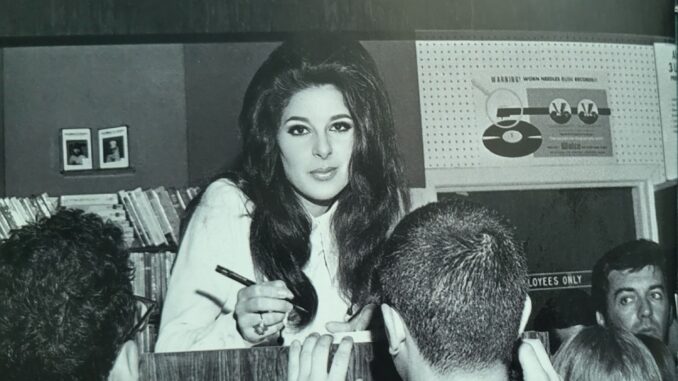
Another in our series of occasional Features looks at one of the great unsung albums of the 60s.
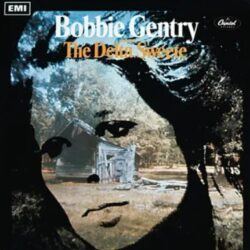 After the fanfare of recording a #1 hit single in Ode to Billy Joe, in 1968 Bobbie Gentry designed her second album, The Delta Sweete, as a quasi-autobiographical portrait of the American South. Her adventurous album was way ahead of its time and a plucky, courageous artistic statement. Most country (or any other) artists would have played it safe with a sophomore album follow-up to a successful debut, but not Gentry. This album is a masterpiece, but, incredibly, yielded no radio hits and was chalked up as a commercial flop. Nevertheless, it has steadily grown in stature and commanded a reissue in 2020 on Capitol Nashville. Available either on 2-CDs or LPs, the remastered version (props to Andrew Batt) sounds a whole lot better and fuller than the original or the version that came with the 2018 8-CD box set, Girl from Chickasaw County. It features the original mono mix alongside a new stereo mix of the album, 10 bonus tracks, including a previously unreleased original demo The Way I Do and a special instrumental version of Okolona River Bottom Band.
The title suggests a set of interconnected songs, a concept album, although it does not deliver a unified narrative. Instead, it is a collection of short stories focusing on the essence and peculiarities of southern gothic living: dark and painful secrets, sultry assignations, doomed romance, infidelity, Baptist churches and family gatherings with all the eccentrics. Whether or not she knew she was taking a chance with this type of release, her delivery is superb, warm and confident, bearing a resemblance to a female counterpart to Tony Joe White. The years have been kind, however, to The Delta Sweete, and it stands as the artistic high point of her career.
On the subject of the Gentry’s career, she only recorded seven studio albums, finishing with Patchwork in 1971. Seven years later at the age of 36, she vanished from the world of music and has kept a very low profile. Some proposed she had retired to Memphis, close to the bridge that made her famous; others guessed Los Angeles. The late Jill Sobule wrote a song titled Where Is Bobby Gentry? No one suggested she was going back to Chickasaw County in the Mississippi delta, where she was born Roberta Lee Streeter and raised on her grandparents’ farm after her parents divorced. She got her first upright piano living there, from a neighbor in return for a dairy cow. 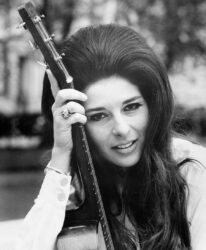
Some may quibble over attaching the concept album label to The Delta Sweete, but as the saying goes, it was close as in horseshoes. It drew inspiration from her swampy, delta roots, and one song flows into the other like riding a raft down the gentle current of the Chickasaw River. Though not the custom in country music at the time, Gentry played multiple instruments on the album, including piano, guitar, banjo, bass, and vibes.
The concept album was not an unfamiliar notion in country music. In 1985, Emmylou Harris recorded The Ballad of Sally Rose, its protagonist a singer whose mentor and lover was a troubled alcoholic musician, mirroring Emmylou’s triste with Gram Parsons. Willie Nelson tackled the vagaries of divorce from both the man and woman’s perspective in 1974. Phases and Stages did nothing to advance his career, although it did yield the single Bloody Mary Morning, which is still a staple of his repertoire. Johnny Cash’s entry into concept albums was called Bitter Tears. It came out in 1964 and dealt with issues and injustices apposite to Indians/Native Americans. Marty Stuart composed the narrative tale of The Pilgrim, based upon a cross-eyed guy from his hometown who marries the most beautiful girl in town. His jealousy drives her into the arms of the Pilgrim, and it does not end well for the guy. In the current century (2007), Albertan Corb Lund used his love of horses and history to pay tribute to cavalry men throughout Canada.
The Delta Sweete begins with a swampy guitar and Fogerty-like chooglin’ groove on Okalona River Bottom Band. She name-drops Mississippi towns: “All the way from the Kosciusko, up from Biloxi Shore” to put across that folks are traveling from all over to join the band. Big Boss Man is a cover of a Jimmy Reed blues, and the blues standard Parchman Farm is a chain-gang lament. In between comes an original, Reunion, about one of those eccentric bring-the-family gatherings in the South, people talking over each other with noisy children underfoot doing what children do at these get-togethers (be pests): “Mama, make Willie quit pullin’ at my hair …. Tommy, put down that stick“. The women are gathered and talking about gardening: “Yes, I guess we got the earliest garden in the county / Beneath the strawberries are a heap of snappin’ greenbeans”. The men are off somewhere having beers and bemoaning the state of crops: “The crops been failin’, Lord, it sure is dry / You’d think that we’d get a sprinkle by and by”.
Gentry’s sweet as sugar vocal follows the segue of strings into Mornin’ Glory, where a mother wonders about the dreams of both the flower and a baby before they are awakened by bright sunshine. Sermon is a traditional country song known as Run On, though she takes songwriting credit. Whatever, she does the fire-and-brimstone tune every bit as much justice as Johnny Cash did years later: “Tell the gambler, rambler, backbiter / Tell him God Almighty gonna cut him down”. John D. Loudermilk’s country stomper Tobacco Road comes next, about the kind of no-hope dump that you can’t disown, however far and fast you run: “It’s gonna bring you back to Tobacco Road”.
Three more Gentry originals follow, softer and mysterious, starting with Penduli Pendulum, a hymn-like reversal of the famous Thomas Wolfe line “You can’t go home again” by the confusion of where you are best suited: “When will I learn departure means a sure return”. She treats Jessye’ Lisabeth as a haunting, imaginative folk fable on the order of Fairport Convention, an untold secret at its heart: “Pray tell, Jessye’ Lisabeth / When you should be sleeping / What secret are you keeping”. Gentry returns to the dream motif in Refractions. Unlike the pleasant supposition of dreaming in Mornin’ Glory this one inches into distressed, nightmare territory as she describes a dream where she becomes a crystal bird: “Glass enclosed, exposed wherever I flew / With no control and a crystal soul that one could see right through”.
After a reflective cover of Doug Kershaw’s Louisiana Man, she ends the album with another original, Courtyard, an ethereal cautionary tale about how actions have consequences, often unforeseen. The ten bonus tracks are split between demos of songs on the album and five extra tracks, including a hot instrumental version of Okalona River Bottom Band and a cover of Seventh Son with full band.
The five albums that postdated The Delta Sweete had dwindling success as Gentry slipped gradually into Nashville Pop’s grasp, adding horns, strings and session musicians. This foreshadowed her run of shows in Las Vegas over the next few years, going the route of Elvis, Conway Twitty, Tammy Wynette and more recently, Garth Brooks and Luke Bryan. It pays well to play the Strip, and Gentry called a lid on her career after a successful run entertaining the high-rollers.
Gentry won three Grammy awards for Ode to Billy Joe and had a nomination for Fancy in 1971, but The Delta Sweete, superior to her other work, never got a sniff. You can’t just order awards like Grammy or AMA on past performance like they are Chinese takeout. The press treated her second album like a loaf of bread that failed to rise, and it charted flatter than a run-over raccoon; nice try, but…. You would have thought she won ten dollars in some county fair for growing the biggest cucumber. Had Gentry come on the scene in this century, Delta Sweete would likely be considered a worthy americana classic. It deserves to be heard.