
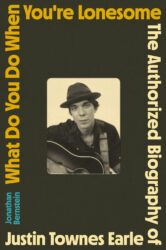
 There is no happy ending to this book. There is scarcely a happy beginning; however, along the journey, Justin Townes Earle’s personality shines through. The effect he had on the people he met and worked with is sometimes profound, at other times magical. Nicknamed “The Prince of Darkness” by one of Steve Earle’s touring crew, and labelled a genius by others. The biography offers a deeper understanding of what Justin Townes Earle experienced and how it shaped his behaviours and music.
The singer tragically died of an accidental drug overdose after ingesting cocaine laced with fentanyl. His death was officially recorded as the evening of August 20th, 2020, and his body was not found until three days later. All happening after the release of his most prophetic albums, The Saint Of All Lost Causes, and in the middle of a global pandemic. It seemed that Earl could keep going, stay alive, if he could run the treadmill of touring, followed by making an album and then more touring. Was the awful pandemic, which took so many lives, partially responsible for his death? Left on his own with just his thoughts, were the demons too strong? Jonathan Bernstein’s biography lifts the curtain on the eventful life of this incredible songwriter and performer. Bernstein, a senior research editor and writer at Rolling Stone magazine, had full access to Earle’s unreleased recordings and unfinished lyrics and was able to interview many of his close relatives and friends, including Earle’s widow, Jennifer Marie. It is an honest account of the artist’s life, delving deeply into his relationships and, of course, the music.
In an interview with journalist Chris Talbott in 2011, Earle said, “I discovered very fast that my way of doing things was going to get me into trouble, and I kept going with it, because I believed the myth for a long time, and I believed that I had to destroy myself to make great art.” Many of the artists Earle revered had succumbed to the myth. Kurt Cobain, Billie Holiday and Gram Parsons. The components in his own name refer to Townes Van Zandt and his own hellraising father, Steve Earle. The myth was something Steve Earle perpetuated, primarily when referring to Van Zandt, and he only tried to devalue Van Zandt’s former words once he found sobriety. His young son no doubt soaked up all this and, by age 12, was heading down the same road as his father.
Bernstein describes how Earle grew up with his mother, Carol Ann, and felt abandoned by his father, Steve Earle. Living in Nashville, this was normal, and Earle once said, “In Nashville, there’s this whole group of girls my age that won’t date a musician because they hate their fathers.” No doubt Justin and Steve had a strained relationship. One bizarre happening, and maybe out of a sense of guilt, Steve Earle included a song at the end of his Just An American Boy live album, sung by Justin Earle. The album was born out of a documentary Steve Earle was involved in following the release of his Jerusalem album in 2002. Time You Waste is an obvious nod towards the many times Justin waited on a father who never turned up—released four years before Justin Townes Earle’s Yuma EP. With the opening lines, it is not hard to imagine the pain his father had caused him: “Remember sitting on a doorstep / Oh with tears in my eyes / Already had my bags packed / And kissed my momma goodbye.”
Justin Townes Earle was born January 4th, 1982. Steve Earle’s first son, as he said on stage, “The entire world changed.” Bernstein does not pull any punches as he takes us through the early years, Justin’s relationship with his parents, and, indeed, Steve Earle’s many relationships, marriages, and divorces. The book suggests that Justin Earle’s relationships suffered because he witnessed all the comings and goings in his father’s turbulent affairs. Steve and Carol Ann Earle officially divorced in 1987, and Carol got a job at a music publishing company. Bernstein explains that, as a now single parent, Carol felt stripped of her independence and, on weekends, would let young Justin spend time with relatives so that she could go out. The young Earle thought he had to protect his fragile mother, not cause her stress, and he kept many issues from her, some as simple as needing lunch money.
Earle became friends with the seventeen-year-old son of Jennifer Patten, who had recently divorced the singer-songwriter Kevin Welch. Her son, Dustin, was a prominent part of Justin Earle’s life, and they would gather at a place called the Chicken Shack with other budding musicians to make music. The shack was basically a small one-room wooden cabin built by a local songwriter, Bill Schleicher. This section of the biography is a fascinating read and charts how Earle became interested in roots music that would form the cornerstone of his recording output. It charts how the Chicken Shack crowd became a band and called themselves The Swindlers, and how they immersed themselves in the music of Guy Clark, John Prine, and Lead Belly. As you read through, there is a feeling that the biography focuses on Earle’s erratic behaviour and the drug taking more than the music, but could there be one without the other? Is it all just a perpetual circle?
Following the tragic events of 9/11, many Americans began a love affair with bluegrass and depression era music. The success of the movie O Brother, Where Art Thou? and its soundtrack further increased this. The music Earle and his Chicken Shack crowd were playing was now cool. The Grammys, under pressure from many, including the Americana Music Association, announced that they would split the Americana/Folk category into two, giving americana music its own award. Bernstein includes an excellent definition of the genre, so if you are ever struggling, and let’s admit it, trying to explain the americana genre is a challenge, turn to this volume.
Earle had released two full-length albums, The Good Life and Midnight at the Movies, when he was asked to open for the legendary drummer and lead singer of The Band. Helm was hosting concerts at his home to raise money for medical bills and treatments and to fend off foreclosure. This was a prestigious gig, and Bernstein recounts how Earle performed really well, and Helm brought him back out onto the stage to sing a verse of The Weight, holding Justin’s arm aloft at the end to rapturous applause. Just after that moment, Steve Earle pushed through the crowd and made his way onstage to sing the Rolling Stones’ number Sweet Virginia with Helm’s band. Bernstein records how a friend of Justin’s in the crowd saw him visibly sink into himself.
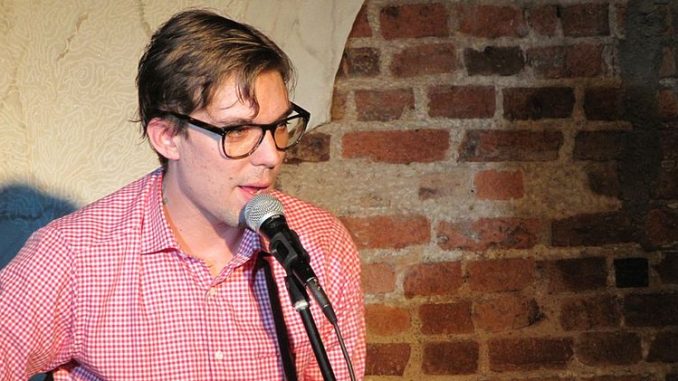
The critical acclaim flew in for Earle’s third full-length release, Harlem River Blues, culminating in a triumphant appearance on The David Letterman Show. This took place one day after his twenty-ninth birthday at the Ed Sullivan Theatre in Manhattan. Bernstein expounds on how Earle was not in a great place at the time. A hiatus of sobriety giving way to Earle’s old ways. The fans are as much to blame as anyone for wanting to party with their bad boy idol. At 11:30 p.m., Letterman introduced Earle as “a talented singer-songwriter”, holding up a copy of the album. The band were in fine form; any concerns that this could be train-wreck TV were washed away as Earle, dressed in a tan suit and black bow tie, crouched over a low microphone, supported by his then-friend, Jason Isbell, delivered a memorable performance.
Bernstein has managed to walk the thin line between out-and-out heartbreak and an overly sunny view of Earle’s life. However, much of what you will read is both challenging and moving. For example, Earle was back in rehab on his daughter Etta’s first birthday, and the last conversation between him, his daughter, and his wife, Jenn Marie, is heart-breaking. Jenn Marie pleaded with Justin to go into long-term rehabilitation, and he responded that “he hadn’t hit a crescendo yet.” Earle had so much hurt inside him that the only way he felt he could keep it at bay was chemically or with an inordinate amount of weed each day. No one asked Earle why he hurt so much. Only looking to treat the drug and alcohol abuse rather than investigating the source. Bernstein does not shy away from the real issue and also celebrates the great things Justin Townes Earle produced musically and the beguiling character he could be. Even though you know the ending, you are rooting for Earle to come through, and in a way, he did eventually find peace and a place to land. His final song sang in public was in Wilmington, Delaware. He sang Ain’t Glad I’m Leaving from his 2008 album The Good Life. Five months later, Justin Townes Earle was found dead in his Nashville apartment. This comprehensive biography is a must for any Justin Townes Earle followers and offers tremendous insight into his life, relationships, and music. We are blessed that we can still hear his wonderful music, we ain’t glad you left, Justin.
