
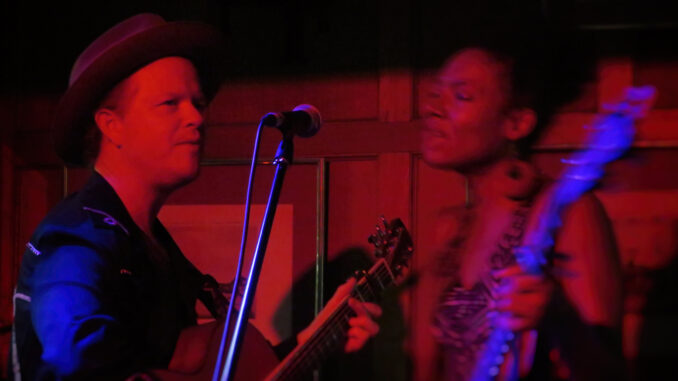
Most folk reading this will probably be most familiar with Canadian Steve Dawson due to his tenure with the Birds of Chicago as guitarist/steel player on several of their tours over here in the UK. Dawson (not to be confused with the other Steve Dawson of Dolly Varden) comes from Vancouver but currently resides in Nashville, where he has his own studio, Henhouse. A skilled player on all manner of stringed instruments, he has long been in demand both as a session player and a producer; his website estimates he has played on or produced over 300 albums, several of them going on to win Juno Awards (the Canadian equivalent of a Grammy), and he is indeed the winner of seven Junos in his own right. The list of names he has worked with is both stellar and seemingly endless, and includes Allison Russell, John Hammond, Van Dyke Parks, David Hidalgo, Jim Byrnes, Dave Alvin, Bruce Cockburn, Kelly Joe Phelps, Matt Patershuck, Matt Anderson and Colin Linden. He has been described as “the consummate sideman – creative, supportive and imaginative” but he has a healthy back catalogue of solo albums, a diverse collection of 11 in total, all of them quite unique as he flits from full blown band work outs to more esoteric recordings, which display his undoubted skills on slide, steel and pedal steel, with others a fine blend of both.
Dawson emerged from the local Vancouver scene initially as one half of the duo Zubot and Dawson before moving on to the avant-folk quartet The Great Uncles of the Revolution. The duo invented their own category of music they called “Strang,” described by them as “acoustic music that kicks ass. It’s folk music for people who don’t like folk music- and for people who love it dearly. Those who have been listening to roots music over the last 25 years or so might find some musical signposts pointing towards the work of Bela Fleck, Tony Rice, Ry Cooder, Darol Anger and David “Dawg” Grisman.”
Dawson released his first solo album, “Bug Parade” in 2001, a set influenced by pickers such as Leo Kottke and John Fahey alongside an abiding passion for Hawaiian guitarists of the 20’s and 30’s such as Sol Hoopii. In his notes for the album, he displays another abiding passion, his love of guitars of all sorts, playing on this album three instruments, described thus: “a National Tricone (the lovely metal beast on the cover), a Weissenborn style Hawaiian guitar, and my huge Larivee acoustic.” Another indication that the man is somewhat obsessed is when he casually notes that his interpretation of Blind Lemon Jefferson’s ‘Hangman’s Blues’ was inspired when he was flicking through his collection of old 78 discs.
“Bug Parade” indicated that Dawson was to be considered in a similar vein to that of Ry Cooder. Both of them are supremely talented guitarists, and both have championed all sorts of roots music, delving into the past and bringing it up to date with a bang. 2005’s “We Belong To the Gold Coast” cemented that comparison with Dawson, especially delving into Hawaiian music on songs such as ‘Patches’, ‘An Orange Grove in California’ and ‘Red Sand Serenade’. It’s important to note that, although Dawson’s guitars are to the fore on all of the selections, the songs are elegantly produced and arranged with the band backings adding much more texture to the overall experience. Dawson takes this a step further on the much more contemporary sounds of “Waiting For The Lights To Come Up”, one of two discs he released in 2008. While there are still zippy guitar showcases such as ‘Hard To Get Gertie’, several of the songs here might be considered within a folk/country/ rock idiom, such as ‘At Arm’s Length’ and ‘Walking Down The Line’, while ‘Somebody’s Got To Help You’ is an excellent foray into swampy territory.
Recorded simultaneously with “Waiting For the Lights To Come Up” was “Telescope”, an instrumental album which showcased Dawson’s pedal steel playing, an instrument he had picked up and was tutored on by Greg Leisz. At times punchy, elsewhere dreamlike, it’s an early entry into what has been called ‘ambient americana’. 2012’s “Nightshade” returns to the more conventional sounds of “Waiting For the Lights To Come Up” but is more than a shade darker, with Dawson drawn to the murkier elements of storytelling. There are glimmers of Tom Waits and Marc Ribot on ‘The Side Of the Road’, and ‘Torn And Frayed’ has more than a touch of Little Feat in its sinuous sway.
In 2013, Dawson settled in Nashville, and his first release after that was his first strictly solo guitar showcase, the excellent “Rattlesnake Cage”, a tribute to the “American Primitive” sound pioneered by John Fahey and Leo Kottke in the sixties. The notes state that the album was “recorded with a single vintage tube microphone that had recently been rescued from decades of hanging from the ceiling rafters of an old theatre in Detroit, you can hear every detail and nuance of each note.” It goes without saying that “Rattlesnake Cage” is highly recommended to anyone with a penchant for acoustic guitar wizardry, be it from Fahey or UK players such as Bert Jansch.
In contrast, “Solid States And Loose Ends” picks up from where “Nightshade” left off, with Dawson diving fully into a full-blown, fat and bluesy album with a horn section and harmonies from the McCrary sisters, while his electrified slide playing has never sounded more evil. Ever the chameleon, Dawson again changed tack on 2018’s “Lucky Hand”, teaming up with his old bandmate Jesse Zubot to create an instrumental album which harked back to their experimental/avant-garde folk sounds. Recorded with a string section accompanying his guitar, the sounds are cinematic and evocative, none more so than when the legendary Charlie McCoy adds his harmonica to a couple of the tunes.
While the pandemic put paid to Dawson’s then regular gig as one third of the Birds Of Chicago touring line-up, he used his imposed solitude to good effect, recording and collaborating remotely while holed up in his studio. The result was three albums released in quick succession in 2022 and 2023 (with a three-month gap in between each). “Gone, Long Gone” was another bluesy dip into Ry Cooder territory with a set of songs co-written with Matt Patershuck, Dawson’s devilish slide guitar snaking away and the band tight and locked in. It also contains the best song title in Dawson’s canon, ‘King Bennie’s Has His Shit Together’.
Next up was the instrumental album “Phantom Threshold”, billed as by Steve Dawson & The Telescope Three (a nod back to his “Telescope” album). Again, it’s ambient, at times bucolic, elsewhere almost sea shanty-like, tipsy, while there are also elements of spy movie soundtracks, Hawaii (as always) and a sweet and sublime version of Brian Wilson’s ‘You Still Believe In Me’. The third of this “pandemic trilogy” was “Eyes Closed, Dreaming”, a companion really to the first one, with Dawson and his remotely accessed bandmates delivering another delightful scoop of jelly roll. Matt Patershuck co-writes four of the songs, and there are covers of old faithfuls such as ‘House Carpenter’, ‘Singin’ The Blues’ and Bobby Charles’ ‘Small Town Talk’. Allison Russell is quite tremendous as she joins in on Ian Tyson’s ‘Long Time To Get Old’ while the gliding tones of ‘A Gift’ reminds one that Dawson’s guitar can fly gracefully as well as it can get down and dirty.
The trilogy closes the door on Dawson’s solo output as it stands right now, but he continues to play live and pop up on just about every other album which gets released these days. Last we heard, he was the music director for a star-studded tribute night to Lucinda Williams’ album “Car Wheels On A Gravel Road“, held in Vancouver. He’s also the host of the “Music Makers And Soul Shakers Podcast”, an extremely interesting collection of interviews with various musicians, which Dawson started doing in 2016, his reason being, “I was hearing all these great musicians on podcasts being hosted by non-musicians, asking them the wrong questions (in my opinion).” Check it out, and please check out the records. You won’t be disappointed.


