
There’s something quietly disarming about Teddy Thompson. Across a career that has never quite sat comfortably within genre lines, he’s built a catalogue defined less by reinvention than by a kind of forensic emotional honesty; songs that return, again and again, to love, habit, regret and self-awareness, each time from a slightly different angle.
His new album Never Be the Same continues that thread, but perhaps with a sharper edge. There’s a sense of midlife reckoning running through it. Not in any grand, dramatic way, but in the quieter realisation that patterns harden, comforts fade, and change becomes both necessary and increasingly difficult. The songs feel direct, sometimes uncomfortably so, circling ideas of repetition, avoidance and the small, telling habits that shape a life.
When we speak, Thompson is candid, dryly funny, and notably resistant to over-analysis, particularly when it comes to his own music. He describes his writing process as instinctive and ongoing, his influences as largely unconscious, and his songs as less about resolution than recognition. What emerges is a portrait of an artist still circling the same emotional territory, but with a deeper awareness of the patterns within it, and little interest in pretending otherwise.
Americana UK (AUK): Hi, great to meet you. Thinking about the new album, I’ve had the chance to spend some time with it, and the songs feel very direct emotionally, almost unguarded. So I wanted to start by asking where you were personally and creatively when you were writing them.
Teddy Thompson (TT): I was kind of all over the place, emotionally and creatively. It’s a difficult question, actually, because it sounds like it should have a clear answer, like there’s a specific mood or period that defines the album, but it’s not really like that for me. I don’t tend to write in one condensed burst. I’m always writing, in a loose way, strumming the guitar, coming up with bits of tunes, fragments of lyrics, just having things on the go as part of my life.
Then, over time, I end up with a few finished songs and think, “Okay, maybe that’s the beginning of an album,” and then I start looking around for other pieces that might fit with it. So, it’s quite spread out. Some of these songs have been around, in one form or another, for a couple of years. They’ve been sort of percolating. Because of that, they don’t feel tied to one particular moment in my life, or one emotional state, or even one person. It’s more like a collection of things that have surfaced over time, rather than one concentrated period.
AUK: That makes sense. I was also curious, as turning 50 can be significant for some, whether that milestone had any influence on the record.
TT: Yeah, I think it does, but not in a direct way. It’s rarely the actual milestone that does anything; it’s the lead-up to it, or the couple of years after. Turning 30 or 40 itself is usually fine. It’s more like being 28 and thinking, “Oh my God, I’m about to be 30,” or being 41 or 42 and suddenly realising, “I’m actually in my 40s.”
So I think a lot of what’s in the songs relates to that general period of life. There’s a lot about change, or the lack of it, which is really what ageing is. It’s unavoidable change. And at the same time, there’s this resistance to it. You want to hold on to things, to habits, to ways of being. That tension between needing to change and not wanting to, or not being able to, is definitely a big part of the album.
AUK: That really comes through. The title Never Be the Same feels central to that idea, but there’s also a lot of repetition in the lyrics: phrases like “same old song” or “same old thing” appear. It feels like an album about being stuck in patterns.
TT: Yeah, exactly. There’s a strong feeling of being stuck. And I think that’s pretty universal, especially at this stage of life. You’re more settled in where you live, what you do, your routines. Even geographically, you’re often in one place, and there’s less obvious possibility for change than there was when you were younger. So there’s this sense of doing the same thing over and over again. I didn’t necessarily set out to write about that, but it kept coming up – that feeling of repetition, of circling around the same habits and the same thoughts.
AUK: There’s also a strong thread of self-awareness, but alongside that, moments of avoidance. There’s a line in Come Back, for example, “If I don’t listen, I can’t hear“, which feels almost like a philosophy in itself.
TT: Yeah, I think that’s very much about avoidance. If you don’t listen, if you block things out, you can carry on doing what you’ve always done. It ties into habits as well. You start to notice that the things you do repeatedly – your little comforts, your routines – don’t really work in the same way anymore. For me, that’s things like wanting the same cigarette at the same time, or the same breakfast every day. I’m quite punctilious and repetitive in that way. Those things become little rewards, little comforts, a kind of structure to the day.
But then you start to notice they’re not really giving you what they used to. They’re not as enjoyable. You’re not even sure you’re enjoying them anymore. They’re just habits. It becomes less about enjoying it and more about just doing it at the same time every day. And then you’re confronted with that realisation: maybe something has to change. Or maybe you just keep going, but knowing that the enjoyment is fading. That’s part of ageing, I think.
AUK: Change is also a feature of the relationships you sing about, too, but sometimes there’s a real tension there. Lines like “When you were here, I couldn’t breathe… come back” are really powerful. Are you drawn to those contradictions?
TT: I think that’s just part of being human. I definitely recognise that pattern in myself. You want someone around, and then when they are around, they drive you crazy, and you want them gone. Then they leave, and you’re lonely and want them back. It’s a very familiar cycle. It’s not something I consciously aim for; it’s just something that comes up because it’s true. Those kinds of contradictions are just part of the human condition.
AUK: Is songwriting a way of confronting those patterns, or more a way of observing them?
TT: I’d say observing them. I’m not very good at confrontation, really, which is probably why I’m able to keep mining the same subject. But creatively, that’s not necessarily a bad thing. You can keep returning to the same subject and find new angles on it. It’s like painting the same object over and over again – every time you do it, it looks slightly different. I think that’s what songwriting is. You’re often writing about yourself, your own patterns, but you find new layers in it. And sometimes what comes to the surface is just the same stuff again. That happens.
AUK: Love is another recurring theme. On I Need Real Love, you talk about mistaking things for love. Has your understanding of that shifted?
TT: Yeah, I think so. For me, I’ve been very influenced by how things look, by appearances. That probably comes from being uncomfortable with how I looked growing up, so looks became very important to me, maybe subconsciously at first.
I’d be drawn to the look of someone; what felt like the “right” look, like what I was supposed to want. Not necessarily conventional beauty, but something that seemed to fit. And then you realise that if it’s based mostly on that, you can get into trouble. I definitely have. You can fool yourself quite easily that something is right when it isn’t.
AUK: I Remember feels quite different in tone – there’s a warmth and clarity to it that stands apart. Was that relationship, or that period, a kind of anchor for you?
TT: Yeah, that one is a bit of a departure. It’s one of the few times I’ve really tried to look back in a more specific way. I don’t usually write very detailed, memory-driven songs; I tend to keep things more general, but with that one, I was trying to picture things from a long time ago, from childhood.
It’s a bit of a gratifying song for me because it’s doing something I don’t normally do. It’s about remembering, really, which is interesting because I’m not someone who has very clear memories of my early life. I don’t have a huge amount of that to draw on in a literal sense. But emotionally, most of what I draw on does come from those early familial experiences. That’s the first kind of love you know, and the complications that come with it. So even if I’m not remembering things in a very concrete way, that emotional core is always there. That’s what I’m using.
AUK: Musically, some of the songs feel like they draw on classic pop traditions. Is that something you’re conscious of?
TT: Not really. I don’t think in those terms at all when I’m writing. I don’t listen to something and think, “I’m going to try and do that.” I just absorb things. And I actually try not to analyse it too much, because I feel like that takes away from the creativity, takes away some of the mystery. I’ve never really had that instinct of thinking in reference points. A lot of musicians will say, “Make it sound like this record” or “like that groove,” and I just can’t do that. I don’t have that kind of analytical mind when it comes to music. In fact, I kind of hate analysing it too much, it makes it feel less creative.
That said, afterwards, when everything’s finished, I can sometimes hear it. Someone will point something out, and I’ll think, “Oh yeah, I suppose that does sound a bit like that.” So it’s all in there, everything I’ve ever listened to, but it’s coming out in a more unconscious way. And I think that’s important to me. I don’t want to be too deliberate about influences, because then it starts to feel like you’re just borrowing too directly. I’d rather it comes out as a mixture of everything, without really knowing how it got there.
AUK: There’s a strong sense of self-critique in the album; you describe yourself as a “bounder”, and there are lines like “catalogue of shame.” How much of that is autobiographical?
TT: It’s all autobiographical at its core. I’ve learned over time that if it’s not coming from something real, it doesn’t hold up. I’ve written songs in the past that weren’t fully grounded in my own experience, and they just don’t last. So every feeling I’m trying to convey is real, how I feel about myself in that moment. The language might be shaped, or stylised, but the emotion is genuine. That’s the key thing for me; it has to be truthful.
AUK: Do you ever hold anything back to protect yourself?
TT: A little, but more in terms of how specific I am. I don’t tend to write very detailed, literal songs with names or very precise situations. So there’s a level of ambiguity there, which gives me some distance. Sometimes a song might be about a relationship, but not necessarily the one people assume, or not in the way they assume. But emotionally, it’s all coming from me.
AUK: On the album Worst Two Weeks of My Life stands out; it links sobriety with what you describe as an “avalanche of thinking.” Was that something you expected?
TT: No, not really. What you realise is how much those habits, whether it’s drinking, smoking, eating, are actually dampening your thoughts and feelings. When you stop, everything comes flooding in. It really does feel like an avalanche. That was a bit of a surprise when I experienced it. You suddenly have to face all the things you’ve been avoiding thinking about.
AUK: Does that lead to clarity, or just intensity?
TT: More understanding than clarity. I think it’s about being more intentional; pausing and asking yourself, “Do I actually want to do this?” rather than just acting out of habit. Even just that small moment of awareness can make a difference.
AUK: There’s an interesting contrast in your work: the lyrics often deal with difficult emotions, but the music can feel quite soft or melodic. Is that deliberate?
TT: Not really deliberate, but I think it comes partly from how my voice sounds. When I started out, people would describe it as “nice” or “pretty,” and I didn’t like that. It made me feel lightweight, like I wasn’t being taken seriously. So I think I’ve tried, maybe subconsciously, to push against that; writing sharper lyrics, trying to bring more grit into the voice as it’s aged. I’ve always wanted a bit more edge there.
AUK: There are some great collaborations on the album; your dad appears again?
TT: Yeah, that’s become a bit of a tradition. It started as a way of bonding when I was younger. We didn’t spend loads of time together growing up, so music became a way of connecting. Now we just try to keep that going when we can. It’s something we both enjoy, and it feels quite natural now.
AUK: And John Grant?
TT: I’ve known John for a long time, maybe ten years. I’m a big fan of his, as a person and as a musician. And this was one instance where I did think quite consciously, “This record could use a bit of what he does“; just that flavour, those textures. So that was a deliberate choice.
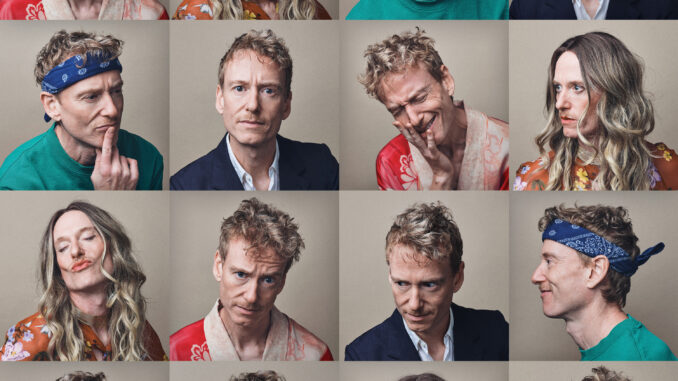
AUK: The album artwork is fantastic as well; it looks like it was a lot of fun.
TT: It was. We did everything in one day: five videos and all the photos. Very fast, very instinctive. That’s how I like to work. If things drag on, they get worse. So this was very much “boom, boom, boom… next idea.” And that energy made it fun.
AUK: You’re touring the album soon. Do the songs change when you perform them live?
TT: They do. We’re not trying to replicate the record exactly; it’s a smaller band, so things naturally shift. That can actually be quite freeing, because you stop trying to recreate something and just focus on performing the songs in a way that works in the room.
AUK: And what’s it like revisiting those emotions night after night?
TT: You learn how to dip into them without getting overwhelmed, and then get out of them again without crumbling. And if the songs are well-written and honest, you can find something new in them each time you perform them. They evolve over time.
AUK: Finally, what do you hope people take away from the album?
TT: I just hope they feel something. That’s really it. If someone listens and feels moved in some way, then that’s the job done. Everything else is secondary.
Tour Dates 2026:
6/3 – Dublin, IE – Workman’s Club
6/4 – Belfast, UK – Black Box
6/6 – Pocklington, UK – All Saints Church
6/7 – Glasgow, UK – St Luke’s
6/9 – Sunderland, UK – The Fire Station
6/10 – Manchester, UK – Stoller Hall
6/11 – Leeds, UK – Howard Assembly Hall
6/12 – Lincoln, UK – Drill Hall
6/14 – Norwich, UK – Epic Studios
6/16 – Brighton, UK – The Old Market
6/17 – Milton Keynes, UK – The Stables
6/18 – Bristol, UK – St George’s
6/19 – London, UK – Union Chapel

