
I can already hear the cries, “Jackson Browne, a bad album – what heresy is this.” After a moment, though, those same voices say more reflectively, “Well, there is his recent output,” or “Well, there was that time in the 80s; that decade wasn’t kind to many people”. Then they would, as you are doing, wait for me to put clarity and arguments together, and then disagree with me totally. And I expect it.
I am going to start with that cliché that leads this feature on many occasions; Jackson Browne has not actually made a bad album, never an indefensible stinker, in his life. Since starting as a songwriter hanging around the Laurel Canyon scene in the 60’s, selling his songs to others, to his first self-titled album in 1972 and through to his fifteenth in 2021, he has made a name and a reputation as a perfectionist with considered arrangements and access to some of the best musicians in the business. And his lyrics cover love, sadness, reflection, tragedy and strongly felt politics, with unmatched articulacy.
However, he is subtly variable in style throughout. Many rightly laud his first five albums and decry the overt politics and production shadings of the 80’s. Others don’t feel he has done much worthwhile in the last 20 years and struggle with his world-music stylings and lived-in vocals. For me, Jackson Browne was my gateway drug into americana (as we now know it) in the late 70’s. I was the classic Grammar schoolboy wearing his hair long-ish and his badges of honour on his lapels and carting obscure albums around in prized record shop bags. My taste was primarily heavy rock, spiced with prog, until I started to swap albums with my best friend at the time. I introduced him to heavier fare, Jethro Tull, Kansas and Genesis; he, in return, lent me Barclay James Harvest, Al Stewart, and Jackson Browne. I listened avidly and started to investigate more widely. Neil Young and Nils Lofgren quickly followed, and I was in. Just shy of 50 years later, I still like my prog, but my collection is heavily laced with americana, and I proudly own all of Jackson Browne’s output. I strongly believe all artists need to grow, evolve, and, moreover, write songs reflective of that period of their lives. So for Can’t Live Without It, I could happily have picked Late for the Sky (1974), Lives in the Balance (1986), I’m Alive (1993) or The Naked Ride Home (2002) – they are all albums I return to and love the diversity and how he has embraced each era sonically and lyrically.
Can’t Live With It: Hold Out (1980)
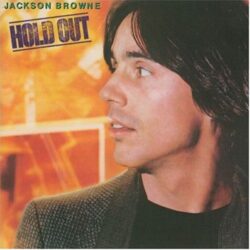 However, when going for Can’t Live With It, there can only be one. Hold Out commits the cardinal sin of being forgettable and, frankly, just not very good. Initially, it is not easy to put your finger on why. All the familiar tropes are in place. He has his established backing band, a group of seasoned session musicians who became known as The Section after working together backing Carole King, James Taylor, Linda Ronstadt, Warren Zevon and Jackson Browne on a regular basis. The playing is exemplary as you would expect. He has his chief foil, David Lindley, providing his own eccentric lap steel and electric guitar flavours to the songs. Somehow, though, none of the tunes quite gel; I have been playing it again as I write this article, and I can’t hum or, frankly, remember anything of it.
And then there are the lyrics, carefully thought out and avoiding cliché as ever but just not skewering the heart or the head in his usual way. The first track is called Disco Apocalypse, and it probably is about as good as you are currently imagining. At times the lyrics and the music just don’t work together; Boulevard at the end of side 1 sounds cheerful and upbeat but appears to be about drug addicts and derelicts on the street. The first track on side 2, Of Missing Persons, was written for Inara George, the young daughter of Lowell George. George was a longtime friend of Browne’s who had died the year before. Considering the sensitivity and beauty with which he had reflected on his own tragedy on the album The Pretender, this track doesn’t quite hit the mark. Contemporary critic Robert Christgau, who didn’t like Browne much, wrote about the album: “I’m less than shocked by the generalized sentimentality disillusioned admirers descry within these hallowed tracks, though the one about the late great Lowell George is unusually rank.” This is unnecessarily harsh in my opinion, but I can see where he is coming from.
Ironically, coming off the back of the massive success of Running On Empty, Hold Out quickly surpassed it in sales and remains the only Jackson Browne album to hit number 1 on the Billboard charts. There are a couple of tracks worthy of note. That Girl Could Sing has the beginnings of a hook line in the chorus and is the closest, along with Call It a Loan, to a quality Jackson Browne track. Call It a Loan is the only one from this set to have made it to a live album, appearing on Love is Strange, his 2010 album recorded in Spain with David Lindley and Tino di Geraldo in rearranged form, acoustic and Latin-flavoured.
Perhaps the most damning of all is that this is the last Jackson Browne album I bought to add to my collection, after hearing it initially in the early 80’s, and even then it was bought for completeness, not love.
Can’t Live Without It: Running on Empty (1977)
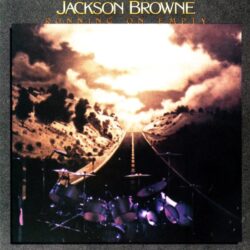 After long consideration, this is the Jackson Browne album that I would rescue in the event of fire or flood. This was the first Jackson Browne I was introduced to and stayed the Jackson Browne album I return to most often. It is the Jackson Browne album I play to friends who like americana but haven’t heard any of his oeuvre. Writing this article is maybe the first time I have stopped to consider why that is.
The easy immediate answer is that you always remember your first time. This was my introduction to Jackson Browne. In nostalgia value alone, then it has to be up there, and yet it doesn’t have a song as powerfully moving as Fountain of Sorrow or as hooky as Shape of a Heart. I think that there are two factors that feed into why I can’t live without it.
One is that this is a “Live” album recorded in various places: on stage, as is traditional, at soundchecks, in a variety of hotel rooms, and even on a tour bus (with a good sound system, you can hear the bus change gear partway through the song). Browne had made his name as a perfectionist, writing carefully considered songs, played and recorded immaculately. This was somehow the antithesis of what he was known for. And whilst I didn’t know that when I first heard it, I think that has been what has made me come back again and again. That looseness and relaxed vibe makes it an attractive album to listen to. It has been criticised as “Jackson Browne lite”; Robert Christgau, who, as noted, was not a fan of Browne, wrote, “(Browne) sounds relaxed, verbally, vocally, even instrumentally…”. Whatever the magic, it was his biggest hit to date so it clearly rang a chord with those who have to part with their own money to listen to an album. The playing, with The Section and Lindley, is excellent throughout. It might have been relaxed, but everything was played by consummate musicians at ease with each other.
The other factor was that, whilst Browne, like Springsteen, was also famous for how his albums were sequenced and the feel or story they put out, this was the first with an overt concept, and Browne even allows cover versions into his world. A live album where none of the tracks had previously been released on studio albums, the songs went from the title track, which generally reflected on the life of a rock musician, to Rosie about a girl met hanging round the venue at the load-in through various songs about travel, the road, drugs, before hitting the last track The Load Out, a song dedicated to the audience and the roadies which segues into a cover of Stay by The Zodiacs, where the lyrics are changed to become,
“People stay just a little bit longer / We want to play – just a little bit longer / Now the promoter don’t mind / And the Union don’t mind / If we take a little time / and we leave it all behind and sing / One more song”.
I have always been a sucker for concept albums, the idea that the album tells the story and that the concept becomes stronger than any of the individual songs. Whilst I had developed this taste through Pink Floyd, I was drawn to it with this album too. So that is perhaps it; it has good songs but not as strong as some of the individual ones he had put out on other albums. Here the concept, which is fully in tune with the relaxed and almost joyous vibe, makes for an overall strong and cohesive album.
Whatever the reason, and maybe I shouldn’t overanalyse it, this is my Can’t Live Without It for Jackson Browne, nearly 50 years and counting.



Jackson, along with Gene Clark, are my musical Gods. (Gram might have joined them; it’s only his more limited body of work that excludes him from the top table.) I’m glad to read that you acknowledge Jackson never made a bad album … but then go on to say “Hold Out” is “just not very good”. Semantics, maybe, but sounds like “bad” to me. Whist I agree it’s not his most accomplished album, I’d rate it on a par with “Running on Empty”
However, the biggest conundrum for me is that his acknowledged masterpieces “Late …” and “Pretender” you consider below “Running …”
My parents take great credit for my upbringing, otherwise I may have by now used a few X like expletives to reinforce my viewpoint! (Only joking .. jovial banter is the limit of my expression of an alternative view – ask Graeme Tait. He, absurdly, thinks “Pretender” ranks higher than “Late ..”)
Anyway, Andrew thanks for a well written and considered article.
Hi Alan, I said you wouldn’t agree with me! I agree Late for the Sky and The Pretender have stronger individual songs but Running on Empty has a relaxed vibe and an overall concept which just edged it for me – plus it was my “gateway drug”. I could have really set the cat among the pigeons and picked Lives in the Balance!!
But thanks for reading the article and taking the time to comment
Jackson’s recent song writing (2000 – present) could’ve done with more melody. Can’t fault his lyrics, but wish the songs were just a bit more tuneful.
Rosie is also about something more than just ‘losing the girl.’ The chorus gives it away, but suffice to say that we find pleasure where we can!
I think that every JB album has a couple of stand out moments, and a few that could have been reconsidered. Despite his meticulous attention to detail, there are one or two cuts on albums that just tread water. However, when he hits it on the bullseye, there are none better.
I’m going to politely disagree with a bit of your assessment. I’ve struggled a bit with some of Jackson Browne’s records after his first four or five. What I have found though is within every record there are a few songs that have stayed with me for over forty years. “Hold On Hold Out” is terrific in my opinion. When I first heard it I remember chuckling and thinking wow, this is going to get burnt and joked about by half the folks that hear it. I was the other half. 46 years later I can sing it word by word. It hit me then and it meant something to me. I know so few artists if any actually who have put out all stunning records over a fifty years later period I think Jackson Brownes canon stacks up to anyone.
I enjoyed your column. Made me at 6:15 AM grab my airpods go back and listen to “ In the Shape of a Heart”, “I’m Alive”, “Naked Ride Home” and just now finishing up my morning with “Hold On Hold Out”. Now I’m going to go wake up my wife and tell her I love her and head to work. That’s what a good column can do even if you disagree a bit.
I go all the way back with Jackson and own all his albums. For me, while Hold Out is not a great album, far worse is Lawyers In Love! Hold Out is pretty good by comparison, songwriting-wise. That being said, most songwriters could only dream of having as many outstanding albums (including some of the later ones!) that Jackson has produced in his career.