
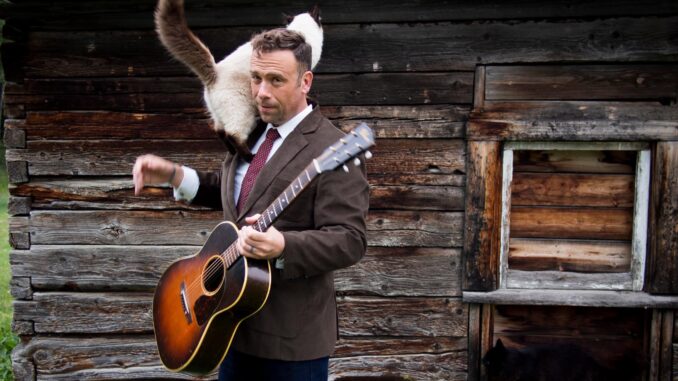
As an animal lover and caretaker of horses, dogs and cats, the latest album from Canadian singer-songwriter Matt Patershuk certainly caught my attention. Dog Tiger Horses on Red Hen Records (2025) is green as grass, country-folk replete with cosmic vocal and instrumental harmonies from a helping of Nashville’s finest. It sounds like flannel shirts fresh out of the wash, unlike his 2013 album Outside the Lights, which he made with the Dirty Plaid Orchestra. It’s a truly delightful record to behold, as dog-eyed songs reckon with relationships and friendships now separated but, in the eyes of hope, never fully surrendered. It’s a truth that explains exactly why the album’s nostalgia works and why the turning seasons of the music feel so invigorating on the first and fifth listen.
“As far as the title goes,” Patershuk explained. “There’s a song about a dog, a tiger and a couple about horses on here. I may have been thinking of this Hemingway quote regarding “The Old Man & the Sea”: ‘Then there is the other secret. There isn’t any symbolism. The sea is the sea. The old man is an old man. The boy is a boy, and the fish is a fish. The sharks are all sharks no better and no worse. All the symbolism that people say is shit.’
His songs may sometimes contradict that thought about symbolism. Matt Patershuk’s music lives in a world that’s passed by. His songs come out of a place where time has slowed way down, where there’s always an opportunity to smell the roses, kick the tyres before buying, and use an old screwdriver instead of a power tool to fix what’s broken.
The album continues the music dialogue between Patershuk and Steve Dawson, the Juno-winning, Nashville-based guitarist, producer and recording artist who has been riding shotgun with him since the beginning of his recording career. “The people who played on this record made it what it is,” Patershuk said humbly. Tim O’Brien gets a big well done for his contributions on guitar, mandocello, mandolin, fiddle and banjo, and as if that wasn’t enough, harmony vocals as well. The shimmering guitar on Good Dog tenderly paints a picture of a long companionship told through the sad eyes of the dog’s owner: “That’s the thing about good dogs, boys, they are already better than you.” Lyricism is the shining armour of Brown Pony, existing as pensive and full of grace, all while building its own world of ache and yearning in just three minutes’ time, its downtrodden narrative bolstered by jaunty fiddle from O’Brien and staunch drumming from Jay Bellerose. The gut-punch sequence comes when the pony-sized (14 hands) horse falls and breaks a hip. The rider couldn’t bear to put her down until a farmer did: “Fifteen long minutes later I heard his rifle split the air, I came back and looked at her, cut a long piece of her hair.”
The album is not all heartbreak, wistfulness and yearning. Tiger Plays the Saxophone showcases Patershuk’s impeccable timing, phrasing and delivery. It’s a complicated tale wrought from viewing the Sesame Street characters and a youngster wanting a picture of a tiger to hang in his room. It has an organic energy that springs from the music and barrels into a time of reminiscence. That pretty much sums up Patershuk’s contribution to Canadian music, showcasing a proficiency and sensibility that has run like a vein of silver through seven albums. The musician is as capable of distilling the human experience in conversation as in song.
Patershuk lives in Grande Prairie, about a 5-hour drive Northwest of Edmonton, fairly close to the start of the Alaska Highway on the Alberta side of the border. It’s a bit of a trek to go up to the Yukon, though, around 12 hours by car. I figured he must be a hockey fan, right? You get the chance to talk hockey with someone and music goes on the back burner. Then we talked about horses and music gets taken off the stove. But before we put plastic wrap over it and stuck it in the fridge, we got around to his music.
Americana UK: The best hockey player on the planet, Craig McDavid, signed for two more years with the Edmonton Oilers. You and other fans must have breathed a heavy sigh of relief.
Matt Patershuk: You want to see Canadians get riled up? If he would’ve left, man, there would’ve been riots in the streets, mass tears. Remember where you were when they landed on the moon? For people in Alberta, it’s like, where were you when (Wayne) Gretzky was traded?
AUK: I’ve read that your girls play hockey.
MP: My oldest now is 20 and so she doesn’t play minor hockey anymore, but my youngest is in her last year. So yeah, I’m really going to miss going to the rink with them. It’s been a lot of fun to kind of follow them around.
AUK: What brought you to Nashville to record the album?
MP: Steve Dawson. We’ve worked together since, well, forever. He is the only person I’ve ever worked with, and he’s a great friend and a great guy. I love making music with him. He is in Nashville, so I followed him there. And I mean, the added bonus is, as you know, that place is chockablock with people who are as good musicians as you’ll ever hear. It’s a luxury to be able to go and have people you wouldn’t have the chance to play with anywhere else.
AUK: Tim O’Brien is one of the most talented cats on your album.
MP: I really loved hanging around with him, aside from music. What a nice guy! He had every reason in the world to ignore my music, collect a paycheck and walk out the door. But he was really invested, and I enjoyed his company.
AUK: What can you tell our readers about Steve Dawson?
MP: He’s from Vancouver before moving to Nashville. I think the underappreciated thing about Steve is, when you’re making music, sometimes people are effusive with praise when you don’t deserve it. He just goes about his business and sets the table for everybody to have a good time. Things are relaxed. He hires good people and lets them do their thing, so everything is down to earth and fun. Obviously he can play the shit out of the guitar, right? But just the way he conducts himself and organizes things in the studio creates a great environment for people to do their best.
And you know what I really love about Steve’s process? You get a bunch of people in a room, and you’ve got this weird song that you cooked up in your basement one night, never knowing what might happen to it. And then you listen to a bunch of people that are just so great at what they do, make something out of nothing. I just love watching something come to life in 20 minutes. It’s pretty exciting.

After we determined if Matt had recorded five or six – maybe seven – records, we talked about the first.
AUK: How did that first recording come together?
MP: I remember that I recorded it in 2012 and it came out in 2013. I went and facilitated at this songwriter’s conference, which was out of my comfort zone. How do you tell somebody how to write a song? It’s a difficult thing to try to put on paper, and there’s sort of an arrogance, even assuming that you can, that I wasn’t totally comfortable with. But I was talking to the people there about how bad my stage fright was and how I was so unsure about even being able to make music that anybody at all would want to hear. Steve very generously agreed to help me make a record. I remember driving down to Vancouver with my pickup loaded up with guitars and whatever else, and thinking very seriously about faking my own death and starting a new life. I was so nervous, but I’m glad I did it.
AUK: Did you start out with open mics or just go for it?
MP: I’ve got a good story for you. There’s not a lot of opportunity up where I live, or there wasn’t then, to do open mics, and so you kind of had to make your own show. I was telling people, if you want some live music for your event, I’m available. There’s lots of ranching people, and rodeo is big up here. I was telling some of my friends that I wanted to try playing in front of people. So, a buddy of mine got in touch with me and said they’re doing this chuckwagon and rodeo, and they’re looking for somebody. I said, okay, I’ll happily go give it a try.
It was called the Teepee Creek Ladies Annual Diamond Dinner. And the thing was, all the women that were associated with the rodeo got together and had this fundraising dinner where they’d give away a diamond pendant at the end. It was only women in this hall, and I was really nervous. I set up all my gear, and you know how those kinds of things are – there’s a bunch of speeches, and everybody has dinner. There were a couple other people there to perform, and the first person who got up was this lady named Oxana, who was a belly dancer from Grand Prairie. So Oxana gets up and does the belly dancing routine, and people go nuts, of course, as they would. My wife was in the crowd. She left the room to have a smoke. My very first gig, and I had to follow Oxana, which was a tough experience.
So I did my set and didn’t pile up too bad. And then the next thing that happened after me was a fashion show for women’s nightwear. A lot of local people that I knew were the models, and I had to stay and play another set. Having to sit there during this women’s nightwear fashion show, I just wanted to crawl into my own skin and die. Things have gotten better since then.
AUK: There are two tracks on the album about horses.
MP: Horses are everywhere up here. My sister had one. My wife loves them, and we’ve had horses since the kids were small. They’re just fun to be around. Even if I’m not riding them often, Saturday or Sunday afternoon after I’m done doing what I have to do, I’ll have a cooler with a couple beers, just sit and watch the horses, watch them do their thing. They’re calming. We also had a trio of goats, three brothers, for a while. We named them Elvis, Carl and Buddy,
AUK: It’s not hard to guess who those goats were named after. My horse is named Carl but not after Perkins. Could you tell us about Blown Horses?
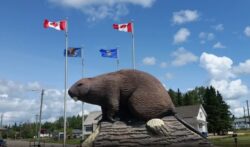
MP: Like I was mentioning, we live in a rural area, and there’s a few towns that surround us. The girls play hockey now in this town called Beaverlodge, home of the world’s largest fiberglass beaver. (That would be Justin Beaver; 18 feet long and 15 feet wide.) You ever looking for a holiday… Anyway, there’s this great old tavern in Beaverlodge. I don’t know if it’s the same way in the States, but here, every small prairie town had a hotel with a tavern and a restaurant, usually a Chinese restaurant in the bottom. And some of them have survived. The last renovation I’m pretty confident in saying was sometime in the mid-1970s. So, it’s got that kind of orange carpet and a theater-shingled faux roof above the bar. There’s a spiral staircase up to the hotel from the tavern with red carpet on it, and it’s got quite the atmosphere. I like to stop in there sometimes by myself to have a beer and listen to people talk. That’s where that blown horses song came from. There are these two old guys talking about life, and one was given the other some advice. He said, “Larry, you don’t know anything but blown horses and crazy women.” I tell you, I couldn’t find a pen fast enough.
AUK: You had me shedding a tear on that last song, Brown Pony.
MP: That one came from a story, too. A friend of mine likes to go pack hunting in the mountains for sheep and goats, and he trains pack horses. Basically, he tells the story that they went to help somebody, and this horse slipped and busted her hip. He was really torn up about it. He didn’t quite have the heart to put her down. There was the guilt of that added on top. It stuck with me, and I had to write a song about it.
AUK: The song Tiger Plays the Saxophone conjures quite the image.
MP: I’m glad you asked. I used to watch Sesame Street when I was a kid, like lots of people in my generation. They used to have those little vignettes like Burt and Ernie mouthing off to each other. There was one, a video about this tiger trainer, and it was in that grainy ‘70s color film. It showed a guy running around this tiger enclosure at a zoo in a khaki outfit. There were three enormous Siberian tigers. They had to tackle this guy and just beat the ever-lovin’ snot out of him for fun. Better than being eaten. When I was a kid, I just thought that looked like the best job going, but thankfully for the future people in my family, I never lived out that particular dream.
But I always had a thing about tigers after that, and I wanted to find a picture of a tiger to put up in my house. It was hard. A lot of ’em looked like they belonged on a biker’s arm or one of those lenticular pictures. I finally found one that I liked, and I’ll just describe it for you. It was a large-format square picture, and around the edges is a big wrought iron cage, probably about 20-foot tall with cast iron points. In the far right of the picture, there’s a guy in a clean white shirt with his sleeves rolled up, and he’s wearing a pair of those riding pants and big boots like the cavalry used to wear.
AUK: I had to look on a map to find Usherville, which is the title of another song. It’s in Saskatchewan, but you know that.
MP: Well, I’m sure it’s the same in the States where lots of people of my great-grandparents’ generation came over from Europe, and they were trying hard to blend in. They didn’t really talk a lot about their family history. Once people come to Canada, it’s kind of a mystery about where they came from and what their real last name was. And of course, when you don’t have details, people tend to start creating a bit of a mythology around it, around my great-grandfather especially. Apparently, he was an orphan that lived in a monastery. He spoke a bunch of different languages, and when he came to Canada with a family friend, he took this person’s last name to get across the border and into the country. He was not really cut out for farming. They had this rock farm in the middle of northern Saskatchewan that was just borderline arable land. They had a pretty tough go. So, it’s about him, and I guess I’m asking him, who are you? Where did you come from? Why didn’t you tell us? Apparently, he was really good with horses, true or not, who knows? People used to bring problem horses to him. Part of the legend that’s been created in the family that nobody knows is true or not is that we’re pretty sure they’re from Romania, and that he might’ve been a gypsy. Could all be true, could be lies, but there’s a song about it now.
AUK: What really hooked you into playing music?
MP: Grande Prairie is a city of about 70,000 people. One of the first dates I took my wife on was this little folk club there, and they had Kieran Kane and Kevin Welch come up, just them and a couple guitars and a bottle of whiskey between ’em. They sat on the stage in this little hundred-person theater and played music and drank whiskey for a couple hours. I had no idea that you could do that. I thought you needed a band and be all over the place. And I was so enthralled by these two masters sitting there with just guitars, I was like, oh, you can do that. I knew I’d never be able to do it that well, but it just dawned on me that it was possible to go and play songs for people.
AUK: What would you say is a song of yours that most typifies Alberta?
MP: There’s one from my last album called Turn the Radio Up that I wrote for my wife. It’s about how sometimes in the rush of life you kind of forget to spend time together. The image or the metaphor that goes through the song is like things go sideways, but we can still jump in the car together, roll the windows down and just go for a drive. Some of the imagery in there really makes me think of home.


I first came across Matt Patershuk about 10yrs ago. I think I’ve got 4 albums (CD’s) but the last one was 2019 (“If Wishes Were ….”) Lost track of him since then, so it’s pleasing to see him “resurface” again.