
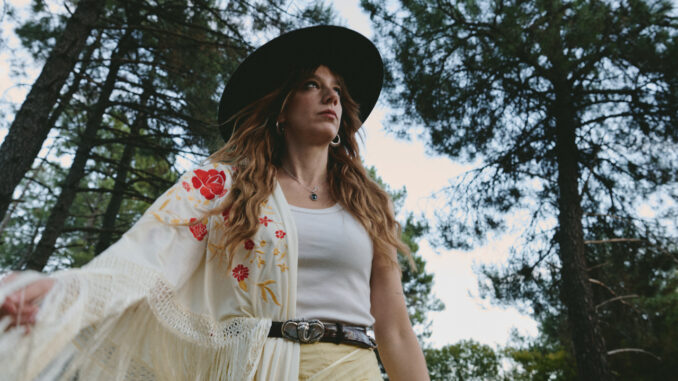
At once nostalgic travelogue, introspective head-trip, and rootsy showcase, Madrid-born Juana Everett’s second album should be her breakthrough record. Past Lives in California swims headfirst through the murky waters of transit, both literal and metaphysical. Bring Me Back skips like a stone across water, its robust rhythm yielding one of her best pure americana songs. Pinecrest looks more inward with snapshot lyrics about leaving Los Angeles to sit on the porch and listen to the rain. What A Swell Party finds her in Joshua Tree, “where I feel free / A pair of boots, a bikini and a hat.” With these eleven expansive songs, the album is a journey in itself, emerging from the sanguine depths of self-excavation to find a whole new realm of possibilities in blending the sound of Nashville with the freedom of the West and, at times, subtle echoes of Everett’s Spanish roots.
There’s a particular kind of wisdom that only sounds right delivered over a slow, dark country, honky-tonk sway, and Everett nails it. The Janitor, a standout track on the album, opens on a truth most songs would treat as tragedy; nobody notices you, nothing lasts, not love, not the version of someone you built in your head, not even the grief of being ignored. Somehow, she proceeds to make these tasteful explorations of the things that haunt her as comforting as a weighted blanket, her voice drifting through warm, unhurried country guitar like smoke through a screen door, airy but deliberate, turning a dream she is chasing into something closer to a toast than a concession. By the time she arrives at “there’s no turning back / my love is my strength,” it doesn’t sting. It glows.
Comparisons to artists like Lucinda Williams and Bonnie Raitt are inescapable, and one could easily imagine Everett resides in the calm before the climactic storm. She is at once looking forward and backwards in a deeply personal way before deciding that the only place to be is in the present, tracing a musical journey through the lives she dreamed of and lived in California, the myths that slowly crumbled, and the people who changed her forever. Her songs are uniquely vulnerable, tasteful explorations of things that haunt her. They are all connected by emotion, all gesturing towards her search for roots, both physically and metaphorically, inviting the listener to roam the Pacific Coast Highway with the taste of ocean salt on their lips, to face the desert wind head-on, drink in forgotten bars, talk to strangers, and dive into the poetry and darkness of the stories she tells.
Americana UK: Hi Juana. On your website, there is a date for a gig in Spain tomorrow night. Where are you?
Juana Everett: I am just outside of Madrid. I’m very excited to be presenting the new album, and it’s going to be a great show.
AUK: You are a Sagittarius, which is a fire sign, which indicates adventurous, don’t like being tied down.
JE: I like not knowing the future or not attempting to know it, not making plans too far down the road because life has proven that things don’t really work that way.
AUK: Why did you move from Spain to live in California?
JE: I think that was because of all the music and bands that I grew up with and all those things in my imagination. When I started, I had a couple of bands in my early twenties, but then when I started playing solo and writing songs, they were very heavily influenced by West Coast music in general, folk and the Laurel Canyon Generation. I thought I had to leave Spain and check it out for myself. And at a certain point in my life, I got sick of my job and sick of my partner, sick of my apartment. So, I thought, “Well, it’s now or never.” And I didn’t know how long that would last, but it ended up lasting over eight years before I moved to Nashville.
AUK: From your website, I learned you wrote independent films as Juana Izuzquiza. Anything I would recognise?
JE: Probably not because independent efforts usually don’t make it to networks, sometimes to festivals. I also do music for podcasts, like at Stanford University they have an arts and science podcast that is really cool. That’s my other musical endeavor. All the music I publish under Juana Everett is my artistic path. Not that the other projects are not artistic or creative, but in those instances, I’m trying to channel whatever they’re looking for.
AUK: The title of your album is Past Lives in California, which sounds as if you are trying to move on.
JE: I ended up moving out of California, but I had the concept for the first album even before I left it because Move On was a very personal story based on all the songs that I wrote, but in Past Lives in California, even though there are some stories that are very personal, some others are imagined or inspired by characters and people that I met out there. I do romanticize California a lot. So, I would think of these songs like lives that I’ve lived there before I lived this one. It was not so much like a farewell approach; it was more like a way to honor that land that inspires the songs.
AUK: Your press materials describe Move On as a dark time for you.
JE: The songs contained in it are very much like me trying to let go of heavy relationships and self-conceptions and, in a way, trying to make room to build a new identity. When I left Spain, it was way more dramatic than I thought it would be, and that process of self-reconstruction was heavy and dark, so those songs helped me through that process. Past Lives in California is written from a place of self-security and self-certainty, as in who I am and who I want to be. It’s nostalgic of the past, but I think it’s more dreamy and more open and has more light.
AUK: The song Bring Me Back is nostalgic. You are singing about childhood, a simpler time.
JE: Definitely. That was me thinking of my childhood years and how everything just seemed easy because you were present in the day, and everything felt so alive, in a way, right? I guess in that time of your life, you’re not so much in your head, so everything is just happening and can be anything.
AUK: What gives you the feeling that you are going to have a good day?
JE: I try to reconnect with that sense of like a child’s approach to life. I actually have a toddler, and she’s helping me a lot to reconnect with that part of me, like the ability to appreciate the little things, to put my feet on the ground and feel the grass, simple things like that.
AUK: GD Roulette is a vastly different song. If you were in a casino, would you play red or black or a number?
JE: Casinos are not my environment, but I would definitely bet a number. That song contains a little bit of rage because California feels so free and so full of opportunity, especially in Los Angeles where I lived, but there are a lot of characters who are trying to trim your wings and tell you that the things you’re trying to do have already been done. You’re not doing anything new, and they’re trying to put down your dreams and make you believe that there’s a formula for everything. Everything’s been done, and you’re just one more songwriter. For me, that was like, well, what’s wrong with that? What’s wrong with me living my life however I want to live it? Why do you need to try to make me feel small? The song first tells you everything is said and done. There’s nothing you can do because this is a roulette, so it’s not on you. But at the end of the song, it’s like, well, precisely because it’s a roulette, why not play? Why should you have a say in which number I want to bet on?
AUK: There is some of that anger in Your Worst Enemy, talking about actors.
JE: It’s a different perspective or a different lens from which I was looking at certain types of characters that I would encounter in Los Angeles, especially people that are more involved in the movie industry. Certain personalities are so big and flamboyant, funny in their own way and annoying too. It’s a way to make a little fun of it all and take these people with a pinch of salt, because nothing’s that serious after all.
AUK: On the website, you talk about travelling up the Pacific Coast Highway and road trips when you’re out in California, like in the song Pinecrest. Do you prefer city life or country life?
JE: I prefer country life, but I like to be close to the city. I don’t love being very isolated. I like to wake up in a quieter environment and be able to have nature around me, but not so much where I need to drive five hours to have a little action. In Spain, I am 50 kilometers north of Madrid, where it is very quiet and mountainous. It’s peaceful.
AUK: One Million Dollars is about stealing money. Have you seen the Spanish TV series Money Heist? In Spanish, it’s called La Casa de Papel. It’s about a group of people robbing the mint.
JE: I never saw the whole thing, but I know of it. Not to get in a very woo-woo conversation, but I think One Million Dollars was sort of me channeling something. I remember precisely how it came about. It was a very stormy day in Los Angeles, which is not that common out there. It was the evening, and I had the windows open so I could hear the rain pouring down, and I was alone at the house. I don’t play a lot in the living room, but this was where I set my amp up, and this riff came about. There was something dark, and I felt a sense of rage in me. I was trying to make room for that emotion, which I don’t allow myself much.
As you said before, I’m a Sagittarius, so I do have rage in me. I’m fiery, but this was like intense rage, and I was trying with that riff to feel it out, and the lyrics just came to me. It was like, “Okay, I’m this person right now. I’m someone looking for revenge and looking to steal some money from this society that is exploiting us constantly.” I just felt like I was that character at the time, and it was one of those songs that was written really fast. Sometimes I can be writing the same song for two years where I write some and then put it in the drawer, then bring it back and finish it. One Million Dollars was like that.
AUK: In Under the Covers, the woman asks about having breakfast. What is your go-to breakfast?
JE: Frequently it’s eggs and honey toast. I used to not eat protein in the morning before I moved to the US, but ever since, I just can’t go without eggs. I need my eggs, or I feel like I didn’t eat anything. Also coffee, decaf these days, because for some reason I don’t handle caffeine anymore.
AUK: The last song feels like it bookends with the opening track. You are still talking about getting back to youth and freedom in What a Swell Party.
JE: It’s straight up heading East from Los Angeles to the desert and maybe then North to Sequoia National Forest, which was my go-to trip when I was fed up with the city. I can’t handle LA traffic anymore. I’m exhausted. I need some fresh air, just heading East, way less crowded.
AUK: Turning the radio on in the car while on that trip, what would you like the first song to come on?
JE: Car Wheels on a Gravel Road by Lucinda Williams would be perfect. I owe my mother a lot because she’s a major in English literature and a great music lover. While everyone else around me was listening to Spanish radio hits, which were not great in my opinion, I was growing up on Neil Young, Van Morrison and Crosby, Stills & Nash.
AUK: The song that is very intriguing is The Janitor Song. No one really notices janitors in high school or people that work in offices. The janitor just comes along, and they’re nondescript in a way. People don’t even know their name. Then the song goes into the car accident, and no one’s cleaning up the road. So, the janitor cleans up, but no one cleans up after her or him.
JE: That breaks my heart when you say it because I feel like, God, you got me emotional. I feel like there’s such incredible people in the world doing jobs like this that are so important and necessary for us to grow in healthy environments. I wanted to pay homage to that, just like the beauty of simple jobs and simple lives and how they are something to aspire to and something to value. That’s the janitor. I think that at the end of the day, we are people, and I feel like society judges us differently depending on our jobs or how much money we make. But at the individual level, there are these emotions that we all share, and that is what makes us human. So why not just remove everything else, because what connects us is at such a basic level?
AUK: On a structural level, I really like the way you took the last word from the verse and connected it to the first word in the chorus.
JE: That was a fun thing. I thought, oh, well, there’s no room. I’ll just connect it. And the end of one will be the beginning of the other. And it ended up being like a game to finish the lyric doing it that way.
AUK: You still exist in two worlds – Spain and America. Which one is more you?
JE: They are both me. Right now, I’m here in America to be myself and find out who that is.

