
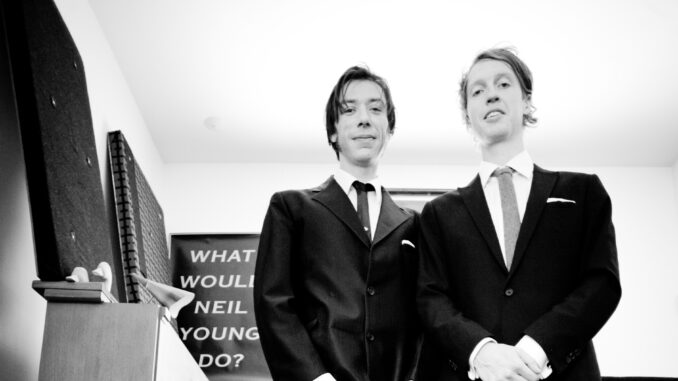
Canada has continued to punch above its weight musically since the days of Neil Young, Joni Mitchell, and the Canuck members of The Band first rose to international prominence in the ’60s, and The Sadies, with their blend of punk, americana, country, surf music, and garage rock, added to this tradition when they were formed by Dallas Good in 1994. The band, through Dallas and his brother Travis, had a link with the Canadian country and bluegrass family band, the Good Brothers, strengthening the links to Canadian musical heritage, and it was a terrible shock to his family, friends, fellow musicians and fans when he tragically died from natural causes in 2022 during coronary treatment. Musically, the tragedy occurred just after The Sadies had recorded what is widely recognised as their best album, Colder Streams, with the help of fellow Canadian icon Richard Reed Parry of Arcade Fire. Richard had been quietly recording with Dallas Good when their schedules allowed since 2008, and by 2022 they had formed a deep musical bond and understanding. These recordings, which contain Dallas Good’s final recordings, were finally given a Record Store Day release in 2025 with Were ‘The Watchtowers’, and have now been given a full release by Yep Roc Records. Americana UK’s Martin Johnson caught up with Richard Reed Perry to discuss the background to the album and his friendship and relationship with Dallas Good. They were in immediate simpatico when they met at a festival in the Yukon in 2008. Richard also explains that they always intended to release the tracks they subsequently recorded as time allowed, something that was brought into even sharper focus following Dallas’s death. According to Richard, the album was 85% complete while Dallas was alive, and he finished it with the help of Dallas’s family, friends, and colleagues. It is clear that Richard and Dallas had a deep musical bond that went way beyond them both being icons of the Canadian music industry, and Richard has managed to create and bring to market a lasting testament to the magic of Dallas Good.
We’re here to talk about the full release of your duo album with Dallas Good: Were ‘The Watchtowers’. How long did you know Dallas?
I met him in 2008, I think. Yeah, we met in 2008 in Dawson City, in the Yukon, and we were both playing at a festival up there. In the style of Canadian folk festivals, they often schedule loads of performances between people who have never played together before, put them on a stage together, and call it a workshop stage. So we got thrown into one of those together, and we decided that we would play an Everly Brothers song, and there was some mutual common ground musically, but we didn’t really have time to rehearse it, so we just said, right, okay, I’ll sing the high part, you sing the low part. We’ll kind of treat it like a weird dub track, make a big cloud of echoes for a long time, and then eventually we’ll just start singing out of that and start playing. That was the plan, and we just flew by the seat of our pants, and for both of us, I think it just felt like a very monumental musical moment.
Without having played together before, we just immediately made something that felt, like, very sort of elevated music. I remember really clearly, being in the tent where we were playing at the festival, and, we were kind of standing there for a little while, making all this noise, and then the moment that we started singing there was an audible gasp, kind of intake of air in the whole room, because the song is All I Have To Do Is Dream by the Everly brothers. There was just a kind of gasp when everybody realised, whoa, okay, this is what’s happening here. They’re not just up there tripping out on echoes. Yeah, and we just both afterwards thought, oh, wow, we have to record that, and then we thought no, let’s just make some music that kind of feels like that, kind of two-part harmony, old style. So a few months later, after that festival, we got together; he came up to Montreal and brought a song with him, or, like, a kind of half-finished song, and we finished that song together. Then the next time we visited, I brought a song, and it just kind of rolled from there.
What in your view made him such a special musician?
Oh, lots of things. Those things are hard to quantify, but definitely a rare and wonderful musician with not just an appreciation of music of the past, but kind of an obsession, you know? He was really a collector and a completist of old rock and roll, old funk, old hardcore, old psychedelic music, and old country music. I mean, he loved kind of everything, also, but that was his field of focus, and yeah, I think he wasn’t afraid just to fully stay true to those influences. I think he really wore his influences on his sleeve very, very proudly, and that was kind of rare in this world of ours. Also, he just had an immaculate style; he played in this old style. He knew a vast arsenal of music, and was always totally unafraid of jumping in and playing different musical roles in different musical ensembles. If a song needed an organ player, well, he was gonna go ahead and figure out some good organ parts for that. And just kind of an amazing showman, really kind of old-style showman, obviously, in the cities, but then also he would go and be the bassist in the surf band. He just really went for what he loved musically. I mean, a beautiful player, you know, beautiful guitarist who could play in all sorts of styles.
You helped The Sadies record what many consider their best album, 2022’s Colder Streams. How easy was it to make that record?
 It was super easy, and I would agree that that’s the best Sadies’ album. That’s my favourite, for sure, even though I’m biased. They have such a natural musical chemistry, and it was mind-blowing, actually, watching them and hearing them do their thing, watching their thing take shape sort of one element at a time. They’d have a few tracks recorded, and I’d be thinking, oh, this sounds a little dodgy, I’m not sure if this is totally there yet, and Sean Dean, the bassist, would would lay his track down, and all of a sudden, the whole thing would start sounding like this 80s thing, or they’d do things like in a non-standard order, like they’d record the guitars first, and then add drums, and then add bass. I remember thinking that was so insane, and yet, that’s just somehow the way that they play together. Just time and chemistry; it would just come together in this way that sounded like the 80s, or nothing. Sometimes it wouldn’t do that for a while, and you’d think it’d just be kind of twiddling your thumbs, thinking, okay, I’m not totally sure about this, not totally sure about this. But it was amazing.
Such, such amazing musicians, all of them, and really open. I think they’ve done enough musically in their careers that they were super ready to take any kind of direction that I was going to throw at them, and also because Dallas and I had been working together in the way that we had, I think he was totally ready and willing to try anything, any kind of suggestion that I had, he was super down with. And Pietro, also, who engineered and mixed the record, the two of us had been working together forever, and he’d been working with Dallas and me on the solo stuff, so there was, like, a lot of trust already established from having worked in this other sphere together. The recordings that make up Were ‘The Watchtowers’, I mean, happened over time, quite a long time.
You obviously enjoyed working together. Was there always the intention to release the recordings?
 Yeah, for sure, but both of us were busy and had full-time gigs, and we just both travelled so much. We would just get together whenever we had time, and we usually only had 2 or 3 days at a time, at the most. Sometimes we’d only have a day, you know, sometimes I’d say, okay, I can get to Toronto and spend the night, spend the next day, and then I’ve got to go right back the next morning. So, we’d do that, but we’d just sit on the couch, and maybe that time we’d only write, work on lyrics. We weren’t showing up with finished songs most of the time. Occasionally, I would say there’s probably one or two songs on the record where the song was done before we played it for the other guys. Most of them, we would bring a sketch, or half a song, or a bit of a song, and just bang it out together, and those things take time, and we didn’t live in the same city.
So sometimes we’d get together for 2 days, and all we did was play a bit of music, and work on a song, play it a few times, and take a few steps forward, and then you leave it. We kept this book we had, and it was called The Purple Book. Well, it was a Purple Book that we kept all of our notes to self in, and all of our ideas, and we would trade that back and forth. Every time we had a visit, the other guy would get to have the book for the next period of time. We kind of just would chart our ideas; we could try this thing in this song, or maybe two drums, sort of like this old song, or whatever. Just keep notes, notes to self, things to try, things to do, and lyrics. We would just hang on to that book and passed it back and forth, and just moved at the pace we moved, but it was always working on a record, you know, that was always the idea. That’s what we were doing; we were making a record, and eventually we were gonna play the songs for people. We would have played some shows eventually, but sadly, that day never came.
No, very sadly. You’ve got a track on the album, ‘There’s Time’, that has a particular resonance, doesn’t it, with that sense of a longer time being available.
Oh, yeah, I can barely listen to it without weeping. I mean, that could be said for most of the record, but that song in particular, the tone of it is so innocent. It was written from a bit of a kid-in-high-school perspective, and it’s such a kind of light-hearted-feeling song. However, it ends with that refrain over and over again. There’s time, there’s time, there’s time, and it’s the way that Dallas is singing on it, combined with the lyric, it just destroys me listening to that song.
‘The Brightest Light’, I think, was the first song you wrote with Dallas. Wasn’t it?
Yeah.
At the time, did you know how successful the partnership was going to be over the years?
No, but I knew that we could both write songs, you know, and both could write good songs, and just that first performance, that Everly Brothers song, it really laid it down in terms of the vibe for both of us. I think we were both blown away by the chemistry right away. And that’s what you, you know, that’s what you wait for in music. Those are the threads that kind of pull you forward in music. You find something that works really well, or flows really easily, or gets you really excited, and you just follow that thread, and those things present themselves at different times during your life. Yeah, it immediately was that for both of us, I think, this partnership.
‘Alone Alone’ has a tremendous sense of an all-encompassing natural life force. What inspired that song?
That song was written from a kind of an animalistic perspective, like, boom. The perspective of everything in the world, having everything in nature having some sort of consciousness or awareness, or, you know, like, everything on this earth enjoying being alive. So it’s written from this kind of post-human perspective, but not in an apocalyptic kind of way, just in a way of life. Life enjoying being life; that’s not human life, and on this kind of very quiet earth, sort of after a great flood kind of thing, and maybe not even post-human; maybe it’s pre-human. It wasn’t supposed to be apocalyptic, except it is post-human, because it talks about, you know, vines, or wind blowing through empty houses, so you know that people have been there. Man, that’s all you knew, but yeah, it’s kind of just kind of a zen-influenced song of quietude and appreciation.
What would Dallas have thought of “Where ‘the Watchtowers'”, particularly as it includes his last recordings?
He’d love it. I mean, I finished it without him, obviously, but there are only a few new elements that weren’t there when he was alive. We’d gotten, I would say, 85% of what it is now; there were two songs that didn’t have lyrics, but they already had vocal melodies; we just hadn’t written words for them yet. So the songs already knew what they were, you know, what themselves were as songs in terms of music, the musical feeling of it, and then there was this strange opportunity or responsibility. From where I was sitting, they needed to be about Dallas, in a way, or about the record, the process, you know, about the reality of finishing the record, and so that’s kind of how I wrote them lyrically. Then there’s this other song that was previously an instrumental that Nico Case sings on, and I sent her the record because she was such a good friend, touring partner, and collaborator of Dallas’s, and she asked if she could write something for this? I said, of course, so that’s the other element that wasn’t there at all when Dallas was still alive and working on the record with me. Other than that, it was lots of smaller, smaller details, and more fine-tuning. Yeah, there’s really only 3 unfinished songs, with a capital U, and I got Travis, his brother, to come and sing with me on two of those two, and he got his parents to sing on one of them. I think all of it made absolute sense, and he’d be really happy with all of it.
The album closes on a poignant note with ‘Not In This World’ and the choir. How quickly did that idea come together?
Mmm, not that quickly. I had the idea, and I knew that’s what I wanted to do; that would be a really meaningful gesture, but it took a long time, because we had to build it into the timeline of releasing the album, or the build-up to releasing the album and announcing it. So, from having the idea to actual realisation, I don’t know, it was quite some time, to be fair. Before I did the public call-out for anyone and everyone who wanted to sing, I had chased all of his musical friends and family who wanted to or who might want to have their voice on there first, and made a couple of trips to record people, including his parents, and some old bandmates in Toronto. So, it kind of took its sweet time, like the rest of the album, I would say.
The album was originally released for Record Day. As an artist, how useful is Record Day as a marketing tool?
I think there are many perspectives one can take on it, but definitely, when you look at it from the perspective that we live in a musical landscape where it’s entirely possible that record stores could disappear. Of course, a record store is just a store, it’s a shop, but for any of us that are alive, until the most recent generation, but just before this very recent time period, the only way to get music, or to find music, and to discover music was people either handing things around, or going down to a record shop, especially the indie ones that would support music that doesn’t necessarily get supported elsewhere, or not get much support anywhere. That’s a really important thing, and even though it’s based, obviously, on a commercial exchange, it’s more than that. Also, music is more than that. It’s like, yeah, you have to pay people for their work, but I don’t feel like Record Store Day is intrinsically more related to Capitalism than to just pure art. Art for art’s sake, you know what I mean? People have to figure out how to make a living, and record stores make a living through the thing that they do, but it’s not about making a living, having a record store. If people just wanted to make a living, they would do something else, especially nowadays.
So, I think, yeah, because I kind of worried about that for a second, did it feel like it was crass to associate the record release with that kind of commercial commemorative day? Then I realised, no, this is great. Dallas spent an accountable percentage of his life in independent record shops looking for stuff; it’s much more meaningful than just the commercial aspect of it, and it’s about fostering community, it’s about fostering musical exploration, music fans recommending music to each other, having hubs for that kind of thing, and not just having everyone be lost in this godforsaken vastness of the internet. So it felt really good to tie it to Record Store Day and to have people support the release in this special way, because it’s an underground-level release. It’s not like it was gonna be a massive chart-topping thing.
What’s next for Richard Reed Parry?
In life?
Well, in your career, at least.
Many, many different things. I’m finishing a few different solo records at the same time that have been in development for a while. I’m just leaving San Francisco, where I was performing a commissioned composition. A book launch for an amazing architecture and design conglomerate, or I guess that’s the wrong word, but a firm, I guess, of these amazing, amazing people, and I composed some music for them for this book that they’ve made, a really beautiful book. I’m gonna start working on a new film, like, scoring a new film, in the fall. It kind of keeps rolling. Dollarcast is working together and writing right now, an instrumental band I’ve been in for many, many years now. Yeah, you know, lots of things, all at the same time.
I’m about done, Richard. Is there anything you wanted to talk about, get out there, that we never got around to?
Not that I can think of. Mind you, it’s hard to remember everything.
Any messages for UK and European fans?
Just pick up the record, and it’s a special little universe you’ll step into, I’d say. Though, it’s very sad, I mean, it’s a lovely record, and I think it’s done Dallas proud, hasn’t it?
It certainly has.
I would hope so; I would think so. Nice to talk to you. Thank you.
