
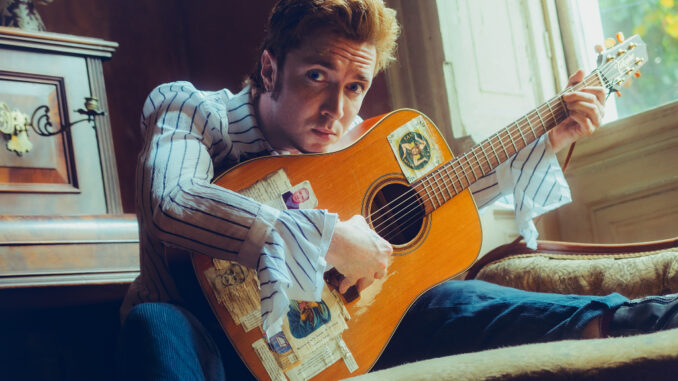
“Radiate a smile if we’re only here for a short while / no we don’t want to miss a day / cus there’s so much we must do,” sings David Keenan on Radiate a Smile, four songs into one of his latest collections, Modern Mythologies (Good Form Recordings, 2025). It’s the type of Keenan lyric that you jot down and then can’t remember an hour later why it first struck you. That’s not a knock against Keenan as a songwriter, but a testament to his refusal to traffic in easily digested morsels of wisdom or slogans intended for bumper stickers. Critics might advise you to “live with an album”; Keenan’s records ask you to get lost in thought while walking the city streets through them. Each song could just as easily be a wistful stroll, winding through dense sidewalks, the alleyways, shops and shadows from high-rise buildings obscuring where and how they might cross or connect at some point. On Modern Mythologies, those willing to wander alongside Keenan will find the artist as poignant and enigmatic as ever while considering a life with more creativity ahead of him than behind.
As Keenan pushes into his 30s, we recognise his familiar, resonant voice ruminating on how the ragged pieces of life might still fit together. It gets highly personal at times. It’s unnerving to listen to the reassuring strums of Romantic in Me become worrisome, with optimism turning to pessimism as a “childhood friend coming back from the dead to look you in the eye.” Keenan admits, “This is an anthology of songs and stories, a testament to all I’ve experienced, the good, the bad and the ugly channeled into something that breaks new ground.”
The mood turns beautifully melancholy on Poison Water, as Keenan seeks some common ground with his own upbringing in Dundalk, a town not far from the Northern Ireland border. “Big man going to tell you what comes next,” he sings in layered vocals, taking stock of his youth. It’s a tender moment over affirming repetitive beats when he concludes that, “Turn my feelings into poems / then I don’t feel so alone.”
A former street busker, Keenan spends time on the road to find answers, the routine of hauling from town to town not a burden but a revelation before each audience. Songwriting and performing as a vocation may not have saved his life, but “it gave me a life,” the nomadic lifestyle as both a birthplace and a source of constant renewal for him. Coming out of a period when the creative pull causes isolation or neglect of other crucial parts of life, Keenan actually squares the circles on Modern Mythologies and the nearly simultaneous release of Just for Today, an album of solo songs that he recorded with Megan Nic Ruairí in February of 2026 and released on Bandcamp in six hours. “This wasn’t an attempt to set a Guinness world record or anything. I just need to make music on my own terms for pure love and spontaneity.”
In the following interview, there’s not a question Keenan is unwilling to ask of himself or answer, nor a path he’s too paralysed to venture down, even if the promise of some tidy resolution seems bleak. For a man who once sang in Crude, “I stagnate then I’ll thrive / I drink coffee then write like a bastard / in search of courage / in search of meaning / in search of song,” it’s far less about what lies ahead. It’s more about stepping out with as David would say, Grá mór.
Americana UK: Hi, David. Nice to see you. After releasing two records in succession, are you working on something else or taking a break?
David Keenan: I’m on holidays in Spain. It’s the first holiday in a couple of years, so we were in Sevilla for a few days, and now we’re in Malaga for a few days before we go home.
AUK: What had you motivated to be extra creative?
DK: Well, I’ve always been that way. Maybe it’s becoming more resourceful, I think, and less conscious of any industry standard mode of releasing music. I think when I was younger and starting out, you believe that, and I was different before TikTok and such. So, I’ve been just releasing music I want to release under my own terms. And to be honest, I’m writing songs all the time, and I know it can be a lot for people trying to keep up, but at the same time, my goal is to get better as a songwriter. It’s like the draftsman or a painter who’s just sketching and painting, and you’re not waiting for a record label. That model is gone where you get an advance, and you have to wait for six months to build up an album.
AUK: Wasn’t Modern Mythologies on a label?
DK: It was, but there wasn’t really much label input. They just printed the vinyl, and that was it. I had to do everything else and picked all the singles.
AUK: It appears the dynamic with labels has changed. Many artists I’ve spoken with say their albums are basically on consignment and hopefully the label promotes them. Maybe they do, and maybe they don’t.
DK: Well, they didn’t promote the last one, and you’re signing away the rights to the songs, signing away royalties while they’re monetizing music videos. There are people waiting six, eight months to be paid for their work. It’s just frustrating. Look, I’ve been around the block in a sense over the last ten years, and I’ve had all sorts of label setups, and now I’m really free. For me, music is a calling. I’ll be doing it when I’m in my 80s, so I just want to get better. It was never going to be a flash in the pan. So, I’m just grateful the songs are coming all the time, and I feel like I’m discovering new things in the writing and in the playing.
AUK: You have a well-deserved reputation as a storyteller. Where did that knack come from or germinate?
DK: I think it was just a natural curiosity with stories and storytelling. Being Irish, you’re brought up essentially in the pub, listening to all these characters, some heavy people and some comic people and tragic people, and you’re absorbing it all as a kid. I was very into walking by the river as a kid, very solitary. I suppose that maybe developed the inner world, and then music was a way of expressing that. My grandfather was a great storyteller, so he would come alive telling a story. He would get bigger; his features would grow. I was fascinated. I’m just gripped by the whole process of it, and I was really looking for a way of telling my own story. I think it goes back to our ancestors sitting around a fire and being amplified by stories and symbolism and archetypes. It’s all connected. It’s ancient.
AUK: What struck me about Modern Mythologies is the songs are anecdotal. They still seem to be innately Irish but have more of a recognisable worldview than in some of your earlier work. Has that been an evolution for you as you’ve gone on? For example, Crude and some of the others seemed perhaps a little angrier or to have more of a bitterness.
DK: I think for Crude, I wanted to get a bit ugly with how the songs sounded. I wasn’t really conscious of it at the time, but I think probably on a certain level I was coming out of the music industry model and expectations and seeing the commercial side of what music really is. Because when you’re starting out, you think it’s all about the music and then you kind of forget that it’s a business and you become a bit cynical. So Crude was me becoming a bit cynical, but trying to use that in a creative way. Whereas for Modern Mythologies, I had a couple of years to develop it, and I think musically it’s more expansive because I’d done a lot of traveling and I was absorbing different types and styles of music. Also, it was more direct lyrically because I became more mature as a writer.
AUK: Your anecdotal songs are often metaphorical in a sense, which is really a definition for mythology, whether religious, political or moral. What are some of the modern myths that you would say these songs represent?
DK: I suppose trying to navigate a disconnected world, looking for connection or trying to find some clarity amongst the oversaturated, dystopian world we’re living in. Consciously or not, I was going back to the archetypal hero’s journey to try to get some sense of stability in my own head. But I think I was demystifying stuff as well on the album. It was actually coming at the tail end of addiction, a few years of battling with that. The songs are layered because you want to communicate with people. And I think maybe it’s an Irish thing, but you help the medicine go down with a bit of sugar, and that’s where the humor comes in or the anecdotes, as you say. I am just looking for a sense of empowerment in my own life with those songs, like the breadcrumbs out of the labyrinth, and the writing is my kind of breadcrumb trail to try and stay on the right side of sanity.
AUK: Is Fool’s Gold a backhanded dig at rock stardom?
DK: That’s probably me being a parody of myself at some point, but I do a version of that live and go off on a tangent where I’m telling a story of walking through your hometown. You haven’t been there in a while, and you’re feeling good about yourself, so you pull out a pair of sunglasses, and you’re walking down the street when a car pulls up beside you, and someone shouts out the window, “Hey, fucking Liam Gallagher, who do you think you are wearing those sunglasses?” Because that’s a real Irish thing, if you go back home and you’re walking around confidently wearing sunglasses.
You have this dialogue in your head that, oh, I can’t seem to be too big for my boots here. People will think I’m Bono or something. These things just come out of me. The fool’s gold is bought and sold until this truth becomes a song. When I wrote that, I probably was in the middle of something that I was trying to get out of. It’s only in hindsight when you look back, and you think songs can predict, for better or worse, where you’re headed. And yeah, the whole rockstar thing or it’s a bit Spinal Tap. You have to be able to take the piss out of yourself. I think I’m on the healthy side of that now, whereas before I would’ve been low self-esteem or just taking myself too seriously.
AUK: Backfields would be a return to the homelands, isn’t it?
DK: Yeah, getting the fingers in the earth like a kid out walking and remembering, re-reminding what’s the connection to it.
AUK: On your other recent release, Just for Today, the impression one gets is you are returning to your roots, where you came from and busking as well.
DK: Yeah, back to the roots of busking on the streets and observing people, seeing yourself in people and trying to project what somebody else is thinking.
AUK: In one song, there is a young person whose mother is an alcoholic and the father a workaholic. We all see things in our parents and think we’re going to do better, I suppose.
DK: I think so. That song is my attempt to be compassionate because I’m a workaholic and I’m an alcoholic as well. So, it’s not really about my parents. It’s about accepting we’re all really fucked up and trying our best. How could you not be living in the world today? Well, I’m a workaholic and a shopaholic, man, and I’m a fucking coffeeholic, whatever. Every cripple has its own way of walking.
I grew up reading Robert Tressell, who wrote a book called The Ragged Trousered Philanthropists. It was about workmen in the 1800s in England being treated like shit by their bosses. I think a lot of socialists were inspired by the book. And I read a lot of George Orwell. I didn’t read Hemingway; I read more of these socialist writers, trying to lean into the empathy and telling ordinary people’s stories. But I’m probably trying to propagate a bit of compassion for myself in the middle of it all.
AUK: In Is That You Under All That Noise, you begin with the individual in a halfway house, but there’s that line about you cried when Steven Hawking died. Were those tears of joy or sadness? Relief from earthly burdens or sorry a brilliant mind passed?
DK: This was from a conversation I had. Some songs are kind of mosaic songs. I don’t really know to suggest something, and they’re open to interpretation. I wrote it at the time Notre Dame in Paris was burning down.
AUK: You talked about dancing on the fire in the ashes, which is another sort of happy/sad juxtaposition.
DK: There’s a lot of that in there. I remember the ashes were still in the air because it was only a few days after it happened.

AUK: You said you don’t trust the words of ChatGPT. As far as music is concerned, is the use of AI a disturbing trend?
DK: I think it’s cheapening, just another cheap trick. In terms of personal taste, hearing corporate slop sound and music, it’s real lazy. It’s like getting slop put in front of you if you’re sitting in a coffee shop. There’s no care gone into it. Maybe it’s a novelty. Maybe you’ve gone there to get a bowl of slop, but there’s nothing in it for me really. Personally, I’m kind of aggrieved by people who call themselves artists or writers, and they’re just throwing things into AI. There’s no effort involved. It’s kind of puritanical, or I have a superiority complex around it. I wrote a poem recently about buying candles in the shop near where I live, and four or five songs that played while I was there were all AI songs. The staff confirmed that was true. Spotify has monopolized how people consume music, and now they’re getting away with not paying artists crumbs by producing these AI chatbot things. I just think it’s evil.
AUK: Do you approach songwriting as more of an autobiographer or a novelist?
DK: Not sure really. I enjoy writing all different types of songs and jumping into different headspaces and different skins and observing. I remember when I was a kid being in the back of the car and writing something gibberish. The sky is green, the grass is blue, and just being amazed that I was able to do that. And it’s still the same thing. I have a notebook everywhere I go. I have no college education, but I’ve been able to travel around the world because I write songs. It’s alchemy, and there’s magic involved in it really, and a lot of luck too, I suppose. I love observing and can’t really articulate myself as well as I can in a song.
AUK: You must have grown up during the “Troubles” in Ireland during the 1990s when the Good Friday Agreement was signed.
DK: I grew up in the Republic but only ten minutes from the border of Northern Ireland. The border comes up a lot in the songs; that’s not an accident. If we were going up the North of Ireland, we used to be stopped at checkpoints. El Paso is the nickname of my hometown. At any border, there’s smuggling going on, and there were all these characters and a lot of suspicion. There was a lot of say nothing. The secrecy was a vibe that you were definitely aware of.
AUK: Once, my girlfriend and I travelled to Ireland, and we wanted to go to Belfast. There were soldiers lining the roads on either side, which was very strange. I’d never seen anything like that. Then there were barriers called peace walls.
DK: That was the reality for people, that kind of sectarian violence. It really ran deep, and the wounds are still healing today. The peace walls, I suppose, were separating communities from the nationalists and the loyalist parts of West Belfast. In a way, they were divisive, but they kept people apart, and maybe that was a tangible divide. Whereas now there are still psychological scars, but I do think healing has happened in the last few years.
AUK: Is there a relation to this in your song Poison Water?
DK: It really touches on everything I said. Growing up, you see there was that dissident element around Dundalk. And when I was a teenager, I’d try to emulate these guys. Maybe they were selling drugs, or they were hard men. As a scared kid, you want to be tough. You want to mask the vulnerability or write it. Anyway, I got the number of this soothsayer or healer from my uncle. He did healings over the phone. I called him, and he said that if you drill down into the foundations of my house, there was a poison water stream running underneath the house that was causing all these problems. That was when I was about 21, but the poison water, that stayed with me.
AUK: You mention hardness and drugs in Cooper Vat. What does the title refer to?
DK: That’s a whiskey distillery. I was walking through Dublin, and there was the Jameson Whiskey factory. And I was just in the horrors of rattling. It’s not a judgment song or anything. I was literally standing there thinking it’s beautiful to look at this copper vat, but I wonder how many lives are destroyed by it. You know, come to Ireland and kiss the Blarney Stone and taste some Jameson. And that’s all lovely on one level, but on another level, how many families are absolutely destroyed by this tourist attraction? That’s the thing about songwriting; you get to look at things from a different angle.
AUK: How did it happen that you worked with three different producers on Modern Mythologies?
DK: I started the record in 2022 before I even did Crude. It was in Orphan Studios, and I was still with the Irish record label at the time, and that was going nowhere. We had a chat, and I said, “Okay, well this is a weird record I want to make.” It wasn’t called Modern Mythologies, but I had 50 Quid Man and Copper Vat, basically the A side of the album, and then I did Crude. I was just trying to save the money to put the album out myself, so I went to a different studio near my hometown maybe a year later with different musicians. It was just the realities of trying to put out a record, and then constantly new songs would be coming in like Fools’ Gold or Poison Water going, “Oh, we want to be on an album, put us on the album.” Then for a while during those couple of years, I wasn’t fit for human consumption, so I was trying to put myself back together. There was that to deal with as well. But we got there in the end, and it cleared space for me. And now I’m back in a position where I’m a free agent again, and I like being free to write whatever music I want to write and put it out in gigs and tour. I’m not trying to write a hit, so that’s very freeing.
AUK: The ironic thing about addiction is you can think your work is actually better when you’re under the influence of whatever your addiction is. I’m doing really good work, but I just have to drink or take these pills to do it.
DK: I can remember scribbling something in a pub in Dublin, and I lost it. So, I don’t know what it said, but I remember thinking at the time, this is fucking genius stuff. And it was just garbage, but I never wrote while under the influence. It was probably in the aftermath when I was in such pain that the writing kind of focused me. When I was out of it, I wasn’t able. You need stamina, and you just can’t focus if you’re itching. Thank God it’s not like that today. I feel like the taps are open and I don’t have this kind of inner saboteur that’s going to open a hand grenade on me anymore if I reach a certain place.
AUK: You often suggest creativity in your songs. What are you putting into life and what you will get from it?
DK: It’s really the primary purpose for me. I used to be really selfish about it and couldn’t maintain any real relationships and became very self-involved. Now there’s a lovely balance because I’ve had experiences with thinking that things would be different if I got to the top of the ladder, whatever the ladder was in my head. And it’s just a fallacy. I just want, as you said, to live well and serve whatever calling. My first gig was, and I’m going off on a tangent, but my first gig was my mother and father’s wedding. I was four. And I remember being terrified by the chain smoke in the room and old women laughing.
It’s grandiose to think that in that moment I decided, but when I started singing this old country song, that was kind of prophetic in a way. It was haven’t you heard “Daddy’s Gone Crazy?” Haven’t you heard “Mama is Gone“? I don’t know who wrote the song, but I remember those lyrics, and there’s never been anything else. And I trust that. I’m not saying that I’m righteous in any way, but there have been moments where you can sell your soul in a sense for a quicker way of getting whatever fucking place seems important. But it’s just a road less traveled than brick by brick. I’m confident in my ability as a songwriter and as a singer and player. There’s satisfaction and self-worth in that. I do feel like I’m getting better. and it’s a great place to be, especially when you might be able to relate when you feel like you’re running on 40, 50% for a few years and you’re not doing it or yourself justice.
AUK: Whether the lyrics to your songs are speaking of troubles, either personal or worldview, the songs now seem to have optimism in them despite perhaps a ragged start.
DK: I think the earlier songs, you’re younger and you’re more nihilistic. But I’m glad there might be a few humblings in life. I’ve had a few of them, and you see the wonder and generosity in people, and it’s affirming. That optimism is a survival tool for my head. And it’s not a kind of deluded optimism, but you have to fucking be optimistic to get out of bed in the morning, really. And to get up on a stage, you have to be open and hopeful. So yeah, I am optimistic.

