
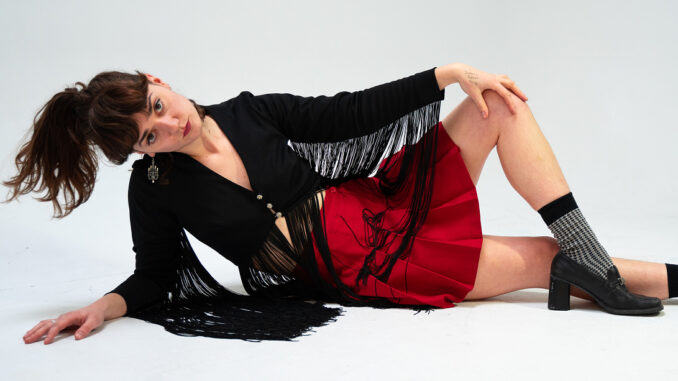
It’s always the ride and not necessarily the destination that makes a trip through a Nora Kelly Band album worthwhile. The songs can be zany, intriguing and melancholic all at once, cavorting to their own primal rhythms with a playful style that is utterly delightful. You feel as if you’ve been pleasurably stranded between Kelly’s two more or less incomparable strengths; one being the charm of a voice that tickles the temporal lobe with her affectations, and the other an undeniable way of putting forth her sprawling canvas of ideas.
As their bio reads, “Nora Kelly Band is a Montreal-based alt-country band that’s sure to steal your heart and your mule.” The band channels their rebellious spirit with So Wrong For So Long (Mint Records, 2026), their second full studio album that continues to push the boundaries of alternative country, following two previous self-released records: Perfect Pig (2022) and Rodeo Clown (2023).
The latter contains two of her best songs: Lay Down Girl, released as a single with lyrics that serve as advice to her former self, with a chorus that chants, “I’ve been a fool…. I’m going back to school / but this time my education’s gonna be ‘bout myself.” The title of the lead track, Mmm-Delicious, is that kind of phrase in a song that sticks with you like poutine. “You’re acting so suspicious / Trying to find out my motivations / I’ll just eat my pride / Mmm-delicious.”
In the new album, So Wrong for So Long, Kelly displays her theatrical flair on the cover with an enhanced image of herself as a fighter in the style of the old Popeye cartoons, complete with sailor hat but lacking a can of spinach. In The Fighter, she describes a time in her early years when she couldn’t cry: “You know wrong from right / That’s what keeps my baby up so late each night / Life ain’t kind to the ones who fight / But I ain’t kind to those who just stand by.”
You might compare her to other edgy Canadian songwriters like Neko Case and Carolyn Mark, though she is a true original. As Oscar Wilde once said: “Be yourself, everybody else is already taken.” Kelly uses role-playing and vivid character work to confront traditional masculine archetypes in country music by challenging expectations of what a protagonist can and should be. She is a fascinating musician. Her songs remind us time and again that the scope of a woman is the size of her fight, and with that she firmly asserts a woman’s place in the outlaw tradition of country music.
Americana UK: Given your campy theatrics on the album covers- rodeo clown, prizefighter- I was curious what you would look like for this Zoom call.
Nora Kelly: That’s so true. Here I am. No, it’s all kind of like a quasi-drag persona.
AUK: I read your mission statement. “Montreal-based alt-country band. Ensure to steal your heart and your mule.” I used to live there. What part of the city are you in?
NK: I used to live in the Mile End, which is a bit more artsy-fartsy, and then I moved here. The neighborhoods are very small in Montreal, but I would say this is more like the Plateau-Mont-Royal. But this little section people call Little France because all of these people from France have moved to this particular neighborhood. That’s kind of funny because the Quebecois, as much as you’d think the Quebecois would like people from France, they really don’t.
AUK: The French tend to look down on the way the Quebecois people speak. Snobby.
NK: Yeah, exactly. I’ve met a few good people from France, but for the most part, I’m not massively into their vibe.
AUK: The song Port City; is that about your old hometown? Sounds like it’s not the kind of place for growing old.
NK: Yeah, that’s Vancouver. I think that’s the general consensus among young people, unless you’re in a tech startup or something, that it’s completely unaffordable, but it’s kind of a personification of it as well. It’s definitely the most out-and-out sad song on the album. At that time, I was feeling like relationships weren’t really working for me, but definitely there’s the parallel of it’s wonderful that my parents still live in Vancouver and I love being there.
AUK: What prompted you to move to the East?
NK: I got into university here, but also, I was already playing in a punk band in high school and knew I really wanted to keep playing music. I’d never been to Montreal before, but I just heard that it was kind of the Mecca if you want to be in a band. So, at 18, I thought, let’s just go under the premise of school, and if it works out, I’ll stay. And if it doesn’t work out, I can always just go back to BC. But it worked out.
AUK: What percentage of your songs roughly are about you or people you know? Or are you the novelist type with your music?
NK: With this new album, I did try to explore more. Perfect Pig and Rodeo Clown are really self-explorations, kind of my realization that I have a lot of people-pleasing tendencies, and I haven’t figured out healthy boundaries. I was working through that and then trying to take the lessons that I learned and put them into songs. But when it was time to start writing for this album, at the beginning I was a bit amused because I realized you can only have so many problems in life that you can write about. If you’re a healthy person, you’re trying to work on those problems and get better. So I was like, wow, I’m actually doing pretty good these days. For some reason, that’s my process: personal lessons and then trying to take what I’ve learned and what I was struggling against and putting it into a song.
But with So Wrong for So Long, I realized, well, it doesn’t always have to be about me. It can be about things that I notice that my friends are going through, or that I’m relating to in another person. That’s similar to what I would imagine a novelist or a fiction writer does. But you realize by the end of writing the song that you’re in it, that it is still kind of about you even if I attempted to write about someone else.
AUK: You have a strong sense of detail in your songs. Is Salt Mine about having a day job?
NK: Well, I still have a day job. I’m not making a living off music, but the last kind of gruelling day job was waitressing and bartending. It definitely wasn’t working in a salt mine. Never done that before. But for Salt Mine, first of all, I was on a Wikipedia deep dive about mines in general because they’re really beautiful. There’s a lot of really beautiful photos on Google of salt mines. And then I realized that the largest salt mine in the world is in Ontario, which is kind of cool. I’ll live with less financial security in order to not really have a strict nine-to-five, but everybody has a few people in their life – I won’t say specifically who – that really don’t enjoy their work and clearly want to leave, but they just can’t for some reason. You can even see it eroding relationships that they care about in their life. So, it was a reflection on that. This person still has the job, and the job doesn’t love them, but they’ve lost the person that they had them. It’s kind of a struggle to explain.
AUK: In a sense, you’re a fighter for music as well as other parts of life rather than compromising. On the cover of the album, it sure looks like you ate your spinach.
NK: Totally. The whole album is about a reckoning with this idea that we’ve all been fed a line of what strength is, which is kind of the Popeye, but the stoic, stable person. I think the miner is the most extreme version of that, somebody who just keeps their head down and works while keeping all of their difficulties to themselves. That’s the version of strength that I grew up with and that I embodied when I was younger. And especially in the song, The Fighter, I try to use that as the thesis to explain that in this chapter of my life I’ve realized that being open with your emotions, being able to hold space and be very outward with your love is strength. Those people are often the true pillars of the community that can actually hold more weight than the kind of stoic loner.
AUK: Your song The Imposter Syndrome deals with the other side of that: people trying to project that they are different from what they are, being a different version of themselves. Sometimes you have your parents, your friends or partners saying, “Well, you’re killing it.” And are you really killing it? Do you tell yourself that you are?
NK: We just got off of this tour a few days ago, and it was really awesome. It sounds funny, but it was really cool because it was a mixture of really well-attended shows and a few just horribly attended shows. But I got to try out things in those shows as a performer. On every stop, I would ask people, and I have been doing this since we added Imposter Syndrome to the live set, how many people in the audience feel the imposter syndrome? And it’s always like 75% of the audience puts up their hand. It has made me recognize that we’re all going around not feeling like we’re doing things right or that we’re the best person for the job.
AUK: Has the band been together long? Your drummer, Ethan Soil, produced the first two records.
NK: We kind of did together. He was my roommate for the last seven years, and we were also in the previous band together, DISHPIT. We did a lot of the little extra recordings, the add-ons and stuff in his bedroom in our apartment.
AUK: I saw a funny clip on Facebook with Ethan and the others in the band doing what I assume was a mock intervention of you.
NK: So, I could speak on that. That was an interesting chapter to the rollout. Like I said, there’s not much money in this band really. It is a labor of love, and I’m definitely the one that has to do the most of the labor. When it’s the album rollout year, there’s a lot of emailing, and it’s not super fun. One thing I’ve always loved to do since I was a kid is making silly videos with my little brother. So, I have this super close friend named Andrew who’s a total goofball. I was like, what if instead of a music video for one of the songs, we just use that budget to make a little mini TV show thing called “The Imposters,” where I am basically an exaggerated, very materialistic, vain version of myself who just wants to become famous?
And then I estrange my band. So that last episode is where they have an intervention with me, and they’re like, “Nora, you’re being really weird.” Basically, I come around, but Andrew, the goofy friend who helped me to make it, played this evil producer character who was manipulating me behind the scenes. It didn’t promote the song, though, but it was really fun.
AUK: With this new record, you are on a label, Mint Records.
NK: The two previous records were self-funded and pretty low-budget. We applied for this big grant in Quebec, and we got it, which was amazing. For the first time, I was able to actually dream big and met with a few different producers in Montreal. But when I met Marcus Paquin, we just immediately got along. He’s really fun, and I love the records that he’s done as well. It was my first time working with a producer and was so cool. I’ve never had somebody give their opinion really on arrangements or maybe change the melody. And that was really awesome. It was the first record where I was like, “This sounds exactly like I wanted it to sound.”
AUK: That’s good because sometimes it’s tough to give up control, even partially, when you’ve been doing it yourself so long.
NK: It’s true, but I’m pretty good with collaboration. Every song on the album, I’m writing the lyrics, the vocal melody and the general chords, but I bring it to the band, and it’s relatively democratic. I want everyone in the band to give me their suggestions and help me arrange it. They’re all next-level talented. Every member of the band is in a bunch of other bands and a serious working musician. I think that process made it pretty easy for a producer to come in and give me advice. He’s not a stickler and was fine if I made a suggestion.
AUK: As in the title of one song, what is your Trial by Fire?
NK: I have this fake thing I say to the press, but it’s really about a specific person that I would rather not mention.
AUK: No worries. Thinking of another song, Irish Goodbye, do you think sometimes people invest too much in a lover or partner or friends in terms of grieving when they’re gone? Is your life worth living without that person? I am thinking of a TV series called The Madison. The wife’s husband dies in a plane crash, and she and her adult children struggle to find meaning in how to go on.
NK: I think it is exactly that. The kind of grief, especially in a relationship where there feels like a lack of closure. It is the moment where you are starting to maybe come out of it and realize that there’s more there than just missing the person, that there’s something that feels broken about you, that you’re worried you’re never going to get back to your normal self before the relationship, if that makes sense.
AUK: An Irish goodbye is leaving a gathering without saying goodbye. Is there a particular Canadian goodbye?
NK: It’s the opposite. You go around to every person at the party and say goodbye. Do you have an Italian goodbye?
AUK: For sure. We shoot someone. There are a couple songs – one is The Fighter – where you mention six years. Is there a significance?
NK: Well, it’s interesting. I didn’t even put that together, but there was a period in my life from 17 to six years later when I just didn’t cry. I could speculate a hundred different ways about why that is, but I do definitely think that those specific six years were, you’re late teens, early 20s, and you’re just figuring out how to be an adult. They were the years where I kept a lot of secrets and didn’t want to burden anyone with my problems. And at the same time, I was having the darkest thoughts and just not in a good place. And interestingly, at the time, that was so difficult because I wasn’t crying. And then the other time is the previous six years from now where I started taking an SSRI medication for anxiety. That song, Scapegoat, is about honestly entering into true adulthood where you’re realizing how things might’ve been difficult in the past. There might be some things that I was upset about, but at this point it’s not serving anything to see myself as a victim, as well as see people or certain traumas as these scapegoats. I’ve grown a lot, and everyone in my life was trying their best, but things happen.
AUK: The Murder of Mr Lucky is quite unsettling. Have you ever had a bad experience with dating apps?
NK: Yeah, I have, but no one died. So, my mother is a great singer. She never wrote songs or anything, but she loves to sing. It’s kind of a tradition that whenever I go home, I rent a guitar from Long and McQuaid, and we sing covers. But one year I came home and was like, “I really want to write a murder ballad. Maybe you can help me. “We watched this movie Arsenic and Old Lace. Have you ever seen that movie?
AUK: Saw it a couple times. Cary Grant is in it.
NK: So we watched that great movie. And then we just kind of cooked the song up. There’s a lot of great murder ballads, but most of them are a true crime retelling of a man killing a woman. We wanted to spin it and have a femme fatale situation, and then I thought it would be fun to modernize it and bring in the dating apps. It was kind of a writing experiment. I honestly didn’t expect it to be on the album when we were writing it. It was just a fun mother-daughter activity. She’s 95% Irish, so very dark sense of humor. I brought it back and showed the band, and they just really loved it.
AUK: For Don’t Lay Your Cards Out, as a musician, you do sort of put yourself out there, in a sense exposing yourself, not literally, of course. How do you feel about that?
NK: It is definitely a consultation to myself, but I think that it’s an interesting song because I am very speak-before-thinking, open-book person these days. And I would say that I’m always laying my cards out. In general, I think it’s a good thing to do; communicating through things is pretty healthy. But I also believe that it’s never a hundred per cent in life and that because I am that way, I’ve had a lot of experiences where maybe I’m sharing too much of myself around people who don’t really want the best for me, who might not really like me. Sometimes that can get me into trouble. Hopefully, if somebody really listens to the music, they can understand that my general mindset and motivation is to be open and warm and kind of community-building. Don’t Lay Your Cards Out is in there to remind myself and maybe other people who are similar to me that it’s good to be that way, but you also don’t have to always be an open book. You don’t always have to give people all of yourself, and that it’s kind of a privilege to people who deserve it.
AUK: What’s one thing that you couldn’t do without during the day outside of music?
NK: My day job is an illustrator. I don’t know if people know that. I feel like I couldn’t do without spending a good portion of the day alone, and I really like visual arts for that. I have a duality to my personality where I am quite extroverted, but only for so long, sort of an extroverted introvert. Visual art is what refuels me and gives me this really fun activity that keeps me offscreen and creative during the day. And then music is my social life – band practice or going to other friends’ shows. Obviously, Montreal has an amazing music scene, so there is a lot to go out and see.
AUK: What’s something that most people don’t know about you?
NK: I’m trying to think of a fun fact. Oh, the other thing is I have an axolotl, which is like a little newt. Do you want to see it?
AUK: Absolutely.
NK: Here she is, my little Mexican newt. Thanks, lady. Oh, I also have a random fun fact you can tell people. I have a taxidermy collection. I’ll show it to you. I have this Canadian lynx and this little quail. I’ve also got this caiman head, a baby duck and a piranha. My five-year plan is to get a nice basement where I can do taxidermy.
AUK: The last person I saw doing taxidermy was Norman Bates in Psycho. There’s no connection, right?
NK: Great movie. That inspired me as a child. Just kidding.
AUK: Last one, Hymn for Agnostics off Perfect Pig. That sticks with you, so tell us a little about that one.
NK: My parents grew up very religious. They raised me, I guess, as an atheist, but they always wanted me to have access to religion. Even though they’re from a Christian background, they put me in the Jewish community center growing up. I always felt like they never taught me to pray, but when I was a little kid, I would pray every night, and it would keep me up way into the night. My dad would have to come in at one in the morning and say, “Nora, go to sleep.” And I’d be like, “I’m praying. Wait, just one second. I haven’t done grandma and grandpa yet.” And I would go through every single person in our family. But I think that I do really resonate with the idea of agnostic in general because, to me, there are a lot of mysterious things that have happened to me and I can’t really put my finger on them, but they make life worthwhile. They enrich the experience so much. And it’s not easy for me to see a religion and think that it speaks to me, and that’s what I believe wholeheartedly. But I definitely do believe that there is something going on that is really unexplainable. I tried to write a song for people that are in that same situation and that people could relate to if they also have a kind of spirituality, but not really a place to put it.
AUK: So, for people that may wonder if, after death, you either go into the ground or a crematory and that’s the end of it, but they are not really sure, or they hope that’s wrong.
NK: There are just too many mysterious things. I’ve had multiple ghost experiences, for example. I’ve seen UFOs once, too, and it’s always with a friend. It’s never alone. That really makes it hard to be like, “Oh, it’s just a weird thing, but I probably was just tired or something.” No, there’s always a person to corroborate it. There’s been a lot of interesting phenomena. And to me, all of that doesn’t add up to we’re just material sacks of meat that just keel over one day, and that’s it. There’s definitely something going on that I don’t think that we can fully grasp. I feel like my generation probably has the least amount of religion, especially in North America, to lean on. We are in a troubling time, but having a religious framework does give you a certain peace of mind about death. There is a lot to wonder about if people are curious enough and willing to look into it and hold a little space for the weird.

Great interview of a great girl who shares her thoughts so authentically.
Love her music!!!