
Impressive collection of character-driven songwriting and classic country sounds.
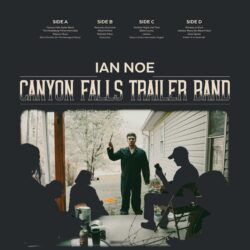 Kentuckian Ian Noe presents a diverse selection of sixteen original songs on his excellent new album, Canyon Falls Trailer Band. It’s Noe’s third release and the second produced by longtime collaborator Andrija Tokić, who captures a warm, intimate sound that perfectly showcases Noe’s wonderfully precise storytelling and down-to-earth delivery. It’s meant to play as a concept album, where the title refers to the name of a fictional band and the music is meant to mirror their legendary industry showcase performance.
While a concept album in theory, it’s not necessarily in terms of content, although there is a common thread running through many of them. The songs feature a rotating cast of characters who appear to weave in and out of the narratives. The title track opens the record and acts as a fitting introduction as it details the formation of the band and, by extension, the genesis of the concept, and it’s where some of the characters make their first appearance. It’s a lofty concept, and it would all be for naught if the songs and playing didn’t stand up, and they certainly do. Far from formulaic, Noe’s detailed songwriting is wonderful to behold. It’s hard not to be enchanted with the lyrical specifics of his songs that frequently depict a less-than-glamorous take on small-town living and some of the sad and beautiful people who inhabit it.
The music sticks predominantly to a classic country sound that makes wonderful use of fiddle and pedal steel, capturing a dynamic sound that never overshadows Noe’s timeless tales of honky-tonks, trailer parks, and ‘hillbilly hideouts’. The pacing also helps keep things interesting by allowing Noe to shift from traditional country to folk and back with ease, never sacrificing the cohesiveness of the songs.
Canyon Falls Trailer Band, a breezy, fiddle-led romp, sets the tone with its upbeat sound that belies some of the darker moments that come later. It’s a perfect setup that is followed by the likeable, midtempo The Heidelberg Fisherman’s Ball. The track is an absolute delight, with its snappy, sing-along chorus where a soaring fiddle dances with some jaunty piano and steel guitar that highlight the band’s talent for filling out the sound in the best possible way.
If the first two tracks provide the bait, the third track sets the hook. Beginning with the ominous refrain “There’s too many ghosts on this farm”, Tobacco Moon is a slow-burning ballad where Noe’s remarkable voice oozes with emotion, perfectly capturing the melancholic, brooding tone of the song. Some plaintive pedal steel and French horn contribute to the mysterious feel of the song that ends with the foreboding lines, “I feel a storm coming soon / A trail of blood in the clay / Like a shadow in /The Tobacco Moon”. Elsewhere, the songs take on a more traditional country feel, such as on the weepy ballad, She’s Familiar (In the Strangest Ways), featuring some gentle harmonica touches from legendary multi-instrumentalist Charlie McCoy, the steady, two stepping rhythm of Another Night Like That, and the thumping country beat of Kentucky Hurricane. The delicate acoustic ballad What I’d Give features some sublime pedal steel that emphasises the country feel of the song, while Noe’s genuine delivery provides just the right amount of pathos. The stirring Antarctica arrives at the midway point of the album and is absolutely stunning in its starkness. A stately-sounding piano leads the haunting melody, with the lyrics showing off the best part of Noe’s songwriting mastery.
Bible Country is another bewitching ballad that uncoils with spooky precision and lyrics brimming with wistful imagery: “All day long in Bible Country / You used to hide in Henry’s loft / Looking down into the valley / Wondering when they’d run you off”. It’s Americana with an edge, moody and dark on the surface, but poignant and heartfelt below, made even more so by some lingering pedal steel.
Noe’s folkier side emerges on the sparse Jukebox Blues (For Blaze Foley) that underscores the power of the words being sung. Indeed, this quietly folkish track stands out as one of the album’s most satisfying moments, both in its subject matter and its presentation. It’s a touching piece that embodies the enduring spirit of Texas troubadours like Foley, and as such, makes for a fitting tribute.
Undeniably country in its presentation, the songs stretch well beyond the realm of modern country and place him a notch or two above many of his more feted contemporaries. After three albums, it’s fair to say that Noe has earned his rightful place as an Americana songwriter of distinction. On behalf of Noe and the band, it certainly appears that they passed the audition.

