
A confident debut that shows the Nashville-based singer-songwriter has a vigour that sets her apart from the crowd.
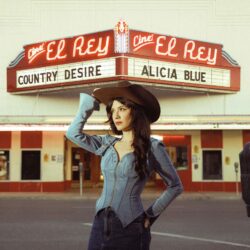 For singer-songwriter Alicia Blue, Waylon Jennings isn’t so much an influence as someone she calls “a creative angel summoning her from another realm”, so to have his son, Shooter Jennings, describe her as “As rare as they come” must feel like quite the accolade. Perhaps even more special is the fact that upon hearing the demos of the songs for her debut album Country Desire, he jumped at the chance to work as her producer, not even the fact that she had no label or budget to back her up dampening his enthusiasm: “I’m not worried about that,” Jennings said, brushing it aside like a minor inconvenience. “You’re going to have a big career.”
The steady build of Run Me Ragged opens the album, and Blue’s tone is sharp, but the edges get softened by her classic country, Dolly Parton-esque twang as she longs for someone even if her friends advise her against them: “Run me ragged tonight / Hope neither one of us gets hurt / We’re burning hot, so bright / I’ll clean the ash I swear I don’t mind.” Backwards Again, with a great banjo breakdown from Rich Brotherton, finds her marching “to the beat of [her] own crazy drum” and singing a “different kinda tune” on a song that straddles the line between americana and bluegrass.
“Kentucky cowboy got his eyes on me / What do you see?” Blue questions on the melodic Kentucky Cowboy, a song born out of her real experience of meeting a genuine cowboy, someone who “breaks wild horses / Down the state line / Off Kentucky and Northern Tennessee”, and would leave her with a number of what ifs, and on Ride, she similarly finds herself yearning for a “motorbike poet” who’s “complicated in the right way”. The lilting warble in Blue’s voice lends itself perfectly to the haunted quality of a song like Hungry Ghost, where she prophetically warns against trying to give yourself to someone who will never get what they want, while on Rose of Tennessee she delivers the heartbreak in the first person accompanied by some lively fiddle playing from Aubrey Richmond.
Clean is bluntly honest on the realities of the modern music business, but Blue remains defiant and determined to forge her own path and come out with her dignity in tact; “If it’s the very last thing / I’m gonna make it out of here clean”, as I Know What Doesn’t Fade also takes aim at the manufactured nature of music and art in the 21st century; “Made by a machine and they’re makin’ em cheap / And everybody’s wondering why the music is free”. Draggin’ A Broken Heart takes a look at the lives of various small-town characters who forge forward despite their own personal tragedies, just as on Waitress Blues our narrator has dreams of being a successful musician and throwing away their apron.
Country Desire is a sprightly and enjoyable debut that explores a tapestry of experiences and feelings, but thankfully, that’s not where the story ends. Blue has something of a prolific nature, so much so that during her sessions with Jennings, they conceived another two albums to form a trilogy, and those next two are already written. Jennings has said Blue has a voice that “comes along once in a generation”, and while her debut LP certainly shows her to have something very special, it remains to be seen from the follow-up releases if that statement can be taken as gospel.


