
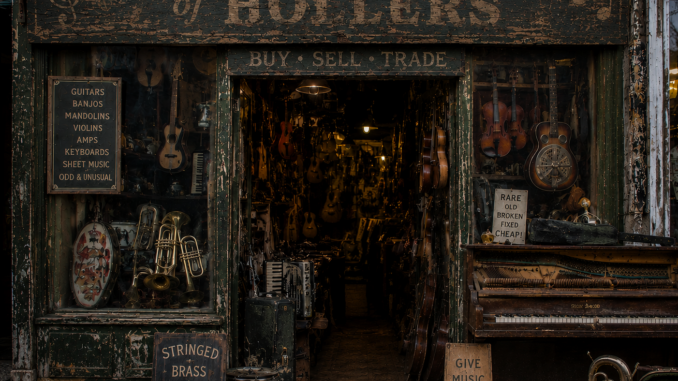
The next Americana Story comes from one of our own. Rick Bayles escaped the UK to live in the Dordogne region of France, and from there he reports back through his monthly Vox Continental column, sharing americana goings on in mainland Europe. In creating the cover image, he also shared with us that ChatGPT is known as ‘Cat, I have farted’ in France.
The Little Shop Of Hollers
by Rick Bayles
It all started with Kurt Stormsinger feeling a little perplexed. Kurt never felt perplexed. John Barrowclough, or ‘Johnny’, as his Mum still called him, had often been more than a bit discombobulated, but since his transformation into the metal guitar god that was Kurt, he always radiated confidence and clarity of purpose. So, feeling perplexed was, well, perplexing, to say the least. And the cause of this strange uncertainty? Kurt had bought an acoustic guitar!
Kurt had never previously owned an acoustic guitar. In fact, Kurt had never previously touched an acoustic guitar. John had messed around a bit on his uncle’s old Harmony Sovereign, discovering the only ‘shredding’ he was able to achieve was the skin on the tips of his fingers. As soon as he could, he’d talked his parents into buying him a cheap Ibanez electric and loaded it with the lightest strings he could find. That’s when he started building a reputation as one of the finest metal gunslingers around. His fingers went up and down that fretboard like a man possessed, and in next to no time he was scooped up by that behemoth of the heavy rock scene, The Apocalypse Vow. The rest, as they say, was history, with The Vow, as they were known to their fans (and there were plenty of them), now the biggest bill-topping stadium metal band ever. Life was good!
So why had he bought this guitar? That was what was perplexing him. He certainly hadn’t planned to do so. He’d been spending a rare day off strolling around The Lanes in Brighton. He found that, with all his piercings removed, his hair pushed up under a beanie hat, and wearing a shapeless old tracksuit, few people recognised him, and he could wander around the shops at his leisure. He’d picked up some nice vintage vinyl, including a near mint, original pressing of Deep Purple’s Book of Taliesyn, on the Harvest label, which he was particularly pleased with, and a couple of small pieces of Navajo jewellery, with their trademark combination of silver and turquoise, which should please the missus, when he spotted a strange little shop, almost hidden in the shadows, with the intriguing name of ‘The Little Shop of Hollers’. He’d wandered inside and, before he knew it, he was being drawn, like a moth to a flame, to a battered old acoustic guitar, nestling in the murk at the back of the shop. “It’s an old Guild F50″, said an American-sounding voice behind him, “probably their most popular jumbo model, over the years. They don’t have the collectors’ appeal of a Martin or Gibson, so the price is reasonable for a 30-year-old guitar. I’ve had it a while, so I could do you a good deal on it”.
Kurt turned round to see a wizened old guy who looked a bit like an old hippy (and judging by the smell in the shop, he still liked his ‘wacky backy’!), with a wry smile and a bit of a twinkle in startlingly blue eyes. “Folks call me Red”, the old guy said, sticking out his right hand, while sweeping his baseball cap off his head with his left, revealing a full head of greying red hair, long and tied back in a neat plait. The next hour passed in a bit of a haze (probably something to do with that lingering shop ‘smell’) and, before he knew much about it, Kurt was back in The Lanes, but was now carrying a battered old guitar case, containing his latest acquisition.
He got the guitar back home to his country pile, in the wilds of East Sussex. Say what you like about being a metal guitar guru, but the pay could be pretty good, if you were prepared to play the game. He took the guitar into the studio and put it on a stand to take a good look at it. It seemed to glow, even in the muted studio light. Kurt made a mental note to himself; maybe it was time to freshen up the studio a bit and do away with the black walls. He’d get a professional in and have the place repainted. Maybe a fresh, lemon colour… Even his wife, who usually met his guitar purchases with an exaggerated groan and cries of “not another ‘battle-axe’!” seemed to appreciate his new buy, “Wow babe”, she gasped, “that’s a beautiful looking instrument! Maybe you’re finally developing some taste where guitars are concerned!” Truth be told, she loved the lifestyle his work brought them, but she’d never been much of a fan of the music.
Over the weeks that followed, Kurt found himself spending more and more time with his Guild guitar. As soon as rehearsals were finished, he’d ditch his Les Paul or Flying V and head back to his flat top, working on new picking styles and techniques that had nothing to do with playing scales at high speed. After a while, he started writing some snippets of songs using his acoustic and, without really knowing he was working on something specific, he suddenly found himself with a new song, and one that he really liked. Unlike his previous output, this song made no reference to Satan or a Pale Rider, though it did mention horses. Kurt appeared to have written a country song! He kept this anomaly to himself at this point. He didn’t feel the rest of the band were ready for his ‘new direction’.
The months had passed, and he found himself back in The Lanes, on another one of those lazy summer days that come around all too rarely. He decided to go looking for that battered old junk shop. It took him a while to find it again (he could swear it had, somehow, moved since his last visit) but, eventually, there it was. Resplendent in the window was the finest electric guitar Kurt had ever seen. It seemed almost golden in the sunlight but was a subtle butterscotch colour that seemed warm and inviting. Propped against the guitar was a sign that said “It was born at the junction of form and function. It’s the hammer of the Honky Tonk Gods.” Kurt was inside the shop in a flash, and there was Red, hand outstretched to greet him. “You like that Telecaster, huh?” he said, with a sly smile. “What did you think of my sign? Not my words, sad to say; they were written by the great Bill Kirchen, as fine a Telecaster player as you could hope to find. I think he nailed the description. What do ya say?!”. Kurt spent the rest of the afternoon noodling around on that Telecaster, and there was no question but that it was going home with him. He’d never had any interest in guitars with single-coil pickups before. He couldn’t get over the range of sounds he could get out of this simple, slab-body, with just two single-coil pickups and only three selector options. It was like discovering guitar all over again. Red cut him another good deal and even agreed to take his old Gibson Flying V in part exchange (“You can always palm those flash instruments off on some wannabe gunslinger”, he’d drawled, knowingly).
Myra, Kurt’s wife, again expressed approval when he brought the new guitar home. “That’s beautiful babe. It’s going to look so good sat next to that Guild of yours”. Kurt got right down to practising with the Tele and, in next to no time, he was chicken pickin’ with the best of them. He had a new enthusiasm for music and was turning out new songs at a prodigious rate. Unfortunately, as predicted, his bandmates didn’t share his enthusiasm. “What the fuck, man?!” and “What’s this hillbilly crap?!” were among the most frequent, and most repeatable, comments made. And it wasn’t just his bandmates that were the problem; the management company also weren’t impressed with his newfound enthusiasm for a different genre of music. “The problem is, Kurt, metal fans don’t want their guitar heroes messing about with hillbilly music. They want to hear you playing faster, louder. More rock, less roll. Stick with the programme, and we can get another couple of albums out over the next 5 years or so, with a couple of worldwide tours, and we’ll all be able to retire and never have to deal with this shit again. I tell you what; I’ll give the record company a call. We’ll tell them you’re having a Steve Tyler moment and want to acknowledge your commitment to the roots of your music; you want to make an americana album. They’re bound to go for it. It makes them look progressive and responsive to their artist’s creative needs. We’ll get some Nashville session players in and set you up with a celeb producer; who do you fancy working with? T Bone Burnett? Daniel Lanois? It’ll need to be someone of that calibre to put you up there with Plant and U2. Yeah, this could work out well! Leave it with me, man. We’ll really make something out of this.” The trouble was, Kurt didn’t want to make an ‘americana’ album with a celebrity producer, and he certainly didn’t want a bunch of Nashville session players all over it, good as they might be. He knew what he needed to do; he needed to sit down and talk this through with Myra; she could always help him see the light.
“Do you know how long it is since we sat down and talked like this? We used to talk all the time about your music, my painting, about how we were going to do things differently, make a difference. It’s great to get back to that, but what do you want to do? Do you want to quit this band, start another band, do something completely different?” The fact was, Kurt didn’t really know what he wanted to do, but it was just possible that John did. “I think I want to explore the new, acoustic music I’ve been listening to and write more in that style. But I’m scared of what the change will mean for us. I don’t know if I can be a success in a different style of music. I’ve always been a rocker, I don’t know anything else!” Myra nodded slowly and thought for a few minutes. “You should do what you want to do. We’ll be OK, regardless. We always have been, and that’s less likely to change than if you carried on doing something you were less and less interested in. My canvases are selling quite well at the moment, and the corporate art market seems to like my work, so we’ve got money coming in from that. You’ve done the heavy lifting over the last few years, so perhaps it’s time to let me contribute a bit more. If the worst comes to the worst, we can always sell this place and downsize a bit, or move somewhere where our money will go a bit further. I wouldn’t mind a change of scenery. For what it’s worth, I like your new music, and it doesn’t give me headaches like some of the old stuff. And let’s face it, a wife with fewer headaches has to have advantages!” and she gave him one of her secret smiles that always made his heart skip a beat. “This all started with that guitar purchase in Brighton. Why don’t you go and see that guy Red again and talk to him, he seems to know about these things”. There you had it. Just like always, she knew how to solve the problems, big or small. She could always see the wood through the trees.
So it was that, a few days later, Kurt was back in The Lanes again and looking for that strange little shop. This time, it didn’t seem quite so elusive and, as he walked in, Red was there to greet him. “I had this feeling I’d be seeing you round about now. I know you’re not looking for another instrument just yet, so what can I do for you?” Kurt didn’t know why, but it all just came tumbling out. He’d only ever met Red a couple of times, but he felt like he’d known him for ever. He was the edgy uncle he’d never had, the free-spirited brother to his father’s rather proper nature. His father was a great guy who had only ever wanted Kurt to be happy in his life choices, but he didn’t really ‘get’ those choices, and Kurt needed someone who had made similar choices to unload on, and he seemed to instinctively know that Red was that man. He told him about the music that Guild guitar was bringing out of him, how the Telecaster had made him listen to different ways of playing. How he felt he was at a crossroads, and his old life in metal didn’t seem to work for him anymore, despite the income it brought him
Red listened without interrupting. When Kurt had finished, Red just nodded slowly. “Have you talked this all through with your old lady? Is she cool with you making changes? This can’t just be about you”. Kurt told him what Myra had said. “Sounds like you guys are in sync. She seems to know you well. I think you can only do what works for you both, but I don’t see that you can go on as you are. We all gotta change sometimes. Time was, I made good money writing songs for other people to sing. Comes a time you have to start singing your own songs. Seems to me like you’ve got some different songs to sing”. They ended up talking long into the evening and, sometime around their umpteenth beer, produced from Red’s private stash somewhere in the dark corners of the shop, Kurt asked the question that had been on his mind for a while, “Why ‘Little Shop of Hollers’? Where’d you get that name from?” Red grinned, “You’d be surprised how few people ask, but I’m pleased you have. There’s a couple of reasons. A lot of the music I like, American roots music, traces its origins back to field hollers, the songs slaves sung in the fields, to help them get through difficult days. Hollers gave them a rhythm to work to, but they also gave them a means of communication and a way to express what they were thinking. A holler is also what Appalachian folk call a small valley, a hollow where they can hide away from folk who might harm them, especially government folk! When I started this place I wanted it to be something of a refuge, a place where musical folk could come to find some of the pieces that might be missing from their lives, a bit like you found those guitars. It’s also a place to learn about communicating, to find a way to say the things that might be important to you. So, ‘The Little Shop of Hollers’ seemed a nice way to combine those two ideas and, maybe, put a smile on people’s faces in the process. Do you like it?” Kurt sat for a moment, a smile spreading on his face, “I love it!”
John was feeling very happy with his life. OK, so he no longer had the big house in the country. That had to go when they needed some cash, just to bridge a difficult period, but it turned out they were just as happy, if not a little more so, with a much smaller place just back from the seafront in Hastings. It was nice to be back in a place with a bit of a buzz about it and, with his newly cut hair, most of his piercings dropped and sporting a close-cropped beard, few people associated this laid-back, slightly hippy-looking guy with the screaming metal banshee he might still bear a vague resemblance to. Myra loved being around the old town and checking out the vintage clothes shop, and she’d started painting watercolours of the local landscape, a far cry from the corporate canvases that graced many a fashionable set of offices. She still painted for those corporate clients; they needed the money these days, and she was pleased to be the main contributor right now, but the landscapes fed her soul in a way the corporate work never could, and she was happy about that.
Kurt Stormsinger ‘died’ just over a year ago now; turned out the management company owned the name anyway, and he gave it up when he resigned from the band. Things were messy for a while, but signing his old songs over to the rest of the guys helped settle things a bit. He still got a royalty; it was just a much smaller share than he used to get, but it was a small price to pay. The Vow are still going. They got a look-alike singer in and gave him another over-the-top name, claimed he was a cousin or some such of the original Kurt Stormsinger. Then the band, with some help from A.I, wrote a bunch of new songs and put out an album with their new singer and everything was good.
Now John is professionally known as ‘Johnny B’ and ploughs a much quieter furrow. Red put him in touch with a small record label over in Austin, Texas. They liked his new songs and have given him a small record deal and he’ll record his debut solo album in a few weeks’ time, no celebrity producer and no Nashville session players, but Red knows a couple of guys that will back him on the recordings and his new record label have already placed one of his songs with a ‘name’ act, though they won’t tell him which one just yet, in case it all falls through at the eleventh hour. And John’s cool with that. The label guys are good people, and he knows they’re not jerking him around, so he’s happy to go along at their pace. He’s got a few minor UK festival spots coming up, and the label are lining up some local bar shows when he goes over to record. In the meantime, he often drops in to Brighton and helps Red in the shop. The Little Shop of Hollers has become a second home to Johnny B, the once and, possibly, future king.
Life, for John and Myra, is good now, and all because of that acoustic guitar that he couldn’t leave behind. Lately, he’s been wondering if Red might not have a nice banjo hidden somewhere in the Holler…


