

Several years after his death, Tony Joe White’s son Jody unearthed more gems from “The Real Thang” sessions and re-releases the album with 10 more unheard tracks.
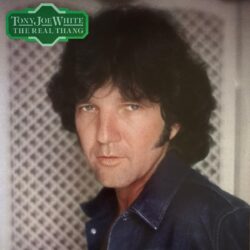
Forty-five years ago, Tony Joe White released an album of what he called “swamp rock” (an amalgam of southern rock, country and blues roots music), and he called it “The Real Thang”. It was only released on vinyl, it only had eight tracks, and it was not very successful in terms of sales; in fact, it did not gain much attention at all. It was perhaps because White, after some success with well-balanced country blues albums in the 70s (“Homemade Ice Cream”, for example), decided to ramp up his songs with a disco beat (that was pretty popular at the time), overlaying his country blues acuity. White became an iconic figure over the years, wrote many songs, some that are still waiting to be unearthed, some that became famous in the hands of other artists.‘Polk Salad Annie’ was one such – it was a single in 1969, appeared on the original album in 1980 when White was at the beginning of his disco groove era, and became very popular when taken up by Elvis Presley, who recorded it on a couple of live albums. Others included ‘Rainy Night in Georgia‘, a soulful big hit for Brook Benton and ‘Steamy Windows’, a later hit for Tina Turner.
‘The Real Thang’ was White’s 7th album, and there were two best-of compilations and a soundtrack album before 1980.
White’s popularity blew hot and cold and then hot again, and he released many more albums, leading right up to the time of his death from a heart attack in 2018, at the age of 75. By this time, he had gravitated into being an americana icon, his earlier recordings only hinting at the mix of styles that became a genre in its own right.
He collaborated with many major artists during his career, starting largely with his friendship with Waylon Jennings, who appeared on the original version of “The Real Thang” on a track called ‘Redneck Women’, and who was a touring companion of White’s. Maybe White’s lack of early commercial success can be put down to the fact that he did not enjoy touring and often bailed out halfway through a tour. Later, he duetted with Lucinda Williams, and Emmylou Harris, and Shelby Lynne and worked with Mark Knopfler. As his description of ‘swamp rock’ music took hold, he became known as The Swamp Fox, a kind of tribute to the swamplands of Louisiana, where he was born and brought up.
Some time ago, his son Jody discovered a raft of songs that his father had written and some that had been recorded during “The Real Thang” sessions, but which had never been unearthed nor heard, and so began the process of a significant re-release of the album, with the same title, but with an additional 10 tracks. And you begin to see that Tony Joe White could, in fact, be one of the architects of americana music in a way he could not have imagined. All the elements are there – country, country soul, blues roots, southern rock, and even at times a folksy vibe combined to put him in the frame (perhaps together with other swamp rock artists such as Creedence Clearwater Revival, Dale Hawkins, JJ Cale, and so on). The new tracks, which lead off the album, generally have a much more country feel. It is quite an amazing expansion of the original, and now runs to 18 tracks, all recorded with the same band made up of White with his trademark guitar sound, harmonica and ‘swamp box’, Steve Spear on bass, Thomas Cain on organ, Waylon Jennings on guitar and vocals, and Jeff Hale, Jennings’ ex-drummer.
The album kicks off with a real cracker, a smooth, slightly funky mid-pacer, newly found, called ‘Goodbye LA‘ wherein White, despite having some good times in the city, preferred to return to his country roots -“It’s not that I don’t like your company / Or the good times that we spent / It’s just that I feel out of place, here Out of my environment”. His relatively low-key guitar playing and trademark harmonica dip in and out of the song, and as becomes the norm throughout the album, they never outstay their welcome, with short, mellifluous solos.
He did not, in all honesty, enjoy big-city life, and it partly became the cause for problems with his record companies. He was not prepared to play the corporate game and wanted to do things his way, influenced by the outlaw character of Jennings, who was co-writer of ‘Cowboy Singer’, a gentle rocker that exemplifies White’s restrained guitar-playing, with a delightful solo. It tells of the pleasures and potential pitfalls of a travelling country singer. White’s songs often contained not only grains of truth about the life of sharecroppers, drifters, rednecks and romantic relationships, but they were often told with humour, as in the riposte to Ed Bruce’s ‘Mama don’t let your babies grow up to be cowboys’ (a huge hit for Jennings and Willie Nelson together), which White twisted into ‘Mama don’t let your cowboys grow up to be babies’; it so amused Jennings that he turned up to play on the recording session. Sung in an almost hungover voice, the short but sweet ‘I Just Don’t Get It No More’ confesses “I don’t remember much about last night / But I do know that I got in a fight / Somebody introduced my nose to the floor / Oh, it just don’t get it no more”.
A number of the tracks are co-writes with his wife LeeAnn, often those tracks involving flirtation and lust as in ‘Redneck Women’ – “So I asked her if she cared to take a ride / I kept looking in her eyes / Hoping she would give me a sign / Then she said honey I don’t mean to push / But let’s quit beating around the bush / Is it gonna be your place or mine”. Or ‘I Get Off On It’, a rather sizzling seduction song, sung to a funky disco beat, as indeed are the last seven tracks of this album, six of which all stem from the original 8-song album. They include the live gig favourite ‘Even Trolls Love Rock’n’Roll’ with its mostly spoken verses and extensive use of the wah-wah pedal (with its nod to Sly Stone), and a re-recorded version of his first hit ‘Polk Salad Annie’.
If you were a disco fan around the turn of the 80s, the tail end of the album (comprising most of the original album tracks, including the then relatively new genre song ‘Swamp Rap’ ) will have great appeal and memories, but the more interesting part of the album is the first half, with much more variety in the pacing in the newly discovered songs, and more to explore of White’s country roots. It starts with a mix of newer tracks and two from the original album, with some leanings towards Johnny Cash (‘I Came Here to Party’), and then in the middle of the album there is a run of country tunes, which nevertheless touch on the usual themes that White explores in his more funky outings; ‘Let’s Trade Heartaches’ could be straight out of the Harlan Howard songbook, while ‘That’s The Way a Cowboy Rocks & Rolls’ has a slightly Spanish tinge (a more swampy version of Marty Robbins on a lovely tuneful song). ‘Hangin’ On‘ looks back over relationships and mistakes that men make before regretting them later. ‘Pour Me a Memory’ is a classic song about a man drowning his sorrows over a lost love, written in tandem with his wife.
Jody White has done an excellent job of curating this mammoth exercise and paced it in such a way that the country songs are placed before the disco, wah-wah, funky tracks that possibly sound a little dated now, with their elements of Sly Stone, and which, to be honest, tend to melt into one long disco groove. There’s nothing wrong with the songs, and throughout the whole album, White’s authentic songwriting shines through with honesty and without artifice.
White liked to follow his own path, the focus on his way of presenting his music the very thing that brought him into discord with his record labels, but you can’t help thinking that the disco funk arrangements on the original “Real Thang” did not endear him to his audience in a way that his earlier 70s recordings, such as “Homemade Ice Cream” (1973) or his later albums (“Hoodoo” 2013) did. Nevertheless, over the years, the disco funk embellishments were toned down and the country elements given a lift, so that White ended up singing and playing in his own sweet spot, known as swamp rock.
The great service that son Jody has done is to highlight the quality of the songs that White consistently wrote and provide a historical context to the merging of two different styles as his career developed. It’s well worth a listen.


