

Dillon Warnek’s “As the Neighbors Tried to Sleep” is a sharp and dizzying collection of songs about everything and anything. “Rolling Stone” raved that his debut album “Now That It’s All Over”, was full of “wry character studies about con artists and dead men.” The saga continues as Warnek revels in such tales, with his wry, anecdotal, and subversive lyricism.
I’m a sucker for any record that begins with There’s enough dynamite in my pockets, To blow you all through the roof, I got wires wired in my jacket, And nothing left to lose. Warnek is a construction worker by day, but this character is anything but on ‘Pistol and A List of Demands.’ The album is a stunning exhibition of boundless imagination and gusts of whimsy. Music like this can make you sit up and pay close attention to detail as the songwriter sketches his narratives in unprecedented angles. As the boundless sagas slip past like mile markers on the Interstate, you realise these have been constructed to build a necessary world where all scenarios have importance.
The album is a collision of Seattle (where he spent early years) strangeness and Nashville (home nowadays) countrified sophistication, but also a convergence of youth from ‘Born in 90’: I was 11 for 9/11, Man those towers fell like they fell from heaven, And speaking of heaven, that’s where the killers think they are, shouting “Allahu Akbar”. Also examined, the perspective of adulthood on ‘Bluebird’ featuring Margo Price: All those politicians claim to understand, Year after year they say “we’ll help you, don’t worry, we got a plan,” See that sparkle in the gutter? That ain’t diamonds and that ain’t glass, It’s the pieces of every promise they ever promised in the past.
Warnek illustrated during an interview that, “My work exists in a Looney Tunes universe of my creation where I cause myself pain. I’m always trying to figure out if what I’m trying to say can even be said.” He has this charming way of defining his characters with a sort of aloofness, like a father who sees the country as populated by his disappointing children. His lyrical gestures are the most punishing, as if his songs were first cousins to Warren Zevon’s ‘Mr. Bad Example.’ There is the drunk lawyer who mistook a chandelier for a piñata. The battered wife who stabs her husband with a steak knife. The young couple out on the town, spending other people’s money. The shmuck playing accordion in the street while people are trying to sleep.
Like it or not, though, “As the Neighbors Tried to Sleep” throws into sharp relief the specific species of zany, miscreant humans that society has turned its back on, offering a grim chuckle as we circle our collective drain. The album is an exciting, mythic endeavour that cultivates desire and curiosity through riveting narratives. It’s gratifying that new music is in such good hands here. Seriously, it will bite you in the butt if you’re not careful.
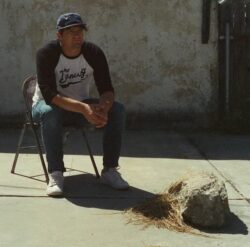
Buckle up, folks, as Dillon Warnek takes us for a spin behind the songs on his record.
There was a battle that took place sometime ago, and the site or sites it happened upon lack any monuments commemorating it. There are no holidays celebrating it. The very date it took place is uncertain. In fact, the only two things one can be sure of are:
1. It happened
2. The wrong people won.
To the victors went the spoils. Anti-socials optimised socialising in their image, people without friends were allowed to redefine friendship, and corporations had their wish granted and were given the means to turn every artist in the world into an employee they could control.
So much music you consume nowadays is created with fear. A music career doesn’t depend on saying what you meant to say. It depends on engagement. It depends on an algorithm that has likes and dislikes. Run afoul of it, and it will render you invisible. Violate its terms of service, and you can be deleted. If you want to have any hope of a career, you have to please the algorithm, and what pleases the algorithm is content. Welcome to your new job as a content creator.
Pistol and a List of Demands – ‘Pistol and a List of Demands’ is a song about a person rejecting their environment and making clear the new terms going forward. There will be no negotiation. The very first lines are: There’s enough dynamite in my pocket/to blow you all through the roof/ I got wires wired in my jacket/ and nothing left to lose.
It’s a crime to be that unafraid, and every authority in the world is hell bent on bringing him to justice. They’ll destroy him if they have to. But they’d better be ready because it’ll look like the goddamn Alamo by the time it’s over. And when finally he dies, his soul will be seen atop a ghost palomino against some heavenly ridge approaching the pearly gates, and St. Peter himself will take off running, shouting, “here he comes!” And soon he’ll pass, unmolested through those untended gates in search of God himself with his pistol and list of demands.
The very nature of art itself is to run afoul and to violate terms. Some things are meant to be unemployable. Go die as an artist.
Pretend You Miss Me – For a while, I had this idea of a fella at the end of his road. He’s dying. He’s got no friends. No family. He’s lived a life of no service. The only thing he asks is that, at whatever counts as the funeral, a woman dresses in red and shows a little leg, and pretends she misses him. He’s probably paid for her company in life, so why is he paying for it once more in death. It’s the closest thing he has to a relationship, and that’s his idea of ceremony. The song is him recounting his life, the things he’s done and seen. He’s cheated and lied. He’s seen Jesus walking on water, wishing he could drown. He lived a life in a world that offered nothing and was only big enough to make a man feel small.
Characters kind of just show up in my head, and I spend a lot of time just wondering what makes them tick and what they think about things. A lot of times, I don’t agree with them or particularly like them, even. But it’s interesting seeing the world through their eyes and arguing with them, and it’s always disconcerting to find out the things you have in common.
Other People’s Money – This song is about a guy someone made the mistake of trusting. He’s somehow in possession of their money, and he’s gonna spend it. He picks his gal up, and they hit the town and go live out a poor man’s idea of being rich. It’s reckless. It’s indulgent. They buy clothes at a fine department store. They go to the ballet. They end up in a fancy restaurant, and he gets drunk on expensive liquor and champagne. Finally, it’s time to go home, and they get in the car, and he drives drunk, right off a cliff. Killing them both.
Actions have consequences. The song is a warning, and I wish his gal could have heard it in time. Don’t get charmed by these grifters. Don’t fall for their schemes. Don’t get into the car with them. Don’t vote them into office. They’ll drive you off a cliff.
Born in 90 – I was born in 1990, and there’s something present in my generation that isn’t present in the previous generations before, and that is an underlying anxiety beneath everything. A sense of dread. A fight or flight response that’s always slightly on.
The song is about a person born in 1990 and follows them along through their life. They start out as a child, playing games and generally being a kid. Then the events of 9/11 happen, soon followed by the housing market crisis of 2008. It ends with them in the present day, waking up with nightmares as their partner soothes them, saying, “baby, they’re only dreams”.
It’s incredibly difficult to have any meaningful perspective on one’s own generation compared to any other. You can’t get up far enough to find a view that lets you take it all in at once. So take it all with a grain of salt. I’m not saying I have any unique vantage on any of this. I was born in 1990; I’m down here with the rest of us. Listen with suspicion and interrogate it as you see fit. If you find something, send me a message. I just know that every year there seems to be another hundred-year flood waiting to wash us all away, and we’ve begun to accrue an awful lot of precedent for such unprecedented events. Makes it hard to sleep at night sometimes.
Bluebird – Sometimes events in this world occur that, no matter who you are or what you do, you find yourself wanting to say something. There’s a lot of songs that deal with issues of class, race and systemic issues. A lot of them boil down to don’t be racist. Hard to argue that point. For me, though, if I were to do that, I’d feel like I’d be taking up space in a conversation without adding anything, and at that point, who am I really doing it for? Last thing you want to do is make something that isn’t about you about you.
This song is about a person examining their own internal biases, their own flaws, their own privileges. It’s easy to fall into the trap of thinking something like oppression is a problem only caused by people consciously trying to cause that problem. It’s a little trickier than that. At the very least, there’s nothing wrong with examining your own accountability. That’s a tricky, slippery slope to try and walk. I was so concerned with making sure I was saying what I meant, I had my incredible writer friends, Margo Price and Jeremy Ivey, sit there and go through the lines with me to be sure. This is the result of the 3 of us. But I take full responsibility for any opinion or reaction anyone listening to it could have.
Bad Lawyers and Worse Luck – Jesus Christ. 9/11. Racism. Come on, man. How would Warren Zevon save this?
They can accuse me all they want, I wasn’t drunk in the Mexican restaurant, As for the piñata, let me make it clear, I had no idea it was a chandelier. There we go. This song is for you, Warren. You’d have written something better. Thanks for all the music.
Speeding Bullet out of Georgia – The woman in this song is leaving a bad situation, and she’s headed any direction so long as it leads away from where she’s coming from. I wrote this song with my friend Margo Price in mind. I sat down and thought, “What would Margo like”. At the start of the second verse, the lady stabs her husband, and I knew I was on the right track. I’m honored to have her sing it with me on the record. Because with this song, I’m just a writer. Margo makes you believe it.
Flowers – I keep on calling, but I can’t get through, The landfill is full of flowers I sent to you. You know where this is going.
Bad Accordion – This song took me 8 months to write. Out of nowhere, both pre-choruses came to me at the same time, fully formed, and I wasn’t sure if I was a talented enough writer to pull off the rest. I almost gave up. This song is about self-destruction. As sung by the last living arsonist from El Dorado – the city of gold. People spend their whole lives trying to get there. He was born there and tried to burn it down.

